Accounting failures are memorable, but memory can become a substitute for analysis. “Enron used special-purpose entities,” “WorldCom capitalized expenses,” or “WeWork used a strange EBITDA” names a topic without showing the evidence, mechanism, statement effect, institutional responsibility, or control response. This module turns those stories into professional work.
Sequence and rationale
- Map institutions and authority. Begin with who writes, applies, oversees, audits, enforces, and uses reporting rules. Place statutes and reforms on a timeline without treating institutional creation as a guarantee of success.
- Separate judgment, bias, error, and fraud. Follow an accounting claim through evidence, entry mechanics, multi-period effects, incentives, and claim status using WorldCom, Waste Management, Sunbeam, and Xerox.
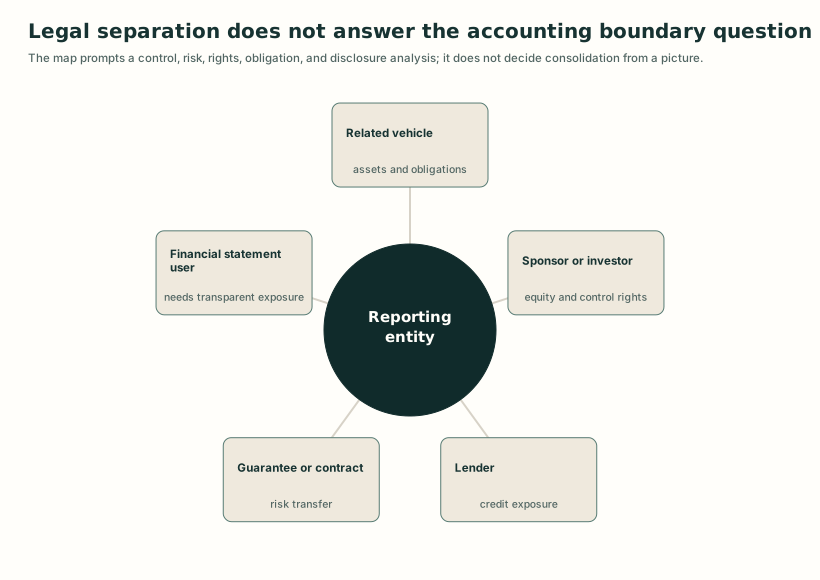
- Reconstruct entities and economic exposure. Use Enron, Adelphia, and Lehman to keep legal form, consolidation, disclosure, related parties, financing, and economic risk distinct.
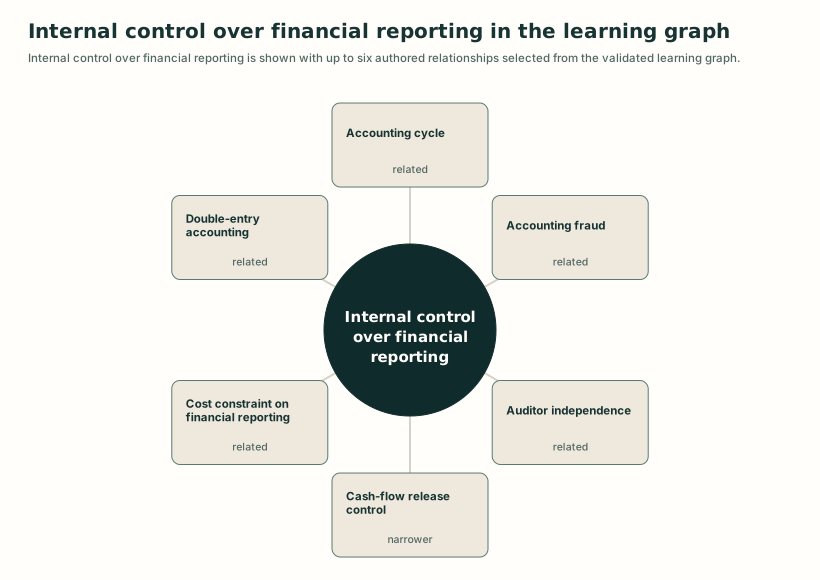
- Map controls, audit, and accountability. Use HealthSouth and AIG to connect risk to control ownership, independent evidence, override response, board oversight, auditor work, and regulator action.
- Evaluate market communication. Reconstruct WeWork's non-GAAP measure and decide which performance, cash, governance, and comparability questions it can and cannot answer.
The cases use public records but are not miniature trials. Complaints are identified as allegations, settled orders and releases are bounded to their scope, and historical entries distinguish later reform from the rules in force during earlier conduct. Students must keep source text, inference, calculation, and recommendation visibly separate.
Cumulative work
The Enron entity-map case is cumulative because it demands every layer at once: accounting scope, financing substance, related-party conflict, disclosure, governance, audit evidence, claim posture, and institutional response. Other cases are not optional anecdotes; each supplies deliberate practice on a more isolated mechanism before the cumulative map.
Audience bridge
Accounting students practice recognition, classification, estimation, documentation, internal control, and audit evidence. Finance students practice economic-exposure reconstruction, statement adjustment, leverage and liquidity interpretation, non-GAAP comparability, and governance diligence. Both groups use the same control: no conclusion outruns the evidence packet.
Boundaries
This is not legal advice, a current technical-accounting update, a complete fraud-examination course, or a claim that ten companies represent all reporting failure. It does not ask students to decide criminal liability or current-rule compliance from a historical complaint. Industry-specific insurance, banking, lease, consolidation, and revenue rules require separate technical modules.
The module develops transferable diagnostic structure: define the claim, locate authority, reconstruct economics, trace statement effects, test evidence, identify incentives, map controls and institutions, state uncertainty, and request the next decisive fact.
Module outcomes
Distinguish the authority and accountability of legislatures, regulators, standard setters, audit overseers, exchanges, professional bodies, boards, management, and auditors in a reporting system.
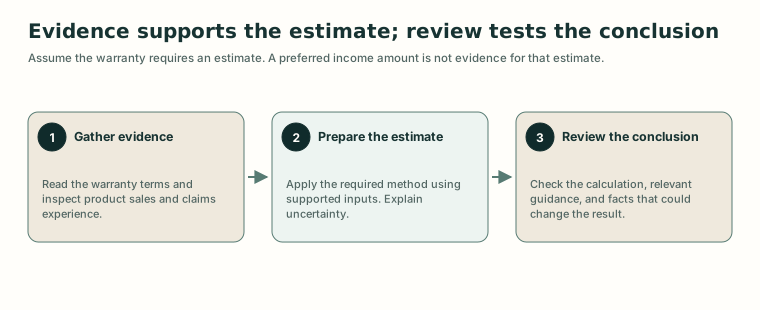
Evaluate a disputed accounting judgment by separating authoritative criteria, evidence, uncertainty, bias, error, alleged fraud, adjudicated facts, and later historical interpretation.
Reconstruct related-party, off-balance-sheet, estimate, revenue-timing, reserve, manual-entry, and non-GAAP mechanisms across entities, periods, statements, and economic exposures.
Map a financial-reporting risk to preventive and detective controls, retained evidence, independent review, governance escalation, and institutional response.
Communicate a source-bounded conclusion that tells preparers, auditors, boards, lenders, and investors what is supported, what remains unknown, and what evidence changes the decision.
Learning sequence
Follow the dependency order, or open the lesson you need.
- Lesson 1Map institutions and authority before assigning blame
- Lesson 2Separate judgment, bias, error, allegation, and fraud
- Lesson 3Reconstruct entities, related parties, and economic exposure
- Lesson 4Map controls, audit evidence, and accountability
- Lesson 5Evaluate non-GAAP measures and market communication
Capstone and summative assessment
Use the cumulative case first, then test each transfer without exposing answer keys.