On this page
Accounting and finance decisions sit inside an economic environment. Resources have competing uses, contracts and controls change incentives, market prices coordinate some choices, and aggregate indicators influence plans without dictating them. This module builds the vocabulary needed to reason across those settings while preserving the boundary between calculation, evidence, judgment, and authority.
Current sequence
The opening lesson supplies the decision grammar for the rest of the module. It moves from scarcity to a feasible choice set, names the trade-off and next-best forgone alternative, compares one incremental change, and then audits the claims made from a model or observed pattern. That sequence prevents later supply, demand, inflation, labor-market, and policy diagrams from being treated as automatic recommendations.
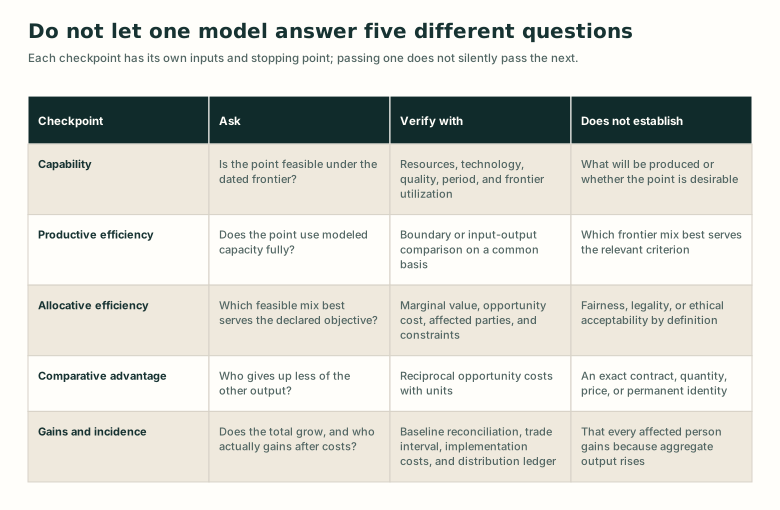
The second lesson applies that grammar to production and trade. A deterministic fictional dataset supports frontier classification, productive and allocative efficiency, absolute and comparative advantage, specialization totals, and a candidate trade interval. The lesson then opens an incidence ledger so a larger modeled total is not mistaken for universal welfare.
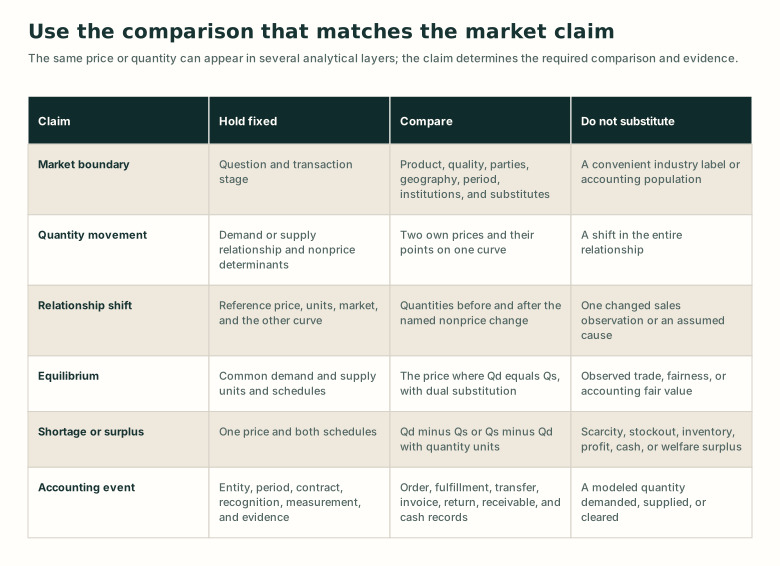
The third lesson defines market and transaction boundaries before introducing demand and supply. Its fictional Linden packet separates own-price movements from stipulated relationship shifts, solves and reconciles three equilibria, classifies price-specific shortage and surplus, and then returns each economic quantity to the separate order, fulfillment, recognition, inventory, and cash records an accounting claim would require.
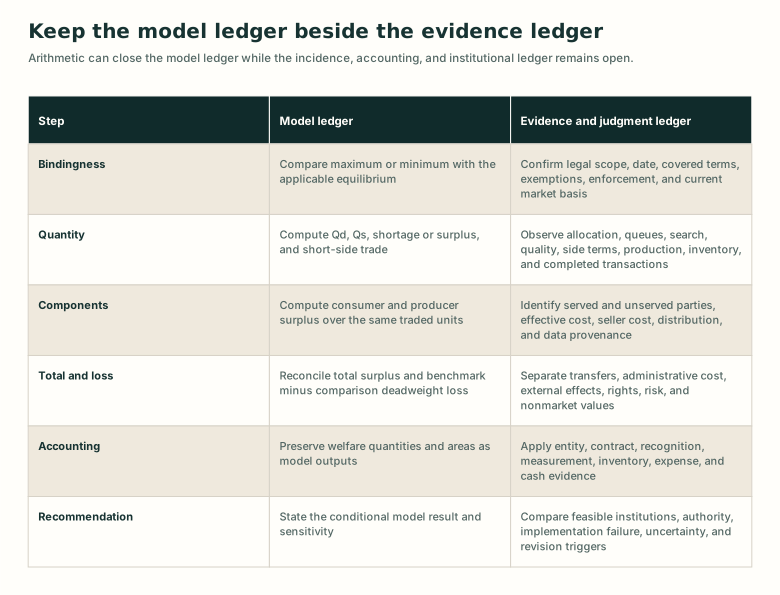
The fourth lesson tests hypothetical maximum and minimum prices against the Linden baseline, computes short-side trade and buyer and seller surplus, and reconciles redistribution separately from deadweight loss. Its two-ledger pattern keeps a closed model calculation beside open legal, operational, distributional, accounting, and institutional evidence.
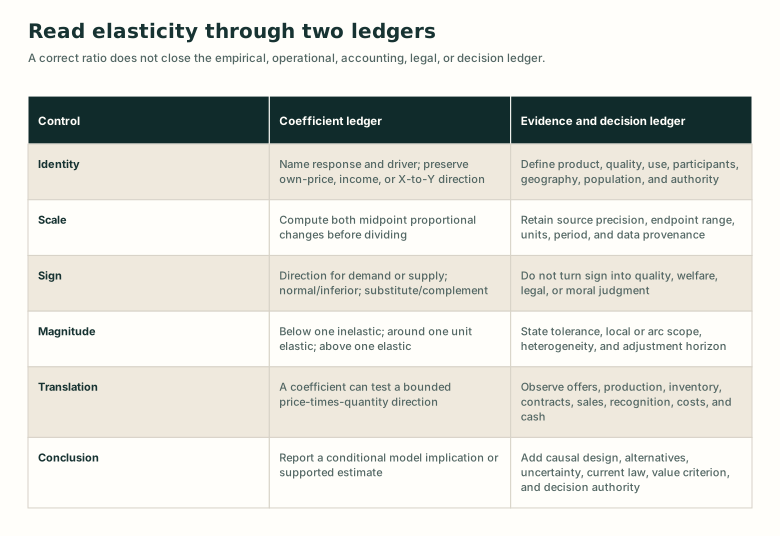
The fifth lesson compares midpoint responsiveness across demand, supply, income, and related-good drivers. It preserves signed direction separately from absolute magnitude, confines substitute, complement, and normal-good labels to their supported scope, and requires an operational and accounting evidence ledger before a modeled quantity is called production, sales, revenue, or cash.
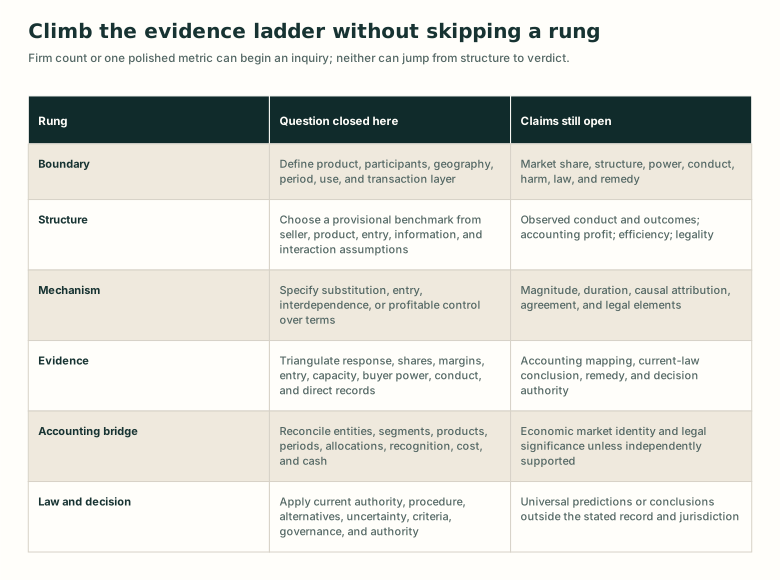
The sixth lesson uses market structure as a provisional screen, follows entry through timely-likely-sufficient milestones, and triangulates market power from substitution, shares, margins, entry, capacity, duration, buyer power, conduct, and direct evidence. It places an accounting-data bridge and current-law analysis on separate rungs before any recommendation.
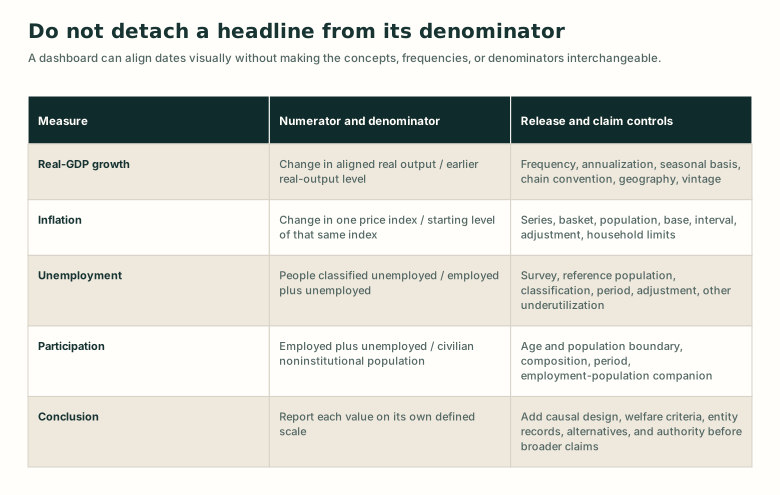
The seventh lesson gives each aggregate headline its measurement contract. Learners reconcile expenditure GDP; separate nominal output, real growth, the GDP deflator, CPI, and productivity; reconcile labor-force population states; and distinguish a real-time indicator, a retrospective cycle chronology, and a causal account. Its frozen BEA/BLS packet preserves historical release vintages instead of silently substituting current numbers.
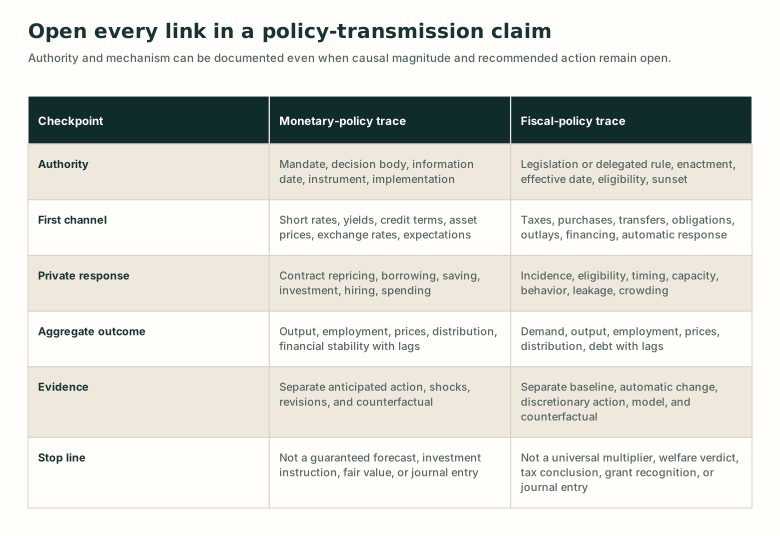
The eighth lesson opens every link in monetary and fiscal transmission and
maps statutes, agencies, statistical releases, legal decisions, historical
accounts, causal estimates, entity translations, and recommendations to their
proper evidence layers. The summative set and internal semantic review are
present. The module remains draft pending human subject-matter review,
learner testing, and final cross-viewport and assistive-technology acceptance.
Learner work
The first lesson uses four fictional packets: a constrained review queue, one additional control review, a compensation-based causation claim, and a model-based capacity recommendation. Each packet requires the learner to label what is feasible, incremental, observed, modeled, valued, and authorized.
The second lesson uses the Rowan–Vale production-and-trade packet. Learners recompute every ratio and total, but a correct calculation must also state the fixed basis, applicable criterion, omitted implementation costs, and affected parties outside the two-producer model.
The third lesson uses the Linden weekly chair-market packet. Learners must label the market, equation status, own-price movement, nonprice shift, clearing point, imbalance, and transaction layer before interpreting a computed amount.
The fourth lesson reuses the packet under explicit controlled-price and efficient-allocation assumptions. Learners reconcile every area and then name the rationing, effective-price, unsold-output, distribution, external-effect, recognition, and implementation evidence the areas exclude.
The fifth lesson reuses Linden for own-price demand and supply response, then adds small Cedar and Harbor fictional packets for income and cross-price relationships. Learners must show both midpoint percentage changes, interpret sign and magnitude independently, and stop before causal, legal-market, forecasting, profitability, or pricing claims.
The sixth lesson uses four anonymous structure packets, a single-seller boundary challenge, an entry-milestone trace, and a concentration screen. Learners must replace label-first conclusions with a market boundary, mechanism, multi-source evidence, accounting bridge, current authority, alternatives, and decision owner.
The seventh lesson uses a fictional Cedar accounting packet for transparent recomputation and a public BEA/BLS packet for release reading. Learners must not mix annual with monthly measures, adjusted with unadjusted rates, output with welfare, unemployment with the full population, or a two-quarter heuristic with the NBER committee's retrospective chronology.
The cumulative Great Recession case culminates in an authority-instrument- channel-outcome matrix and a board memo. The learner must interpret market and aggregate evidence without turning equilibrium into fairness, GDP into welfare, chronology into cause, or a policy channel into a guaranteed forecast. Seventeen module-level summative items test the same transfers in smaller, independently scored decisions.
Boundaries
This module teaches foundational economic reasoning for accounting and finance learners. It does not provide investment, legal, tax, or policy advice. It does not yet cover econometric identification, game-theoretic solution methods, international macroeconomic models, detailed central-bank implementation, public-finance incidence, or labor-search models.
Every model result remains conditional on its assumptions and domain. Every current statistic or policy statement remains bound to its source, release date, definition, and revision status.
Module outcomes
Frame a constrained choice by identifying the decision maker, feasible alternatives, binding constraints, objective, information date, and authority.
Identify trade-offs and opportunity costs without summing infeasible or mutually exclusive alternatives.
Compare marginal benefits and costs while separating sunk amounts, accounting measures, uncertainty, and decision consequences.
Analyze incentives as choice-environment changes without treating them as proof of behavior, causation, misconduct, or intent.
Audit an economic model and separate description, implication, empirical estimate, causal claim, normative criterion, and recommendation.
Classify output combinations against a production frontier and distinguish productive capacity use from allocative selection under an explicit criterion.
Compare absolute and comparative advantage, reconcile potential gains from specialization, and separate aggregate model results from implementation and distribution.
Define a market and distinguish price-driven movements from demand and supply shifts before solving and interpreting equilibrium, shortage, and surplus.
Connect market-model quantities to operational and accounting records without treating offers, trades, fulfillment, recognition, and cash as one event.
Test price ceilings and floors, compute surplus and deadweight loss on one scope, and distinguish model efficiency from distribution, accounting, and complete welfare.
Diagnose a market-failure mechanism and compare institutional remedies without treating the diagnosis as a policy command.
Compute midpoint own-price, income, and cross-price elasticities; separate sign from magnitude; and preserve market, evidence, transaction, and decision boundaries.
Classify market-structure models, test entry and strategic-interaction mechanisms, and triangulate market-power evidence without collapsing economic, accounting, legal, and decision claims.
Recompute GDP, price-index, growth, productivity, unemployment, and participation measures; preserve their denominator and release contracts; and separate cycle chronology from heuristics and causal claims.
Trace monetary and fiscal policy through authority, instruments, timing, channels, evidence, lags, incidence, and entity translation without turning mechanism or history into a guaranteed forecast or recommendation.
Learning sequence
Follow the dependency order, or open the lesson you need.
- Lesson 1Frame constrained choices and bounded economic claims
- Lesson 2Map production, efficiency, and gains from trade
- Lesson 3Trace market schedules, shifts, and equilibrium
- Lesson 4Evaluate price controls, surplus, and market failure
- Lesson 5Measure elasticity and related-good responses
- Lesson 6Analyze market structure, entry, and power
- Lesson 7Read output, prices, labor, and business-cycle evidence
- Lesson 8Audit policy transmission and institutional evidence
Capstone and summative assessment
Use the cumulative case first, then test each transfer without exposing answer keys.
Summative sequence
17 scored decisions- Select the opportunity cost from the feasible set
- Separate the next control review from sunk effort
- Reconcile productive capability and comparative advantage
- Keep potential gains separate from their distribution
- Separate a demand shift from orders and recognized revenue
- Reconcile equilibrium without inventing transactions
- Reconcile a binding ceiling before claiming incidence
- Diagnose the mechanism before selecting a remedy
- Use elasticity to test revenue direction, not profit
- Qualify a cross-price relationship before using it
- Treat market structure as a hypothesis, then test entry
- Separate market-power evidence from accounting and legal conclusions
- Reconcile GDP and preserve the release contract
- Read price and labor releases on separate contracts
- Distinguish NBER chronology from a shortcut
- Audit every link in a monetary-policy claim
- Match fiscal claims to authority, dates, and evidence