This module begins where a basic depreciation schedule stops. Assets remain in use while information changes; assets leave the entity; and expected benefits can deteriorate before a planned disposal. Each event reuses carrying amount but asks a different accounting question.
Why the sequence matters
Estimate revision comes first because it preserves the allocation model and changes remaining inputs. Disposal comes next because it removes the asset and connects the residual gain or loss to cash-flow articulation. Impairment comes last because it adds the most demanding scope, unit-of-account, forecast, and measurement controls.
Supported carrying amount
├─ New estimate information, asset remains in use → prospective allocation
├─ Control transfers in a bounded sale → derecognition and gain or loss
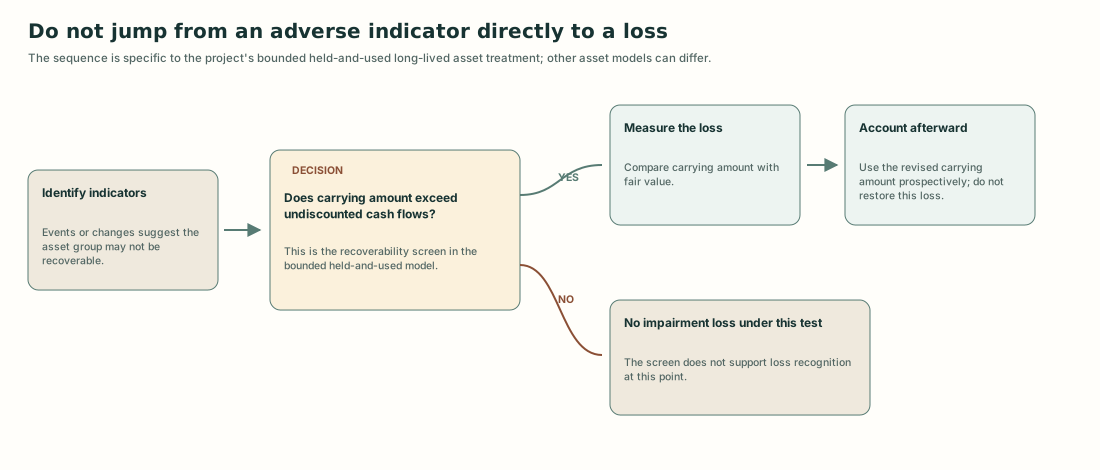
└─ Adverse indicator, asset group held and used → screen, then possible loss
The same $1 of carrying amount cannot be treated as though all three branches occurred to one asset at one time. The Beacon case uses three different assets to force clean identification and prevent accidental combination.
Accounting and finance lenses
Accounting learners prepare calculations, entries, rollforwards, and scope controls. Finance learners trace how estimate timing, gains, losses, investing cash receipts, and noncash charges affect margins, asset balances, cash-flow bridges, comparability, and future capital questions. Both groups must separate verified mechanics from interpretations that require operational, market, contractual, forecast, or valuation evidence.
Boundaries
The module is US-GAAP-specific where standards govern the result. It covers a clean estimate change rather than error; one ordinary fixed-cash sale to a noncustomer; and one held-and-used Topic 360 asset group with supplied fair value and no goodwill. It excludes complex sale contracts, held-for-sale assets, businesses, subsidiaries, partial sales, abandonment, goodwill and intangible impairment, valuation methods, taxes, disclosure preparation, and IFRS comparison.
Across all three branches, keep each dollar of carrying amount attached to its asset, date, evidence, and decision path; the shared input does not make the accounting events interchangeable.
Completion supports later property, plant, and equipment, statement analysis, audit-estimate, valuation, and credential-alignment branches; it does not claim complete coverage of any professional examination blueprint.
Module outcomes
Classify and compute a prospective depreciation-estimate revision while preserving the information timeline and prior-period accounting.
Derecognize a simple depreciable asset sale and trace distinct carrying-amount, gain-or-loss, cash-flow, and indirect-reconciliation effects.
Apply the bounded US GAAP held-and-used impairment sequence without collapsing indicator, recoverability screening, and fair-value loss measurement.
Communicate separate accounting-preparer and finance-analysis conclusions with explicit scope, evidence, and uncertainty boundaries.
Learning sequence
Follow the dependency order, or open the lesson you need.
Capstone and summative assessment
Use the cumulative case first, then test each transfer without exposing answer keys.