On this page
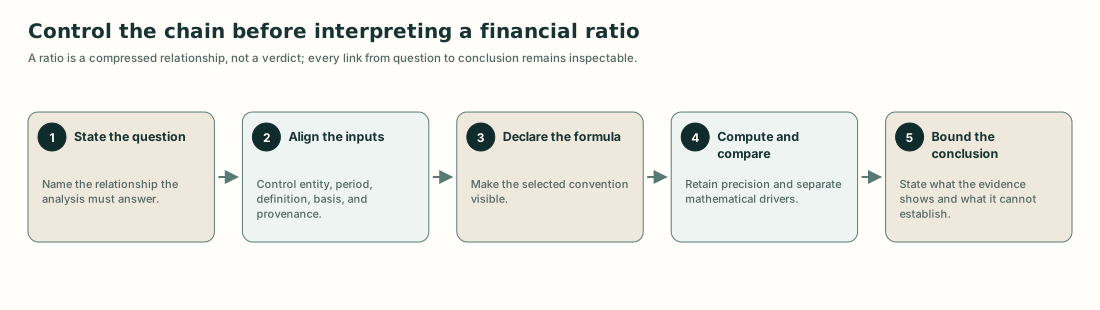
This module begins where a one-year ratio dashboard becomes inadequate. It asks students to control three periods, transform statements without losing their amounts, trace operating numerator inputs through accounts, and then explain a linked working-capital pattern without inventing its cause.
Sequence and rationale
- Align comparative statements. Verify headings, equations, versions, and adjacent-period continuity before measuring movement.
- Build horizontal and common-size views. Preserve scale, relative change, fixed-base direction, composition, and zero-base limits.
- Reconcile operating numerators. Separate credit sales from collections, cost of goods sold from purchases, and credit purchases from payments.
- Compute turnover and days. Pair each flow with the corresponding average balance and attach evidence requests to every interpretation.
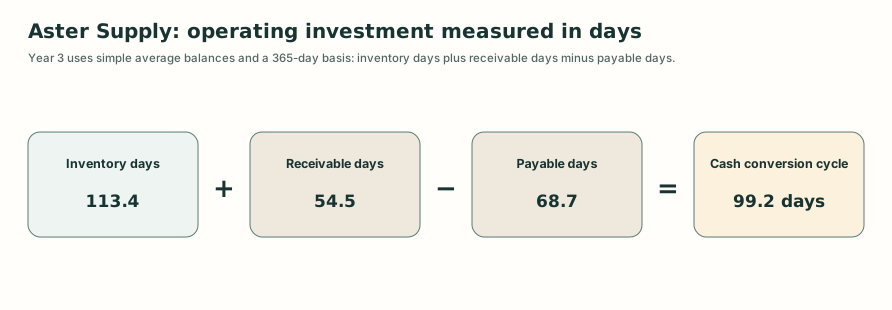
- Explain the cash conversion cycle. Link the three components, attribute mathematical movement, and distinguish history from forecast or policy.
The order is intentionally shared. Accounting students see how analytical fields emerge from statement and account evidence. Finance students receive cleaner inputs and learn exactly where a plausible operational story outruns the reported data. Undergraduates work from visible tables and rollforwards; graduate students challenge denominator sampling, proxies, seasonality, classification, business-model comparability, and competing explanations.
Cumulative work
The fictional Aster–Birchline packet contains two comparable wholesalers across three annual periods. Aster grows sales while receivable and Inventory days lengthen and net-income share falls. Birchline grows while both days measures shorten. Students prepare a reproducible calculation appendix, an accounting- control note, and a finance-committee analysis plan.
The case does not ask which company is “better.” It asks what changed, how the components reconcile, what the statements support, what they do not support, and which records would discriminate among competing causes.
Boundaries
The module uses positive annual operating flows, ordinary trade receivables, merchandise Inventory, ordinary trade payables, exact disclosed credit sales and credit purchases, simple beginning-ending averages, and a 365-day convention. It excludes zero or negative turnover denominators, interim seasonality, write-offs, returns, discounts, factoring, supplier finance, manufacturing cost systems, acquisitions, foreign currency, and changing entity scope.
Common-size and turnover formulas are analytical conventions, not US GAAP or IFRS definitions. The module does not forecast cash, optimize working capital, detect fraud, value a company, recommend credit or payment policies, or claim CPA, CFA, FINRA, or other credential coverage. Those tasks require additional authority, data, uncertainty, and versioned alignment.
Module outcomes
Build a controlled three-period comparative packet that preserves entity, date or period, currency, units, definitions, accounting basis, version, equation ties, and line-level continuity.
Compute and distinguish dollar change, period-over-period percentage change, fixed-base trend indexes, and statement-specific common-size percentages, including a fail-closed zero-base policy.
Reconcile net credit sales to collections, merchandise purchases to cost of goods sold and Inventory, and credit purchases to supplier payments before selecting ratio inputs.
Compute receivable, Inventory, and payable turnover from corresponding flows and average balances, then convert each to days under one declared convention.
Reconcile the operating and cash conversion cycles, attribute multi-period movement to their mathematical components, and separate historical observation from cause, forecast, optimization, and valuation.
Give accounting readers reproducible source and rollforward controls while giving finance readers bounded comparisons, tradeoffs, stop conditions, and specific next-evidence requests.
Learning sequence
Follow the dependency order, or open the lesson you need.
Capstone and summative assessment
Use the cumulative case first, then test each transfer without exposing answer keys.
Summative sequence
7 scored decisions- Distinguish dollar, percentage, and fixed-base change
- Select and interpret common-size bases
- Reconcile credit sales, collections, and receivables turnover
- Reconcile Inventory and compute turnover
- Select the payables-turnover numerator
- Reconcile a cash conversion cycle
- Write an evidence-bound operating-efficiency conclusion