On this page
This module gives both accounting and finance students a common mathematical language without pretending that one discipline's authority or judgment rules belong to the other. The shared spine is date, interval, rate, period, cash-flow timing, operation, reconciliation, and boundary.
Sequence and rationale
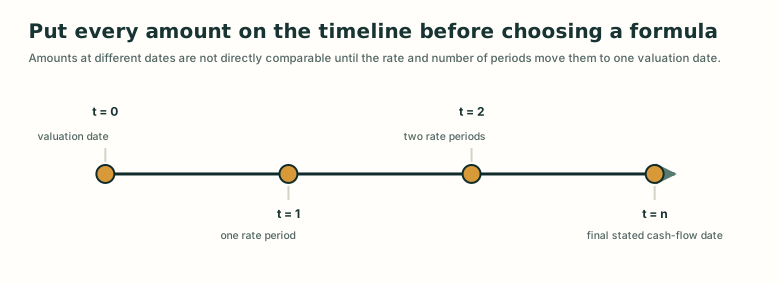
- Control the timeline and units. Students cannot choose a formula until valuation date, cash-flow dates, rate type, interval, and period count agree.
- Compound and discount single sums. Present and future value become one reciprocal mapping, with a round-trip check instead of two mnemonics.
- Compare rate conventions. Stated, periodic, and effective rates remain distinct fields so annualized language cannot leak into monthly formulas.
- Value level payment streams. Timelines distinguish ordinary and due annuities before students use compact factors.
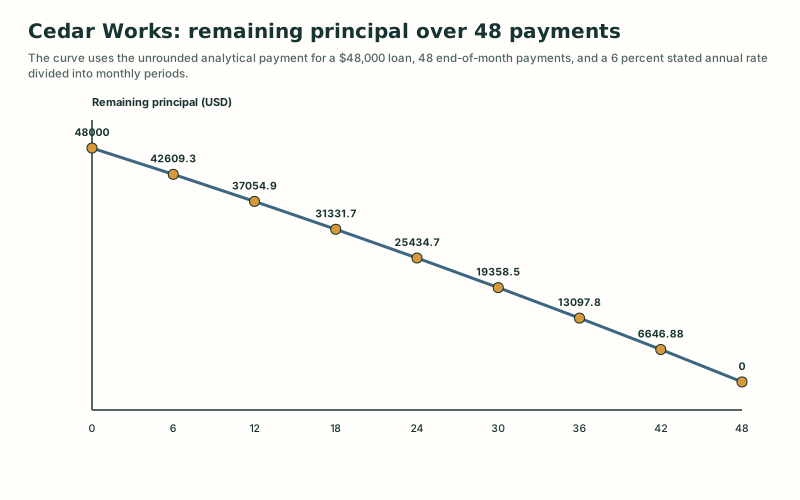
- Reconcile a loan schedule. The final lesson turns an annuity solution into a row-by-row rollforward with four independent controls.
The order serves novice undergraduates by making each input visible. Graduate students use the same controls to diagnose hidden spreadsheet conventions, source unsupported rates, and separate mechanical validity from professional conclusion.
Cumulative work
The fictional Cedar Works packet contains three independent tasks: fund a fixed future target, compare payment timing for a service plan, and analyze a level- payment equipment loan. Students deliver an auditable calculation appendix and a short dual-audience memo. They are graded for reconciliations and boundaries, not for recommending an investment or loan.
Boundaries
The module uses deterministic cash flows, equal discrete periods, supplied nonnegative rates, fixed rates, finite streams, and analytical full precision. It excludes uneven cash flows, NPV, IRR, perpetuities, growing annuities, continuous compounding, day-count conventions, variable rates, stochastic cash flows, inflation, currency, taxes, fees, credit risk, product disclosure, affordability, valuation, and investment advice.
It does not teach lease, pension, bond, note, debt-issuance, impairment, asset- retirement, revenue-financing, or fair-value accounting. Present-value arithmetic alone never establishes recognition or measurement under US GAAP, IFRS, or another framework. The module also makes no CPA, CFA, FINRA, or other credential-coverage claim.
Those exclusions are sequencing choices. Later modules can reuse this tested date-and-unit foundation while adding uneven cash flows, evidence-supported rates, uncertainty, contractual terms, authoritative standards, and versioned credential alignment one layer at a time.
Module outcomes
Translate a bounded narrative into a cash-flow timeline with a declared viewpoint, valuation date, payment dates, interval unit, periodic rate, period count, and scope boundary.
Compute and reverse single-sum present and future values while preserving dates, units, assumptions, full precision, and direction checks.
Distinguish stated annual, periodic, and effective annual rates and compare only aligned conventions without turning arithmetic into product advice.
Classify and value ordinary annuities and annuities due, including the zero-rate limit and one-period timing reconciliation.
Compute a level end-of-period payment, build a full analytical amortization schedule, and reconcile principal, interest, payment, and ending balance.
Separate shared financial mathematics from accounting authority and finance rate-selection judgment for undergraduate and graduate learners.
Learning sequence
Follow the dependency order, or open the lesson you need.
Capstone and summative assessment
Use the cumulative case first, then test each transfer without exposing answer keys.