This chapter is under review. Its wording, examples, and checks may change. Report an error or an unclear passage.
In this chapter
- Every record needs a clear boundary
- Which activity belongs to Lakeview?
- Ownership does not erase the boundary
- Where do the tools belong?
- One event can enter two sets of records
- Complete both perspectives
- The event is not the document or the record
- Event, document, or record?
- The period sets another boundary
- Which event happened in October?
- Clear boundaries prevent three errors
- Wrong entity
- Omission
- Duplication
- Can Harbor Cart pay its supplier on Friday?
- Next: Classify what belongs inside
- Sources and scope
Every record needs a clear boundary
Elena owns Lakeview Repairs, a small appliance-repair business. During September, several events occur:
- Lakeview receives $2,000 from a customer for completed repair work.
- Elena deposits $500 of her personal money into Lakeview's bank account.
- Elena uses her personal card to buy $300 of tools for Lakeview.
- Lakeview borrows $4,000 from Community Bank.
- Elena pays her home electric bill from her personal bank account.
All five events involve Elena, Lakeview, or both. That connection does not put all five events in one set of records.
An entity is the person, business, organization, or other defined activity whose records we are examining. A reporting entity is the defined activity represented by a particular set of financial reports. Lakeview is the entity in this chapter's business records. Elena, the customers, and Community Bank have their own perspectives and records.
The boundary answers a basic question: whose resources, obligations, and activity are these records meant to describe?
Which activity belongs to Lakeview?
Ownership does not erase the boundary
Elena owns Lakeview, but the owner and the business do not have one combined set of records. Lakeview's records describe the business. Elena's personal records describe her household activity and her interest in the business.
| Elena's personal records | Lakeview's business records |
|---|---|
| Personal checking account | Business bank account |
| Home electric bill | Repair-shop electric bill |
| Personal credit-card balance | Business loan |
| Elena's interest in Lakeview | Money Elena provided to Lakeview |
The payment method does not decide which entity received a resource. Elena used her personal card to buy the $300 of tools, but Lakeview received and uses the tools. Lakeview therefore needs a record of the tools and of the value Elena provided. Elena needs a separate personal record of what she paid.
Chapter 3 will classify those effects. For now, the boundary tells us that leaving the tools out of Lakeview's records would omit part of the business.
Where do the tools belong?
Apply the boundary to the five events that opened the chapter.
Sort September's five events
Decide which set of records needs each event. Ownership and payment method do not decide the answer; what each entity received or gave does.
5 items over 3 buckets. Your result is saved in this browser and is not sent.
The chapter has not yet named what each effect is. It only asks whose records the event belongs in.
Follow the activity across each boundary
Elena
Home bill
Personal card payment
Interest in Lakeview
Lakeview Repairs
Customer receipt
Tools used by the business
Amount to repay
Community Bank
Amount lent
Amount to collect
Repayment evidence
One event can enter two sets of records
Community Bank transfers $4,000 to Lakeview under a signed loan agreement. This is one connected event, but the parties occupy different positions.
| Lakeview Repairs | Community Bank |
|---|---|
| Receives $4,000 | Provides $4,000 |
| Has an amount to repay | Has an amount to collect |
| Uses the borrower's records | Uses the lender's records |
Lakeview cannot use the bank's perspective as its own. An amount owed by Lakeview is an amount to collect for Community Bank. Each entity records the event from its position under the contract.
This distinction also appeared in Chapter 1. The Rivera household and its lender needed separate records of the same car loan. We can now state why: each record has a different entity boundary.
Complete both perspectives
The event is not the document or the record
An economic event, its supporting document, and its accounting record are connected, but they are not the same thing.
| Part | Tool purchase example |
|---|---|
| Economic event | Lakeview receives tools for use in repair work. |
| Source documents | The store receipt and Elena's card statement describe the purchase and payment. |
| Accounting record | Lakeview records the supported effects of receiving the tools and Elena providing the value. |
A source document is evidence about an event. Receipts, invoices, contracts, time records, and bank statements can support dates, amounts, parties, or terms. A document does not decide the entity by itself. Lakeview may need Elena's card statement even though the card is personal because that statement supports a purchase made for Lakeview.
The document also does not replace the accounting record. One receipt may support more than one recorded effect. Several documents may support one event. The accountant must identify the event, the entity, the period, and the effects supported by the evidence.
Event, document, or record?
Event, document, or record?
Classify each item from the Community Bank loan.
3 items over 3 buckets. Your result is saved in this browser and is not sent.
Detailed visual description
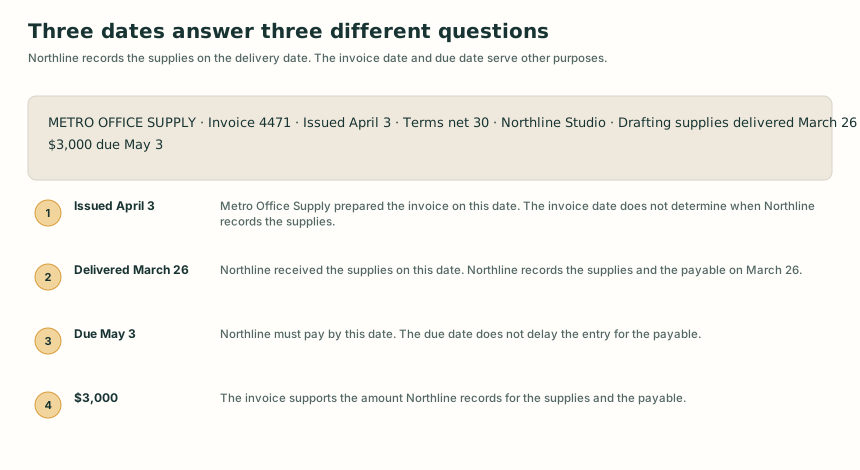
A vendor invoice from Metro Office Supply has four annotations. The vendor issued the invoice on April 3. Northline Studio received the supplies and records the payable on March 26. Payment is due on May 3. The invoice supports the recorded amount of $3,000.
The period sets another boundary
Lakeview prepares records for September 1 through September 30. Dates near the end of the month require care:
Work, document, and cash dates around September 30
- September 28 Work date Lakeview completes a customer repair
- September 30 Document date Lakeview and Community Bank sign the loan agreement
- October 2 Cash date Community Bank transfers the loan proceeds
- October 5 Cash date The customer pays for the September repair
The accounting period is the span of time covered by a report or record. The repair work happened during September, while the customer's cash arrived in October. The agreement was signed in September, while the loan cash arrived in October.
Those dates do not tell us whether signing the agreement created a recordable obligation. The contract terms and applicable accounting rules would control that decision.
Later chapters will explain when Lakeview reports revenue and other accounting effects. This chapter makes the narrower point: document dates, work dates, and cash dates can differ. We must identify them before deciding what belongs in a period.
Which event happened in October?
Clear boundaries prevent three errors
An unclear boundary can produce three different problems.
Wrong entity
Lakeview records Elena's home electric bill as a business event.
The records now include activity outside the business boundary.
Omission
Lakeview leaves out the tools because Elena used a personal card.
The records now omit a resource the business received and uses.
Duplication
Lakeview records the $2,000 customer payment once from its receipt and again from the bank deposit.
The documents describe one receipt of cash, but the records count it twice.
A set of records can add correctly and still contain any of these errors. Checking the entity, event, and period helps prevent them before we classify or calculate anything.
Can Harbor Cart pay its supplier on Friday?
Harbor Cart is a food business owned by Marcus. It is preparing records for April. Consider these facts:
- Customers paid Harbor Cart $1,800 during April.
- Harbor Cart bought $600 of ingredients with its business debit card.
- Marcus paid his apartment rent from his personal account.
- Marcus used his personal card to buy a $900 refrigerator for Harbor Cart.
- Harbor Cart received $2,500 from a bank loan on April 30.
- A supplier invoice says Harbor Cart must pay $700 on Friday, May 2.
Before opening the feedback, identify:
- the entity and period;
- the events that belong in Harbor Cart's records;
- the event that belongs outside the business boundary;
- a useful document for each included event;
- one possible omission or duplicate; and
- one fact the available records cannot establish.
Start with the boundary. The other prompts build on it.
Whose records need each April fact?
Harbor Cart is the business. Marcus is its owner. Sort each fact before you open the feedback.
6 items over 3 buckets. Your result is saved in this browser and is not sent.
Sorting by entity does not yet tell you whether Harbor Cart can pay $700 on Friday. The feedback below explains what the listed facts leave open.
Compare your reasoning with the worked answer
The entity is Harbor Cart, and the period is April. Customer receipts, ingredient purchases, the refrigerator, and the bank loan involve Harbor Cart. Marcus's apartment rent belongs outside the business boundary.
Bank records can support the cash receipts, debit-card purchase, and loan transfer. Sales records can support the source of customer cash. The ingredient receipt and refrigerator receipt can support what Harbor Cart obtained. The loan agreement and supplier invoice can support amounts, parties, and terms.
Harbor Cart could omit the refrigerator because Marcus used a personal card. It could also duplicate a customer receipt by recording both a sales record and the matching bank deposit as separate cash receipts.
The listed facts do not establish whether Harbor Cart can pay $700 on Friday. We do not know its complete cash balance, other payments due, or whether all April activity has been identified. The records can support parts of the decision without settling it.
Next: Classify what belongs inside
We can now identify whose activity and which period a record describes. We can also distinguish the event from its documents and later accounting record.
The next chapter asks what each included event gives to or requires from the entity:
- What resources does the entity control?
- What obligations does it owe?
- What claim remains for its owners?
- Did the entity earn value, use value, or exchange value with an owner?
Those questions lead to the exact terms asset, liability, equity, revenue, expense, investment by owner, and distribution to owner.
Sources and scope
- The FASB Conceptual Framework explains reporting-entity boundaries and the elements of financial statements. This chapter uses those ideas at an introductory level.
- The SEC beginner's guide to financial statements provides a plain-language overview of company financial statements and their use by investors.
Lakeview Repairs, Community Bank, Elena, Harbor Cart, and Marcus are fictional. The examples teach entity, event, document, and period boundaries. They do not provide legal, lending, or personal financial advice.
Key concepts in this chapter
Use a concept page when you want a definition, a fuller explanation, or related practice.
Use now
These pages explain ideas used in this chapter.
- Economic entity assumption — The accounting assumption that a business's activities are recorded separately from the personal activities of its owners.
- Reporting entity — The business, group, or other defined set of economic activities represented by a particular set of financial reports.
- Economic event — An occurrence or change in conditions that can affect the resources, claims, activities, or decisions of a person or entity.
- Source document — A document or data record used as evidence for facts about an economic event before or while the event is represented in an accounting system.
- Accounting record — An entity's documented representation of supported economic effects in its accounting system and related records.
- Time-period assumption — The accounting assumption that a business's continuing activities can be divided into reporting periods, such as months, quarters, or years.
Next
These pages preview ideas developed in later work.
- Accounting transaction — An economic event or condition that meets the applicable recognition requirements and changes one or more financial statement elements.