On this page
An accounting transaction is an event or condition that the entity concludes must be recognized. It is narrower than an economic event: some events affect plans or decisions without meeting the requirements for a financial statement element. A journal entry is one part of the accounting record made for a recordable transaction. The transaction and its record are not the same thing.
An owner investment, a cash purchase, a credit purchase, or a completed service can be an accounting transaction. A discussion about a possible purchase is not. Before a company records an event, it needs evidence that the event occurred and that it meets the applicable recognition requirements. A source document can support the parties, dates, terms, or amount, but no document decides the accounting treatment by itself.
Start with the economic event
Ask these questions before choosing account names:
- What happened during the reporting period?
- Which resources or claims changed?
- Did the event involve an owner, creditor, customer, supplier, or the company's use of a resource?
- What evidence supports the amount, date, parties, and terms?
The answers identify the affected accounts. For example, suppose a company receives equipment and pays cash. The delivery record and invoice show what the company received, when it received it, and how much it cost. The company records an increase in Equipment and a decrease in Cash. It does not record an Accounts Payable liability because it paid at once.
Exchange, financing, and performance
A cash purchase of equipment decreases one asset and increases another. Borrowing cash increases an asset and a liability. An owner's cash investment increases an asset and equity. Providing a service and earning revenue changes an asset or liability along with equity.
Cash alone does not identify the transaction. Cash received from a customer can be revenue, collection of a receivable, or an advance for work the company still owes. A transaction can also occur before cash moves. A company can earn revenue on account or receive supplies on credit.
The accounting equation checks whether the effects remain balanced. Balance does not prove that the date, amount, or accounts are correct.
Event, condition, estimate, and correction
Many introductory examples involve an exchange with another party. Accounting also records changes caused by the passage of time or new information. A company records resources as it uses them, obligations as they arise, and corrections when it finds errors. The definition therefore includes both events and conditions.
Boundaries
The recognition rules depend on what happened. Revenue, leases, contingencies, and financial instruments each have their own requirements. Transaction analysis starts with 2 questions: What changed, and why should the company record the change now?
Continue the learning path
The event-to-account lesson starts with evidence and element effects. The mixed-events example then follows several events through recognition decisions. Use the recordable-events task to decide which events enter the records under stated facts.
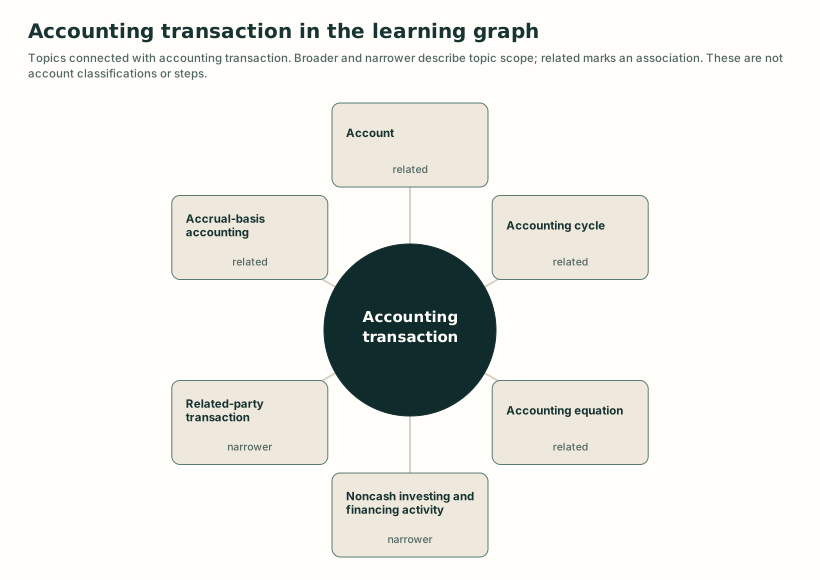
Accounting transaction in the learning graph
Detailed visual description
A structural map places Accounting transaction at the center and connects it to related concepts, prerequisite concepts, or lessons from the knowledge graph. Edge labels distinguish broader, narrower, related, prerequisite, and teaching relationships where present.
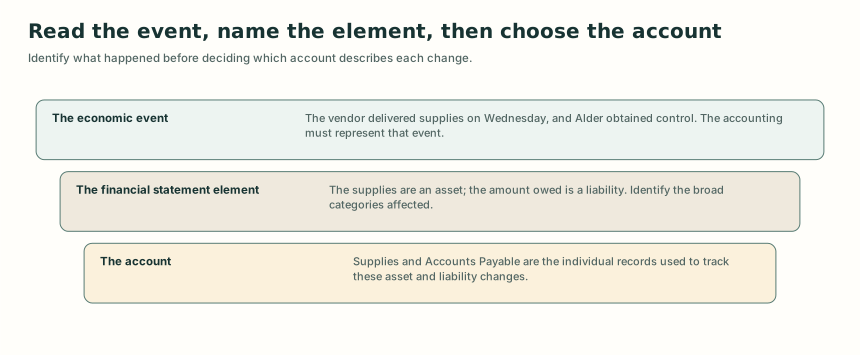
Event, element, account
Detailed visual description
Three nested rectangles organize the analysis of Alder's delivery. The outer rectangle identifies Wednesday's receipt and control of supplies. The next identifies assets and liabilities as the affected elements. The inner rectangle identifies Supplies and Accounts Payable as the accounts used to record the changes. The display shows an order of analysis, not a claim that the event occurs inside an account.
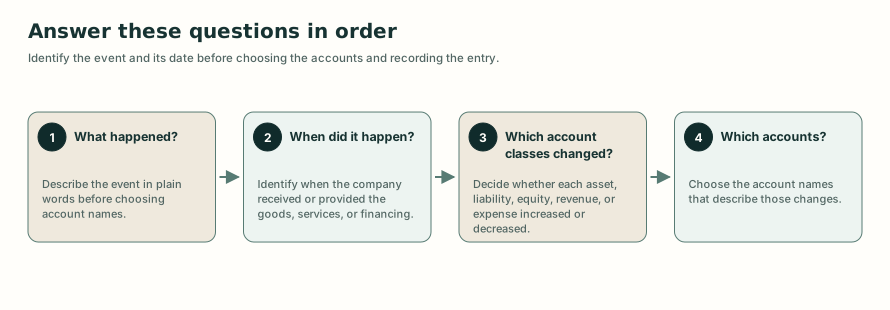
From an event to the affected accounts
Detailed visual description
A left-to-right flow of four questions. First, describe the event in plain words. Second, identify when the company received or provided the goods, services, or financing. Third, decide which asset, liability, equity, revenue, or expense classes increased or decreased. Fourth, choose the account names that describe those changes.
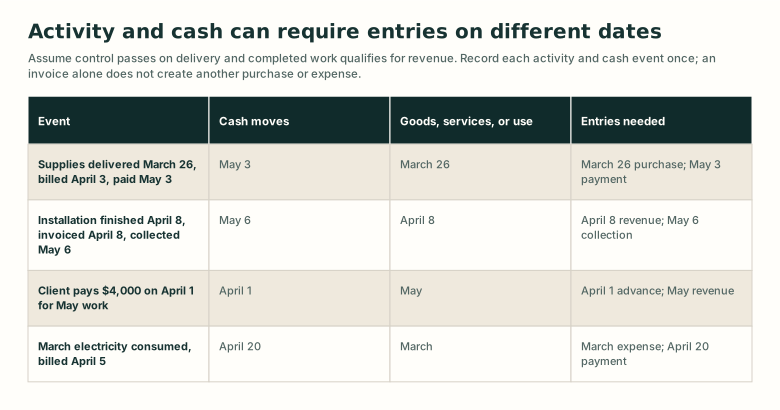
Record the activity and the later cash event
Detailed visual description
Four standalone timing examples assume qualifying recognition and control on delivery. Supplies received March 26 are recorded then; payment May 3 settles the payable. Installation completed and billed April 8 creates revenue and a receivable; May 6 collection settles it. A $4,000 April 1 advance creates a liability; May work earns the revenue. March electricity creates expense and a payable; April 20 payment settles it. Every row includes separate accounting for the activity and cash event.
Three dates, two entries
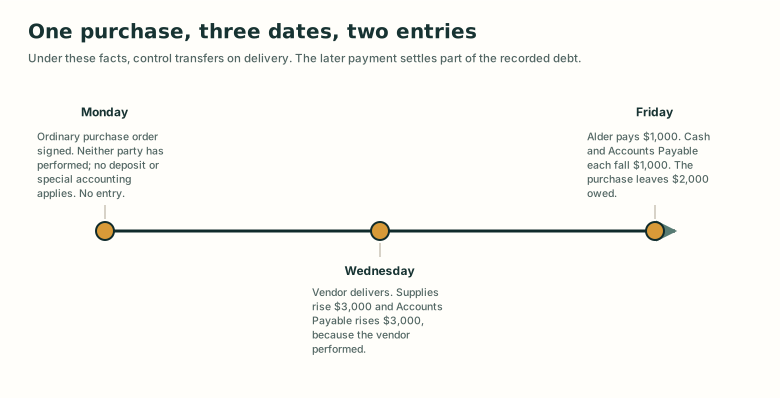
Detailed visual description
Alder Design's teaching example assumes an ordinary purchase agreement, no deposit, no special contract accounting, and control transferring on Wednesday's delivery. Monday's signed order has no entry. Wednesday's delivery increases Supplies and Accounts Payable by $3,000 each. Friday's $1,000 payment reduces Cash and Accounts Payable by $1,000 each, leaving $2,000 owed for this purchase. The payment does not create an expense.
Which invoice date belongs in the journal?
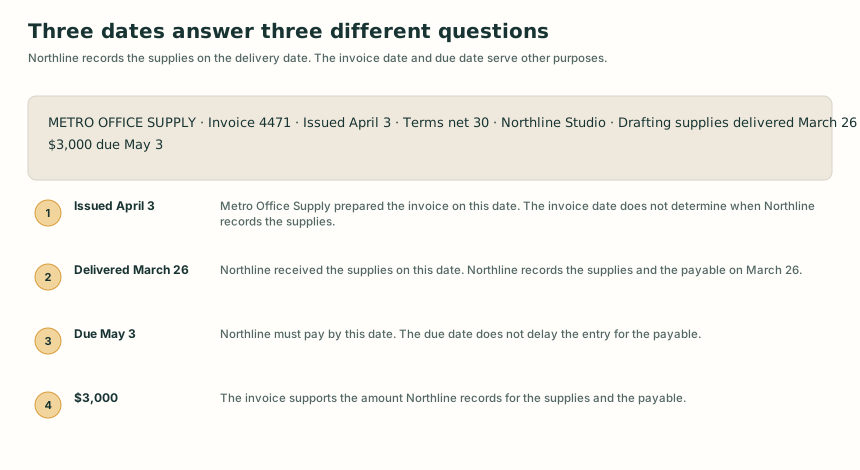
Detailed visual description
A vendor invoice from Metro Office Supply has four annotations. The vendor issued the invoice on April 3. Northline Studio received the supplies and records the payable on March 26. Payment is due on May 3. The invoice supports the recorded amount of $3,000.
Put the concept to work
Understand this concept
- Distinguish the underlying economic event from the accounts, entry, and documents used to represent it.
Apply this concept
- Identify whether a basic fact pattern creates a recordable transaction and describe the elements affected.
Learning resources
Choose a lesson, try an application, or inspect the sources behind this concept.
Build on these ideas
- Accounting equation — Understand
To apply this concept: Helpful. The equation supplies a first model for describing which recognized elements change.
- Accounting transaction — Understand
To apply this concept: Required. Application requires separating what happened economically from how the event will be recorded.
Lessons
Worked examples and cases
Practice
Common mistaken ideas
- Mistaken idea: A signed future contract always creates a recognized liability
- Mistaken idea: Every asset purchase is an immediate expense
- Mistaken idea: Every cash receipt is revenue
Show 1 more mistaken ideas
Sources
More specific topics
Related concepts
Show 8 more related concepts
Use this idea next
- Account — Understand
Required level here: understand. Helpful. The distinction between an event and its record makes the role of an account easier to see.
- Accounting cycle — Understand
Required level here: apply. Required. The cycle begins with accepted analysis of events and conditions affecting the entity.
- Accounting equation — Apply
Required level here: understand. Helpful. The learner benefits from separating the event being analyzed from the accounts used to record it.
Show 12 more next steps
- Accounting transaction — Apply
Required level here: understand. Required. Application requires separating what happened economically from how the event will be recorded.
- Accrual-basis accounting — Analyze
Required level here: apply. Required. The learner must identify the event or condition and its effects before assigning them to a reporting period.
- Deferral — Analyze
Required level here: apply. Required. The payment or receipt, later consumption or performance, and any refund are distinct events or period-end facts.
- Double-entry accounting — Apply
Required level here: apply. Required. The learner must first identify every economic effect that the entry is intended to represent.
- Economic entity assumption — Understand
Required level here: understand. Required. Separation begins by identifying whose economic event is being recorded.
- Expense — Apply
Required level here: understand. Required. The learner must identify what was consumed or incurred before selecting the expense effect.
- Journal entry — Understand
Required level here: apply. Required. The economic event and its recognized effects must be identified before they can be represented.
- Operating cycle — Understand
Required level here: understand. Required. The cycle links economically related purchasing, production or service, sale, and collection events.
- Related-party transaction — Understand
Required level here: understand. Required. The learner must first identify the underlying exchange, obligation, service, or financing event.
- Reporting entity — Understand
Required level here: understand. Helpful. A transaction is recorded from the perspective of a particular entity rather than from an unbounded economic scene.
- Revenue — Apply
Required level here: understand. Required. The learner must identify what the entity did before selecting the revenue and asset effects.
- Unit of account — Understand
Required level here: understand. Required. The learner must identify the transaction and its rights or obligations before deciding what is evaluated together.
Used in these readings
These chapters explain or apply this concept. The label states how the chapter uses it.