On this page
The accounting equation shows the relationship among assets, liabilities, and equity:
Assets = Liabilities + Equity
Assets are the company's recognized resources. Liabilities are present obligations. Equity is the amount that remains after subtracting liabilities from assets. Equal debits and credits help preserve this relationship when a company records transactions, but the equation is not a debit-credit rule.
What each side shows
Suppose shareholders invest $40,000 cash in a new company. Cash and total assets increase by $40,000. Equity also increases by $40,000.
If the company instead borrows $40,000 from a bank, Cash still increases by $40,000. This time Notes Payable and total liabilities increase by $40,000. The company has the same amount of Cash in both examples, but the claims on its assets differ. In the first example, shareholders hold the residual claim. In the second, the bank has a $40,000 creditor claim that the company must repay.
A transaction can change composition without changing totals
After the owner contribution, the company pays $15,000 for equipment. Cash falls to $25,000 and equipment rises to $15,000. Total assets remain $40,000; liabilities remain zero; equity remains $40,000. The equation shows no change in those totals. The individual accounts show the exchange of one asset for another.
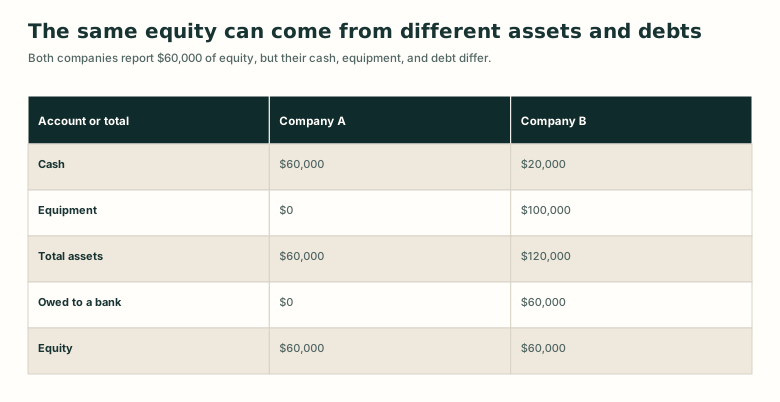
The equation shows the totals, but it does not show everything about the company. Two companies can report the same total assets, liabilities, and equity while holding different assets and owing different obligations.
Extending the model through performance
Revenue increases equity through business performance. Expenses decrease equity through business performance. Shareholder investments and dividends also change equity, but they are not revenue or expenses. Separate accounts preserve these differences during the period.
Boundaries and common confusions
Balance does not prove that the records are correct. A company can omit a transaction, use the wrong account, or record the wrong amount on both sides and still keep the equation balanced. Reported asset amounts also do not necessarily equal market values. The equation checks the relationship among reported totals; it does not prove that every total is complete or correct.
Sources and currency
The element relationships are grounded in the FASB Conceptual Framework; OpenStax provides a secondary comparison for introductory transaction analysis. Transaction-specific accounting conclusions require the applicable authoritative guidance.
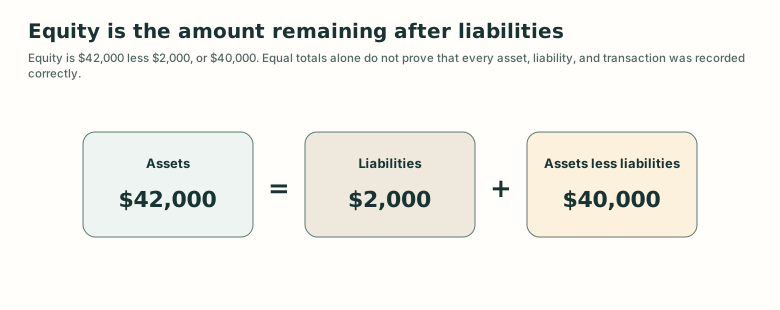
Equity is assets less liabilities
Detailed visual description
A standalone example has $42,000 of assets and $2,000 of liabilities. Equity is their difference, $40,000. The equation shows $42,000 equals $2,000 plus $40,000. The relationship does not establish that the underlying accounting records are complete and correct.
The accounting equation in its concept neighborhood
Detailed visual description
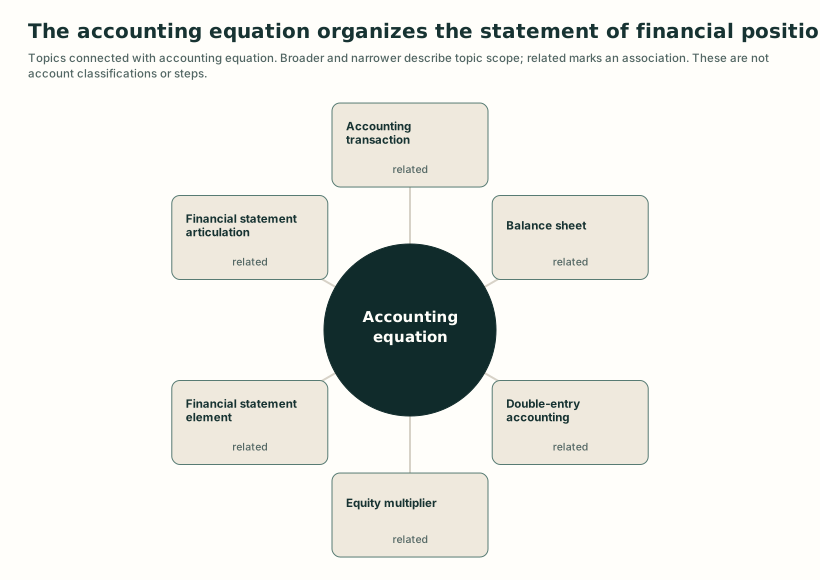
A central accounting-equation node connects to the first six authored related-concept neighbors in stable graph order. The current graph links it to accounting transaction, balance sheet, double-entry accounting, equity multiplier, financial statement element, and financial statement articulation.
The same equity with different assets and debt
Detailed visual description
A comparison table with two columns. Company A holds $60,000 of cash, no equipment, total assets of $60,000, no bank debt, and equity of $60,000. Company B holds $20,000 of cash and $100,000 of equipment, total assets of $120,000, $60,000 owed to a bank, and equity of $60,000.
Put the concept to work
Understand this concept
- Explain the accounting equation as a relationship between resources, creditor claims, and the residual interest rather than as a memorized balancing trick.
Apply this concept
- Analyze the effects of a basic transaction on asset, liability, and equity totals while preserving the accounting equation.
Learning resources
Choose a lesson, try an application, or inspect the sources behind this concept.
Build on these ideas
- Accounting equation — Understand
To apply this concept: Required. Transaction analysis should follow from the claims-on-resources model rather than from unexamined sign rules.
- Accounting transaction — Understand
To apply this concept: Helpful. The learner benefits from separating the event being analyzed from the accounts used to record it.
- Asset — Understand
To understand this concept: Required. The left side of the equation represents recognized economic resources controlled by the entity.
Show 2 more prerequisites
- Equity — Understand
To understand this concept: Required. The learner must interpret equity as the residual after liabilities rather than as a particular asset.
- Liability — Understand
To understand this concept: Required. Creditor claims must be distinguished from the residual interest on the right side.
Lessons
Worked examples and cases
- Classify five cash transactions
- Owner investment followed by an equipment purchase
- Supplies purchased on credit and partially paid
Show 2 more examples and cases
Practice
- Asset purchase and the accounting equation
- Cash received before the service
- Equation effects across 4 transactions
Show 1 more practice items
Common mistaken ideas
Sources
Related concepts
Show 3 more related concepts
Use this idea next
- Account — Apply
Required level here: understand. Helpful. Element effects constrain which account classifications can represent a transaction coherently.
- Accounting equation — Apply
Required level here: understand. Required. Transaction analysis should follow from the claims-on-resources model rather than from unexamined sign rules.
- Accounting estimate — Analyze
Required level here: apply. Helpful. The learner should trace how an estimated expense or offset affects assets and equity while preserving articulation.
Show 5 more next steps
- Accounting transaction — Apply
Required level here: understand. Helpful. The equation supplies a first model for describing which recognized elements change.
- Balance sheet — Analyze
Required level here: apply. Required. Ending assets must equal liabilities plus equity.
- Balance sheet — Understand
Required level here: understand. Required. The statement preserves the claims-on-resources relationship among assets, liabilities, and equity.
- Double-entry accounting — Understand
Required level here: apply. Required. The learner needs the element-level invariant before interpreting the recording invariant.
- Equity multiplier — Understand
Required level here: apply. Required. Assets equal liabilities plus equity at each aligned position.
Used in these readings
These chapters explain or apply this concept. The label states how the chapter uses it.