On this page
Equity is what remains in the accounting model after liabilities are deducted from assets. It is a residual claim, not a box of cash reserved for owners. At a company’s formation those amounts may happen to coincide. The coincidence ends as soon as the company exchanges cash for another asset, borrows, earns income, incurs expense, or distributes resources.
A residual, not one account
The equation expresses equity as assets minus liabilities. Within equity, an entity may report contributed capital, retained earnings, accumulated other comprehensive income, treasury shares, and other components. Those accounts explain sources and changes in the residual; none is the complete definition of equity.
Suppose owners contribute $40,000 and the company buys equipment for $15,000 cash. The company now has $25,000 cash and $15,000 equipment. Total assets and equity remain $40,000. Equity did not fall to the cash balance because the purchase changed the composition of assets, not the residual amount.
Owner transactions and performance
Equity can change through transactions with owners and through the entity’s performance. An owner contribution raises assets and equity without creating revenue. A distribution can reduce assets and equity without creating an expense. Revenue and expense affect equity through performance, but they are not interchangeable with contributions and distributions.
This separation matters for both accounting and finance. An analyst wants to know whether book equity changed because the business earned a return, issued shares, repurchased shares, paid dividends, or experienced another recognized change. The same ending balance can result from different transactions during the period.
Book equity is not market capitalization
Reported equity follows the financial-reporting model and the measurement of recognized assets and liabilities. Market capitalization is the market price per share multiplied by shares outstanding. The two numbers answer different questions and need not be close. Referring to both as “company value” hides the difference in their measurement and meaning.
Sources and currency
The residual-interest definition follows the FASB Conceptual Framework. More specific classification, presentation, and transaction questions require the applicable authoritative guidance.
Compensation or distribution
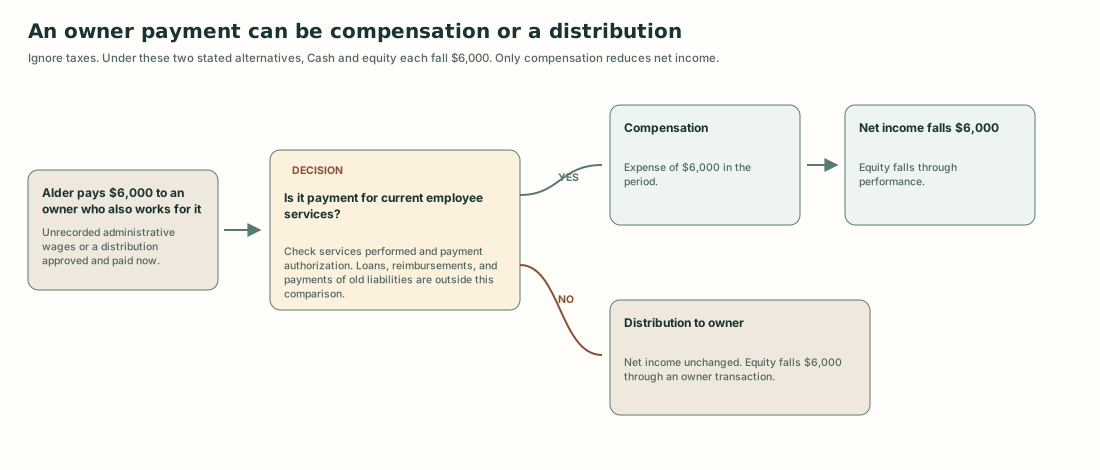
Detailed visual description
Alder pays an owner who also works for the company. The comparison is limited to two previously unrecorded events: current administrative wages, or a distribution approved and paid now. Ignore taxes. Compensation creates $6,000 expense, reducing income and equity by $6,000. A distribution reduces equity by $6,000 without reducing income. Both reduce Cash by $6,000. Loans, reimbursements, capitalized employee costs, and settlement of previously recorded liabilities require different analysis.
Equity in the learning graph
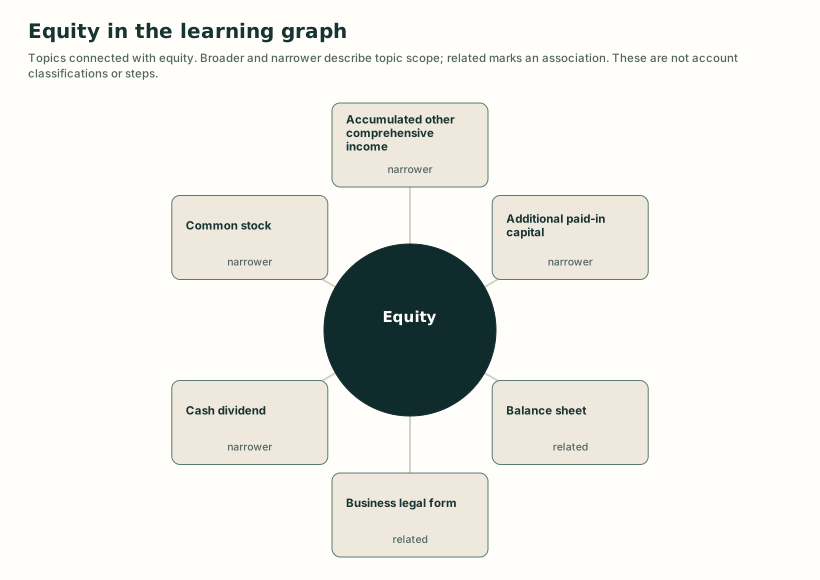
Detailed visual description
A structural map places Equity at the center and connects it to related concepts, prerequisite concepts, or lessons from the knowledge graph. Edge labels distinguish broader, narrower, related, prerequisite, and teaching relationships where present.
Equity is assets less liabilities
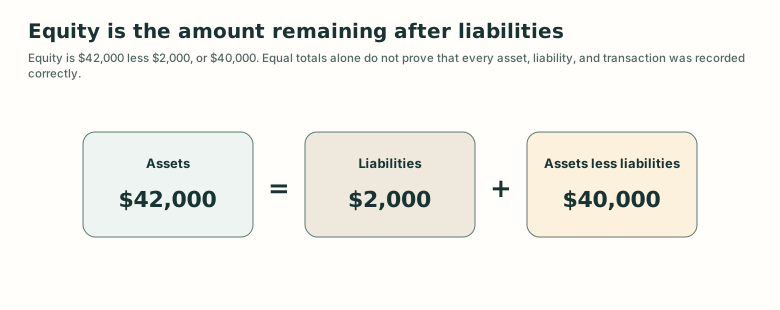
Detailed visual description
A standalone example has $42,000 of assets and $2,000 of liabilities. Equity is their difference, $40,000. The equation shows $42,000 equals $2,000 plus $40,000. The relationship does not establish that the underlying accounting records are complete and correct.
The same equity with different assets and debt
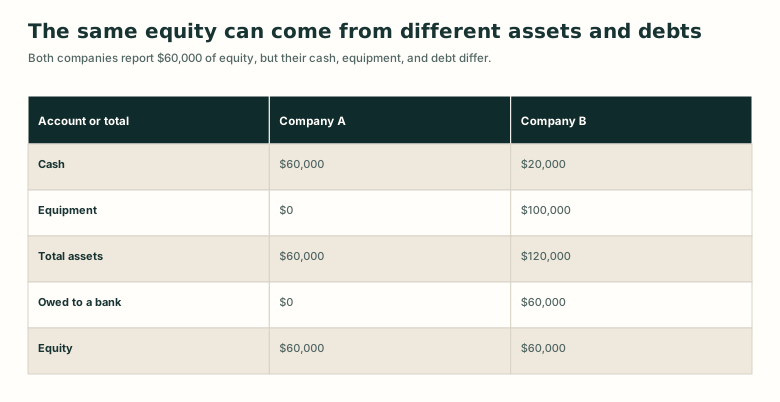
Detailed visual description
A comparison table with two columns. Company A holds $60,000 of cash, no equipment, total assets of $60,000, no bank debt, and equity of $60,000. Company B holds $20,000 of cash and $100,000 of equipment, total assets of $120,000, $60,000 owed to a bank, and equity of $60,000.
What changes equity
Detailed visual description
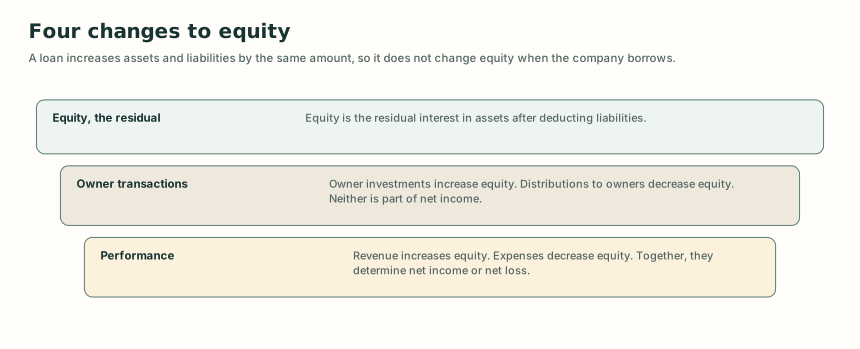
Three nested rectangles show equity and the two sources that change it. Owner investments increase equity, and owner distributions decrease it. Revenue increases equity, and expenses decrease it. Borrowing increases assets and liabilities by equal amounts, so it does not change equity when the loan begins.
Put the concept to work
Understand this concept
- Explain equity as a residual interest and distinguish it from cash, contributed capital, and market capitalization.
Analyze this concept
- Analyze whether a basic change in equity arises from owner transactions or operating performance.
Learning resources
Choose a lesson, try an application, or inspect the sources behind this concept.
Build on these ideas
- Asset — Understand
To understand this concept: Required. A residual interest cannot be interpreted without understanding the resources from which claims are deducted.
- Equity — Understand
To analyze this concept: Required. Analyzing changes requires first distinguishing the residual from a particular asset or equity account.
- Liability — Understand
To understand this concept: Required. Equity is measured after liabilities, so the learner must recognize creditor obligations separately.
Lessons
Worked examples and cases
Practice
- Asset purchase and the accounting equation
- Cash payments with different accounting effects
- Equal receipts from owner, bank, and customer
Show 2 more practice items
Common mistaken ideas
- Mistaken idea: An owner distribution is an expense
- Mistaken idea: AOCI is cash or a separate asset
- Mistaken idea: Equity is the cash a company has
Show 1 more mistaken ideas
Sources
Broader topics
More specific topics
Show 18 more more specific topics
- Common stock
- Issued shares
- Liquidating dividend
- Multiple-security issuance
- Outstanding shares
- Par or stated value
- Participating preferred stock
- Preferred dividend arrearage
- Preferred stock
- Property dividend
- Retained earnings restriction
- Share capital authorization
- Share issuance cost
- Share retirement
- Shareholders' equity rollforward
- Stock dividend
- Stock split
- Treasury stock
Related concepts
Use this idea next
- Accounting equation — Understand
Required level here: understand. Required. The learner must interpret equity as the residual after liabilities rather than as a particular asset.
- Common stock — Apply
Required level here: understand. Required. This prior idea supplies the quantities or classification needed for the current analysis.
- Distribution to owner — Understand
Required level here: understand. Required. A distribution is a reduction of the residual ownership interest rather than a performance cost.
Show 12 more next steps
- Equity multiplier — Understand
Required level here: understand. Required. The denominator is a residual accounting claim, not company cash or market capitalization.
- Equity — Analyze
Required level here: understand. Required. Analyzing changes requires first distinguishing the residual from a particular asset or equity account.
- Expense — Understand
Required level here: understand. Required. Expense reduces the residual through performance rather than through an owner distribution.
- Investment by owner — Understand
Required level here: understand. Required. An owner investment is defined by its effect on and relationship to the residual ownership interest.
- Permanent account — Understand
Required level here: understand. Required. Continuing contributed and accumulated equity balances do not reset merely because a reporting period ends.
- Preferred stock — Apply
Required level here: understand. Required. This prior idea supplies the quantities or classification needed for the current analysis.
- Retained earnings restriction — Apply
Required level here: understand. Required. This prior idea supplies the quantities or classification needed for the current analysis.
- Retained earnings — Understand
Required level here: analyze. Required. Retained earnings is one account explaining a source of change in the residual equity element.
- Return on equity — Understand
Required level here: analyze. Required. The denominator is a residual accounting amount shaped by owner transactions and accumulated performance.
- Revenue — Understand
Required level here: understand. Required. Revenue is one source of nonowner change in the residual interest.
- Share capital authorization — Apply
Required level here: understand. Required. This prior idea supplies the quantities or classification needed for the current analysis.
- Shareholders' equity rollforward — Apply
Required level here: understand. Required. This prior idea supplies the quantities or classification needed for the current analysis.
Used in these readings
These chapters explain or apply this concept. The label states how the chapter uses it.