On this page
Return on equity relates a period's net income to the average accounting equity supporting the entity. Harbor reports $24,000 net income and $80,000 average equity:
$24,000 ÷ $80,000 = 30% ROE
The percentage is separate from a shareholder's stock-price return, dividend yield, or cash distribution rate. It is an accounting relationship under the declared entity and equity definitions.
OpenStax Section 6.6 presents ROE beside return on assets. ROA uses average assets; ROE uses average equity. The shared net-income numerator does not make the measures interchangeable.
Reconcile the denominator
Harbor begins with $75,000 equity, earns $24,000, receives no owner contributions, and distributes $14,000:
$75,000 + $24,000 − $14,000 = $85,000 ending equity
The average is $80,000. The rollforward matters because a denominator should not enter the workpaper as an unexplained database field. Accounting learners should tie it to the statements. Finance learners should ask how distributions, buybacks, losses, or other equity changes affect the ratio.
Separate operating return from financing amplification
Harbor and Beacon both report 12% ROA. Harbor's equity multiplier is 2.50; Beacon's is 2.00:
Harbor: 0.12 × 2.50 = 0.30 = 30% ROE
Beacon: 0.12 × 2.00 = 0.24 = 24% ROE
Harbor's higher ROE is not evidence of higher ROA. It is the mathematical effect of more assets per equity dollar under these facts. That distinction changes the next question from “Which company operates better?” to “What claims finance the assets, at what cost, maturity, and risk?”
High ROE can be fragile
A small equity denominator can make ROE large. Distributions or repurchases can reduce equity and raise the ratio even when net income is unchanged. Losses can drive equity toward zero or below it, making ordinary comparisons unstable. Accounting estimates, impairments, acquisitions, preferred claims, and noncontrolling interests can also alter the numerator or denominator.
Harbor's own $14,000 distribution shows this mechanism. The distribution is not an expense and does not reduce net income. It does reduce ending equity and therefore affects the average-equity denominator.
Positive ROE does not prove cash generation. Beacon's operating cash exceeds net income while Harbor's falls below it in the fictional packet. One year of either pattern is a prompt to inspect the bridge and trend, not a quality label.
ROE becomes useful when it is decomposed, reconciled, and bounded. A single ranking discards the very information the ratio can help uncover.
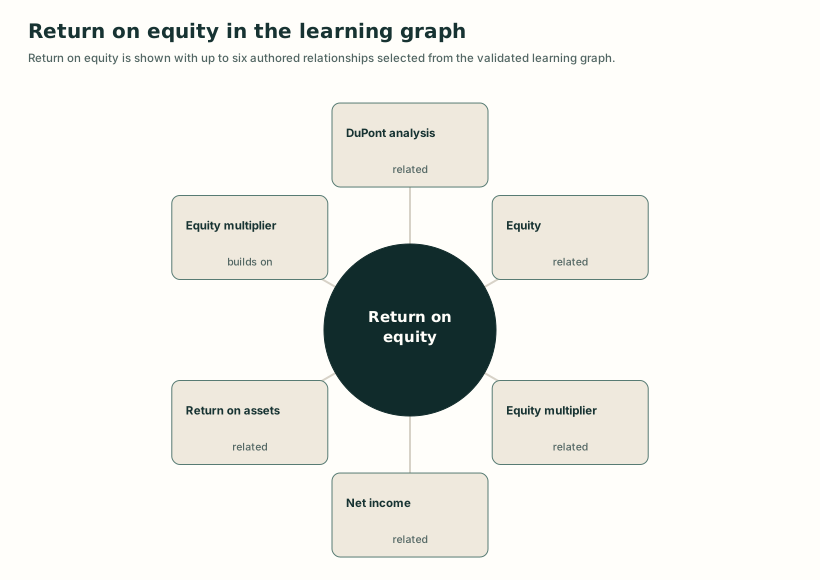
Return on equity in the learning graph
Detailed visual description
A structural map places Return on equity at the center and connects it to related concepts, prerequisite concepts, or lessons from the knowledge graph. Edge labels distinguish broader, narrower, related, prerequisite, and teaching relationships where present.
Put the concept to work
Understand this concept
- Explain ROE as same-period net income per average accounting equity dollar and distinguish it from shareholder market return, cash distribution, and operating performance alone.
Analyze this concept
- Compute ROE from aligned income and average equity, reconcile it to ROA times the equity multiplier, and challenge conclusions that ignore leverage, denominator quality, cash, or risk.
Learning resources
Choose a lesson, try an application, or inspect the sources behind this concept.
Build on these ideas
- Equity multiplier — Analyze
To analyze this concept: Required. The multiplier supplies the leverage component and its denominator controls.
- Equity — Analyze
To understand this concept: Required. The denominator is a residual accounting amount shaped by owner transactions and accumulated performance.
- Net income — Understand
To understand this concept: Required. The numerator is the entity's accrual-basis period result under the declared scope.
Show 2 more prerequisites
- Return on assets — Analyze
To analyze this concept: Required. ROA supplies the asset-return component of ROE.
- Return on equity — Understand
To analyze this concept: Required. Calculation and interpretation require a declared equity scope.
Lessons
Worked examples and cases
Practice
Common mistaken ideas
- Mistaken idea: A higher return ratio always means a better company
- Mistaken idea: An ending balance automatically matches a period flow
- Mistaken idea: DuPont components are independent levers
Show 1 more mistaken ideas
Sources
Related concepts
Show 2 more related concepts
Use this idea next
- DuPont analysis — Analyze
Required level here: analyze. Required. The recomposed product must reconcile to the independently calculated target.
- Return on equity — Analyze
Required level here: understand. Required. Calculation and interpretation require a declared equity scope.