On this page
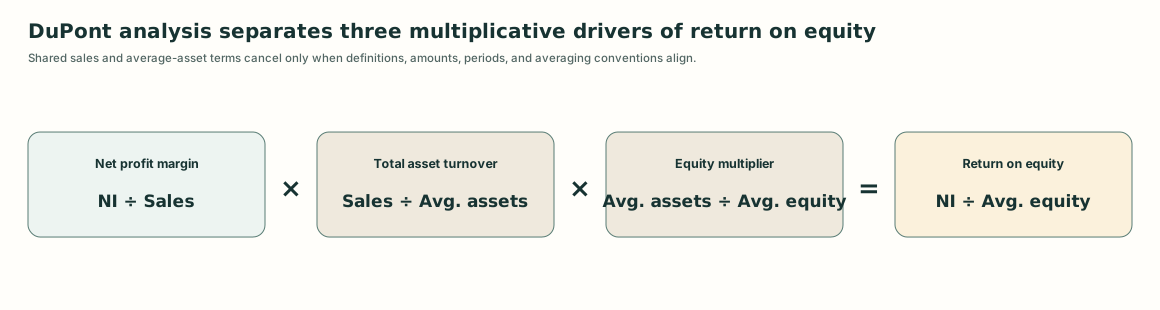
DuPont analysis opens ROE into three visible relationships:
net income / net sales
× net sales / average total assets
× average total assets / average total equity
= net income / average total equity
Net sales and average total assets cancel only because the same definitions and amounts appear in adjacent components. If one component uses ending assets and another uses average assets, the displayed product is no longer the stated identity.
Read each driver as a different question
- Net profit margin: how much net income remains per sales dollar?
- Total asset turnover: how much sales is generated per average asset dollar?
- Equity multiplier: how many average asset dollars correspond to each average equity dollar?
For Beacon:
10% = 0.10
0.10 × 1.20 × 2.00 = 0.24 = 24% ROE
For Harbor:
8% = 0.08
0.08 × 1.50 × 2.50 = 0.30 = 30% ROE
Convert the percentage factor to decimal form before multiplying. Treating
10% as the whole number 10 creates a result one hundred times too large.
Harbor's lower margin is offset by higher turnover, giving both companies 12% ROA. Harbor's higher multiplier then raises ROE to 30%. The decomposition has identified mathematical attribution: equal asset return, different leverage.
The components interact economically
The three factors are algebraically separable but not necessarily independent business levers. A low-margin, high-turnover strategy may depend on inventory, pricing, capacity, and supplier terms. More leverage can change interest cost, liquidity, investment capacity, and risk, which can later affect margin and asset use. Improving one component can weaken another.
Therefore “increase all three” is not a strategy. It is a request to ignore tradeoffs.
Treat reconciliation as a control
Calculate ROE directly from net income and average equity. Calculate the three components independently. Their difference should be zero within the declared precision. A mismatch can reveal inconsistent periods, definitions, averages, units, or data joins.
Agreement proves internal arithmetic, not data truth or business quality. The next work is to inspect source statements, footnotes, operating evidence, financing terms, multiple periods, and credible peers. DuPont analysis earns its place by making that next work more specific.
DuPont analysis separates operating return from financing structure
Detailed visual description
Four boxes present net profit margin, total asset turnover, the equity multiplier, and return on equity. Multiplication signs connect the first three and an equals sign leads to return on equity. The caption warns that the shared sales and average-asset terms cancel only when definitions, amounts, periods, and averaging conventions align; the arithmetic identity alone is not a causal explanation.
Put the concept to work
Understand this concept
- Explain how consistent net-sales and average-asset terms cancel in the three-step DuPont identity, leaving net income divided by average equity.
Analyze this concept
- Decompose and compare ROE across aligned entities, verify the recomposed identity, identify each mathematical driver, and distinguish that attribution from unsupported causal or risk conclusions.
Learning resources
Choose a lesson, try an application, or inspect the sources behind this concept.
Build on these ideas
- DuPont analysis — Understand
To analyze this concept: Required. Analysis must preserve the identity and compatible conventions.
- Equity multiplier — Understand
To understand this concept: Required. The multiplier supplies average total assets divided by average equity.
- Net profit margin — Understand
To understand this concept: Required. Margin supplies net income divided by net sales.
Show 3 more prerequisites
- Ratio comparability — Analyze
To analyze this concept: Required. Cross-entity decomposition requires aligned definitions and evidence.
- Return on equity — Analyze
To analyze this concept: Required. The recomposed product must reconcile to the independently calculated target.
- Total asset turnover — Understand
To understand this concept: Required. Turnover supplies net sales divided by average total assets.
Lessons
Worked examples and cases
Practice
Common mistaken ideas
Sources
Related concepts
Show 3 more related concepts
Use this idea next
- DuPont analysis — Analyze
Required level here: understand. Required. Analysis must preserve the identity and compatible conventions.