On this page
A ratio is a compressed relationship, not a verdict. Dividing net income by sales can describe how much period income remains per sales dollar under a declared definition. It cannot, by itself, tell a reader why the relationship changed, whether the inputs are comparable, or whether the result is desirable.
Begin with a question and an input map
Suppose an analyst asks why two packaging companies with the same net income report different returns to owners. Before calculating, the analyst records:
| Control | Question |
|---|---|
| Entity | Do numerator and denominator belong to the same reporting entity? |
| Time | Is each flow from the same period, and is each stock measured at a date that represents that period? |
| Definition | Are “net sales,” “net income,” assets, and equity defined consistently? |
| Basis | Do currency, units, accounting policies, restatement version, and consolidation scope agree? |
| Provenance | Can every amount be traced to a statement, note, schedule, or stipulated teaching fact? |
Only then does the quotient earn an interpretation.
Preserve the chain from source to claim
A defensible analysis leaves a trail:
question → source amounts → alignment controls → formula convention
         → full-precision result → driver comparison → bounded conclusion
The arithmetic is one link. Accounting learners should be able to reconcile the source amounts and explain stock-versus-flow timing. Finance learners should be able to identify economic drivers and request missing operational, industry, contractual, or market evidence. Both need the whole chain.
Equal outputs can conceal different mechanisms
Beacon and Harbor each earn $24,000 on average assets of $200,000, so
$24,000 ÷ $200,000 = 0.12 = 12% return on assets under this module's
convention. Beacon combines a 10% margin with 1.20 asset turnover. Harbor
combines an 8% margin with 1.50 turnover. The identical ROA is real arithmetic,
but it does not describe an identical business model.
Leverage adds another layer. Harbor uses less average equity per dollar of assets, so its ROE exceeds Beacon's even though their ROA is equal. Calling Harbor “better” would skip risk, financing terms, asset age, trend, and peer context.
A ratio is not a GAAP line item
Financial statements supply many inputs, but most analytical ratios are constructed measures. Labels and conventions can differ across textbooks, databases, covenants, and analysts. State the formula used; never assume that a shared label proves a shared calculation.
The correct closing move is a qualified claim: what the controlled comparison shows, which driver created the difference, and which evidence is still needed before a decision.
A controlled financial-ratio-analysis workflow
Detailed visual description
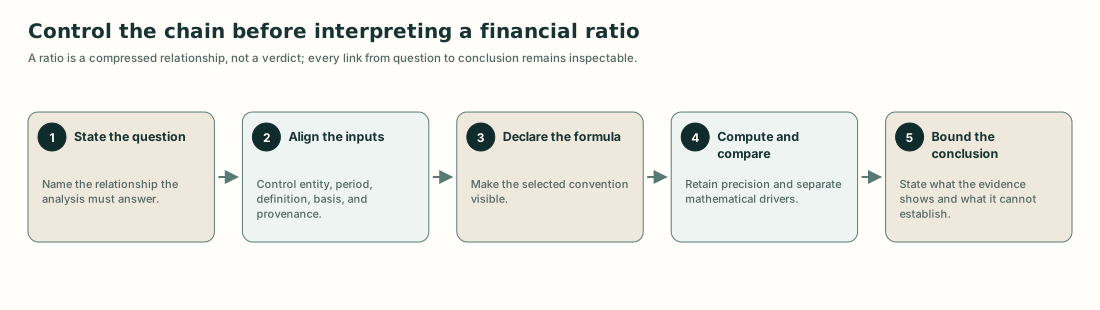
The workflow begins with the question to be answered. It then controls entity, period, definition, basis, and provenance; declares the formula convention; computes and compares with retained precision; and ends with a conclusion limited to what the controlled evidence supports.
Put the concept to work
Understand this concept
- Explain a source-to-ratio workflow that preserves the question, definitions, entity, period, units, reporting basis, calculation, and interpretation boundary.
Analyze this concept
- Build and critique a bounded ratio comparison by tracing every input to evidence, recomputing the result, separating mathematical drivers, and naming missing context.
Learning resources
Choose a lesson, try an application, or inspect the sources behind this concept.
Build on these ideas
- Financial ratio analysis — Understand
To analyze this concept: Required. Analysis depends on a reproducible workflow rather than an isolated quotient.
- Financial statement articulation — Understand
To understand this concept: Helpful. Articulation helps a learner challenge numbers that cannot coexist across statements.
- Financial statements — Understand
To understand this concept: Required. Ratio inputs must be traced to statements with different date and period scopes.
Show 1 more prerequisites
- Ratio comparability — Analyze
To analyze this concept: Required. A cross-entity or cross-period conclusion requires aligned definitions and scope.
Lessons
Worked examples and cases
- Align a period flow with average statement balances
- Explain Beacon and Harbor's Year 5 return difference
- Lehman Brothers: a quarter-end balance-sheet disappearing act
Show 1 more examples and cases
Practice
Common mistaken ideas
Sources
More specific topics
Show 15 more more specific topics
- Contingently issuable shares
- Diluted earnings per share
- Diluted EPS ordering
- EPS control number
- EPS numerator and denominator reconciliation
- If-converted method
- Income available to common shareholders
- Incremental earnings per share
- Operating efficiency analysis
- Participating security
- Potential common shares
- Retroactive share adjustment
- Treasury-stock method for EPS
- Two-class method
- Weighted-average common shares
Related concepts
Use this idea next
- Debt-to-total-assets ratio — Understand
Required level here: understand. Required. The ratio requires a controlled question, definition, date, and interpretation boundary.
- Financial ratio analysis — Analyze
Required level here: understand. Required. Analysis depends on a reproducible workflow rather than an isolated quotient.
- Operating efficiency analysis — Understand
Required level here: understand. Required. Efficiency measures inherit the source, definition, timing, and interpretation controls of ratio analysis.
Show 1 more next steps
- Ratio comparability — Understand
Required level here: understand. Required. Comparability qualifies the source-to-ratio workflow and its resulting claim.