On this page
The current ratio expresses how many dollars of classified current assets are reported per dollar of current liabilities. Northstar reports $120,000 of current assets, including $30,000 of cash, and $80,000 of current liabilities:
$120,000 current assets ÷ $80,000 current liabilities = 1.50
The result is unitless. Reporting it as $1.50 confuses a relative measure with a dollar amount.
The ratio and difference answer different questions
Northstar and a smaller peer each report $40,000 working capital. Their current ratios are 1.50 and 3.00 because the underlying scales differ. The ratio aids relative comparison; working capital retains the absolute dollar cushion. Both still compress composition and timing.
Equal changes can move the ratio in opposite directions
After Northstar pays $20,000 Accounts Payable with Cash, its current assets are $100,000 and current liabilities are $60,000:
$100,000 ÷ $60,000 = 1.6667, approximately
Working capital remains $40,000 while the ratio rises from 1.50 to about 1.67. Cash also falls from $30,000 to $10,000. The higher ratio is an algebraic result of removing equal amounts from a numerator larger than its denominator; it does not by itself prove stronger practical liquidity.
Now reverse the direction with a different transaction. Buying $20,000 Inventory on account raises current assets to $140,000 and current liabilities to $100,000. Working capital still equals $40,000, but the ratio falls to 1.40. Neither the payment nor the purchase can be judged from ratio direction alone.
A high ratio can carry weak assets
Inventory obsolescence, slow or doubtful receivables, restrictions, seasonality, window dressing, and mismatched maturities can make a high ratio less protective than it appears. A very high ratio can also indicate idle resources or inefficient working-capital use, depending on the business and strategy.
Comparison protocol
Match entity scope, date, currency, units, accounting policies, and classification basis. Then inspect component quality, operating cycle, cash- flow trend, maturity schedule, funding access, and industry economics. If current liabilities are zero, the ratio is undefined rather than infinite or automatically perfect.
Boundaries
No universal “good” current ratio applies to every entity. This foundation does not compute quick, cash, defensive-interval, turnover, or cash-conversion-cycle measures. Covenant definitions can also differ from the statement-derived ratio and must be calculated from the governing agreement.
Source boundary
The current ratio is an analytical calculation from classified totals. ASC 210 does not prescribe a universal favorable ratio. Read ASC 210-10-45-1 and ASC 210-10-45-5 for the general current sections that supply its numerator and denominator.
Current ratio in the learning graph
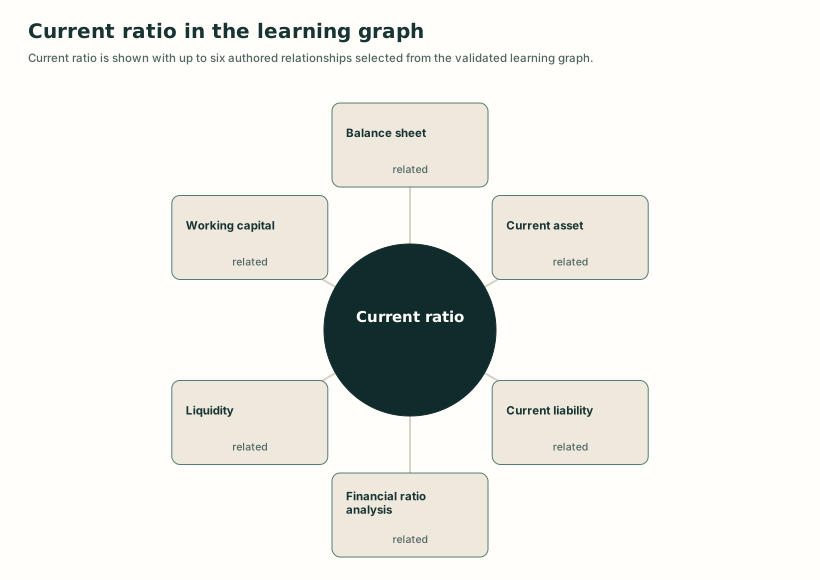
Detailed visual description
A structural map places Current ratio at the center and connects it to related concepts, prerequisite concepts, or lessons from the knowledge graph. Edge labels distinguish broader, narrower, related, prerequisite, and teaching relationships where present.
Put the concept to work
Understand this concept
- Explain the current ratio as a unitless relative comparison of classified current assets to current liabilities, including its denominator and composition limits.
Analyze this concept
- Compute and compare basic current ratios across positions, explain transaction-driven changes, and challenge conclusions unsupported by composition, timing, trend, or industry context.
Learning resources
Choose a lesson, try an application, or inspect the sources behind this concept.
Build on these ideas
- Current asset — Analyze
To understand this concept: Required. The numerator must come from supported current-asset classifications.
- Current liability — Analyze
To understand this concept: Required. The denominator must come from supported current-liability classifications and cannot be zero for a defined ratio.
- Current ratio — Understand
To analyze this concept: Required. Analysis requires the ratio's formula, unit, denominator, and classification basis.
Show 2 more prerequisites
- Liquidity — Analyze
To analyze this concept: Required. A ratio comparison must be tested against broader payment-capacity evidence.
- Working capital — Analyze
To analyze this concept: Required. The dollar difference provides a complementary scale view and exposes transaction effects the ratio can obscure.
Lessons
Worked examples and cases
Practice
Common mistaken ideas
Sources
Standard references
Related concepts
Show 3 more related concepts
Use this idea next
- Current ratio — Analyze
Required level here: understand. Required. Analysis requires the ratio's formula, unit, denominator, and classification basis.
Used in these readings
These chapters explain or apply this concept. The label states how the chapter uses it.