On this page
A balance sheet reports assets, liabilities, and equity at a stated date. It is also called a statement of financial position. The balances describe the ending position, not all the activity that occurred during the year.
Prepare the statement from ending amounts
Classify adjusted asset and liability balances, then use the calculated ending equity. Revenue and expenses affect equity through income; they are not separate balance-sheet lines. Dividends also affect equity rather than income.
A contra-asset account reduces the amount reported for its related asset. Accumulated Depreciation therefore reduces Equipment even though both are listed separately in the trial balance. Its credit balance does not make it a liability.
The standalone statement example shows cost, accumulated depreciation, and the resulting equipment subtotal. That example is unclassified: it does not separate current and noncurrent assets and liabilities.
Check more than the equation
Assets must equal liabilities plus equity. Net assets means assets less liabilities, so net assets equals equity, not total assets.
An omitted asset and an equal omitted liability can leave the equation balanced. Equal totals therefore do not prove that the statement includes every required item or that each amount is correctly measured.
Do not treat ending balances as cash flows
A change between two balance sheets can include transactions, noncash adjustments, and changes in estimates. It does not automatically describe cash received or paid. The statement of cash flows addresses those cash movements.
Reported equity is also not the price at which the business could be sold. The balance sheet uses accounting recognition and measurement rules and does not list every valuable feature of the business.
Balance sheet in the learning graph
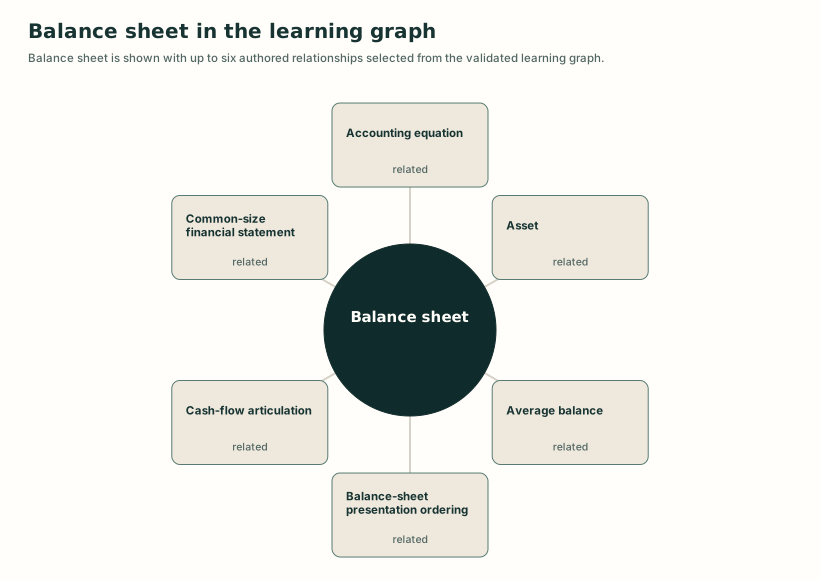
Detailed visual description
A structural map places Balance sheet at the center and connects it to related concepts, prerequisite concepts, or lessons from the knowledge graph. Edge labels distinguish broader, narrower, related, prerequisite, and teaching relationships where present.
Put the concept to work
Understand this concept
- Explain the balance sheet as a date-specific presentation of recognized assets, liabilities, and equity rather than a period activity report or market valuation.
Analyze this concept
- Prepare a basic balance sheet from classified ending balances, including a contra-asset, and analyze the equation and gross-to-net presentation.
Learning resources
Choose a lesson, try an application, or inspect the sources behind this concept.
Build on these ideas
- Accounting equation — Apply
To analyze this concept: Required. Ending assets must equal liabilities plus equity.
- Accounting equation — Understand
To understand this concept: Required. The statement preserves the claims-on-resources relationship among assets, liabilities, and equity.
- Accumulated depreciation — Analyze
To analyze this concept: Required. Gross Equipment and its credit-normal contra balance must produce the correct net asset amount.
Show 2 more prerequisites
- Balance sheet — Understand
To analyze this concept: Required. Preparation depends on date, entity, unit, and recognized-position scope.
- Financial statements — Understand
To understand this concept: Required. The balance sheet is one dated position statement within a linked report set.
Lessons
Worked examples and cases
Practice
Common mistaken ideas
Sources
Related concepts
Use this idea next
- Adjusted trial balance — Apply
Required level here: understand. Required. The asset, liability, and equity balances are read off into the balance sheet.
- Average balance — Understand
Required level here: understand. Required. A balance-sheet amount is measured at a date rather than over the whole period.
- Balance sheet limitation — Analyze
Required level here: understand. Required. The diagnosis is a reading of the statement as a whole.
Show 5 more next steps
- Balance sheet limitation — Understand
Required level here: understand. Required. A limitation is stated against what the statement does report.
- Balance sheet — Analyze
Required level here: understand. Required. Preparation depends on date, entity, unit, and recognized-position scope.
- Cash-flow articulation — Understand
Required level here: analyze. Required. The corresponding ending Cash balance supplies the date-specific endpoint.
- Common-size financial statement — Understand
Required level here: analyze. Required. Balance-sheet lines and total assets describe the same measurement date.
- Financial statement articulation — Understand
Required level here: analyze. Required. Ending equity must appear consistently within a balanced ending position.
Used in these readings
These chapters explain or apply this concept. The label states how the chapter uses it.