On this page
Financial statements answer different questions about the same business. They report performance, financial position, changes in equity, and cash flows. Notes explain accounting policies, estimates, and details needed to understand the reported amounts.
Choose the report for the question
| Question | Report |
|---|---|
| What income did the business earn during the period? | Income statement |
| Why did each equity component change? | Statement of changes in equity |
| What assets, liabilities, and equity are reported at the ending date? | Balance sheet |
| What cash receipts and payments explain the period's change in cash? | Statement of cash flows |
The income, equity, and cash-flow statements cover a period. The balance sheet reports a position at a date. A complete reporting package also addresses comprehensive income when applicable and includes required notes.
Read the labels before comparing amounts
Match the company, period, date, currency, and units. Dollars and thousands of dollars require conversion before comparison. A company's own statements may also differ from statements that include its subsidiaries.
Do not assume that matching line names prove matching facts. Check whether the reports use the same adjusted balances and whether a later version includes corrections that an earlier version omits.
Trace the connections
Net income contributes to the change in retained earnings. Ending equity is shared by the equity statement and balance sheet. The standalone statement example shows those links with complete facts and calculations.
The statements report amounts under accounting rules. They are not a complete inventory of every valuable feature, risk, or market expectation affecting the company. Use the notes and relevant supporting evidence when interpreting them.
Financial statements in the learning graph
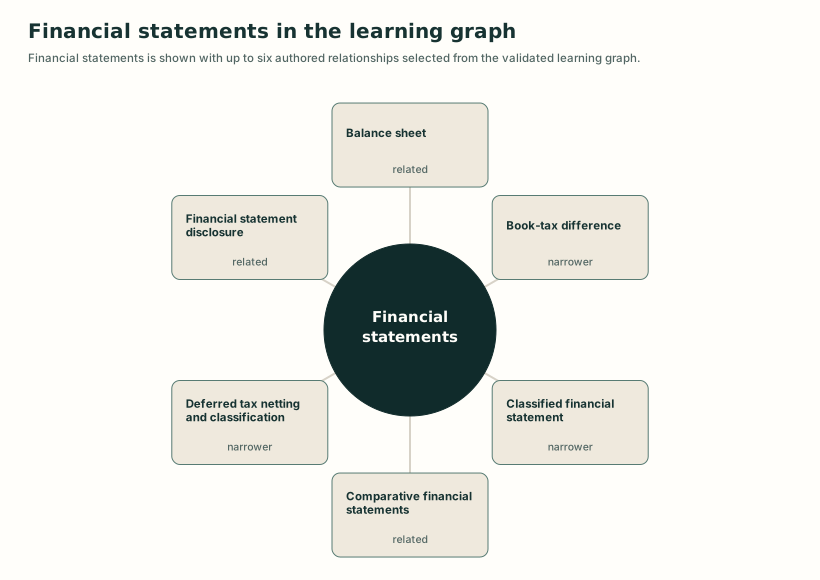
Detailed visual description
A structural map places Financial statements at the center and connects it to related concepts, prerequisite concepts, or lessons from the knowledge graph. Edge labels distinguish broader, narrower, related, prerequisite, and teaching relationships where present.
Put the concept to work
Understand this concept
- Explain financial statements as a linked report set whose statements, dates, periods, units, and notes answer different but connected questions.
Analyze this concept
- Analyze which basic statement, date or period, unit, and comparative context are needed for a financial question and identify unsupported cross-statement conclusions.
Learning resources
Choose a lesson, try an application, or inspect the sources behind this concept.
Build on these ideas
- Accounting cycle — Understand
To understand this concept: Required. The statement set follows adjusted account balances and precedes or accompanies later closing and publication steps.
- Financial statement articulation — Understand
To analyze this concept: Required. Cross-statement analysis must preserve the links among performance, equity, and financial position.
- Financial statement element — Understand
To understand this concept: Required. Statements organize recognized elements and changes without turning each element into one universal printed line.
Show 1 more prerequisites
- Financial statements — Understand
To analyze this concept: Required. Selection requires knowing the distinct scope and connection of each statement.
Lessons
Worked examples and cases
Practice
Common mistaken ideas
Sources
More specific topics
Show 11 more more specific topics
- Effective tax rate
- Enacted tax rate
- Income tax provision
- Income tax provision rollforward
- Income tax rate reconciliation
- Income taxes paid disclosure
- Outside-basis difference and indefinite-reinvestment boundary
- Per-share effect of an accounting change or error
- Statement of cash flows
- Taxable income
- Temporary difference
Related concepts
Show 15 more related concepts
- Financial reporting institution
- Financial statement articulation
- Financial statement disclosure
- Financial statement presentation
- General-purpose financial reporting
- Income statement
- Interim financial reporting
- Materiality
- Monetary unit assumption
- Public filing navigation
- Ratio comparability
- Reporting entity
- Securities regulation
- Statement of changes in equity
- Understandability
Use this idea next
- Balance sheet — Understand
Required level here: understand. Required. The balance sheet is one dated position statement within a linked report set.
- Classified financial statement — Understand
Required level here: understand. Required. Classification organizes a statement whose purpose and linked totals the learner must already recognize.
- Comparative financial statements — Understand
Required level here: analyze. Required. Comparison begins with the scope, date or period, and articulation of each underlying statement.
Show 15 more next steps
- Corporate governance — Understand
Required level here: understand. Helpful. Financial reporting is one major information flow through which boards and owners monitor management.
- Financial ratio analysis — Understand
Required level here: understand. Required. Ratio inputs must be traced to statements with different date and period scopes.
- Financial reporting institution — Understand
Required level here: understand. Helpful. The learner should know what reports these institutions help define, oversee, audit, distribute, or use.
- Financial statement presentation — Analyze
Required level here: analyze. Helpful. Presentation effects travel through an articulated set rather than one isolated page.
- Financial statements — Analyze
Required level here: understand. Required. Selection requires knowing the distinct scope and connection of each statement.
- General-purpose financial reporting — Understand
Required level here: understand. Helpful. The statements are a principal general-purpose reporting surface whose role the learner is now qualifying.
- Income statement — Understand
Required level here: understand. Required. The income statement is one part of a linked statement set with a specified period and scope.
- Interim financial reporting — Understand
Required level here: understand. Required. Interim reports use the same connected statement system over a shorter period.
- Non-GAAP measure — Understand
Required level here: understand. Helpful. A learner benefits from knowing the GAAP statements and subtotals from which many alternative measures begin.
- Public filing navigation — Understand
Required level here: understand. Required. The learner needs to recognize the financial statements and notes within the larger filing.
- Ratio comparability — Understand
Required level here: analyze. Required. Alignment begins by identifying each statement's entity, date or period, and reporting basis.
- Securities regulation — Understand
Required level here: understand. Helpful. Issuer disclosure rules often use financial statements and related narrative disclosures as information for investors.
- Statement of cash flows — Understand
Required level here: understand. Required. The cash-flow statement is one period report within a linked statement set.
- Statement of changes in equity — Understand
Required level here: understand. Required. The statement is the period bridge between performance and ending balance-sheet equity.
- Time-period assumption — Understand
Required level here: understand. Required. The assumption is visible through statements with different date and period scopes.
Used in these readings
These chapters explain or apply this concept. The label states how the chapter uses it.