On this page
Two ratios are comparable only for a stated purpose and after relevant differences have been controlled or disclosed. Matching formula labels are not enough.
The comparison contract
Beacon's net sales are reported for Year 5 in whole USD. Its ending assets are a December 31 stock. Pairing those values with Harbor's quarterly sales, a prior- year asset balance, amounts in thousands, or a different consolidation scope would create a quotient, but not the intended comparison.
At minimum, inspect:
- legal or reporting entity and consolidation boundary;
- fiscal period and balance-sheet dates;
- currency, scale, and sign convention;
- numerator and denominator definitions;
- accounting policies and estimates material to the measure;
- original, amended, or restated statement version;
- unusual transactions or structural changes; and
- the business, industry, and life-cycle context needed for interpretation.
Some differences can be repaired. Thousands can be converted to whole dollars; a documented 53-week year can be disclosed; beginning and ending balances can be averaged under a declared convention. Others require evidence the analyst does not have. A missing acquisition note or unidentified restatement version is a reason to pause, not an invitation to guess an adjustment.
Comparable does not mean identical
Beacon and Harbor can be compared in the fictional packet because it stipulates the same year, currency, units, aggregate policies, and net-sales definition. Their margin, asset mix, financing, and working-capital behavior are supposed to differ. Those differences are the substance of analysis, not defects to erase.
The question is whether a difference belongs in the economic explanation or instead contaminates measurement. A newer production line may genuinely raise turnover; a major acquisition completed on the last day may make a simple beginning-ending average a poor representation of assets employed throughout the year. The first is a possible driver. The second is a measurement warning.
Stop conditions improve analysis
A strong workpaper says when the evidence is insufficient. If equity is negative, the ordinary equity-multiplier and ROE interpretation in this module does not apply. If net income is zero or negative, an operating-cash-to-income ratio becomes unstable or sign-confusing, so use the absolute gap and inspect the bridge. If definitions differ materially and cannot be reconciled, report the noncomparability rather than ranking the outputs.
Comparability is therefore not a ceremonial disclaimer. It determines whether the calculation can support the sentence written beneath it.
Ratio comparability in the learning graph
Detailed visual description
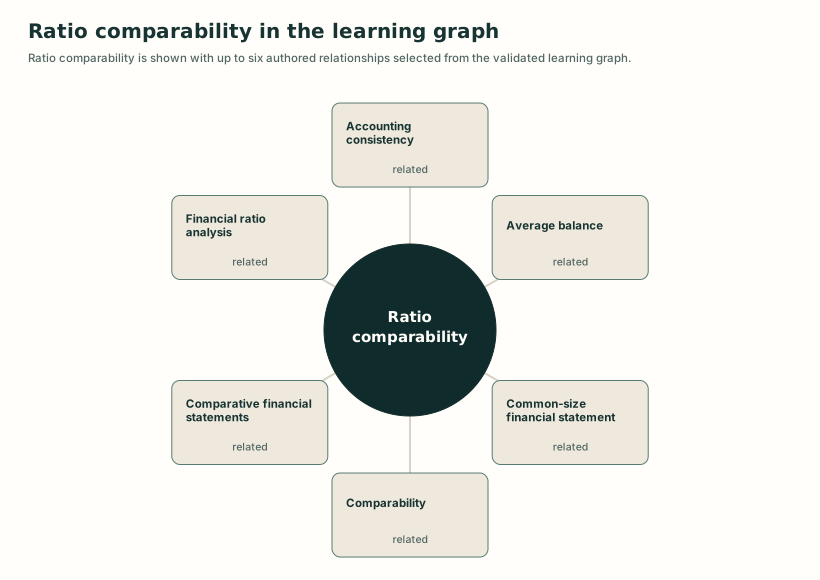
A structural map places Ratio comparability at the center and connects it to related concepts, prerequisite concepts, or lessons from the knowledge graph. Edge labels distinguish broader, narrower, related, prerequisite, and teaching relationships where present.
Put the concept to work
Understand this concept
- Explain why comparable ratio analysis requires aligned entities, periods, currencies, units, definitions, accounting bases, and statement versions.
Analyze this concept
- Diagnose material comparison failures in a ratio packet, distinguish repairable alignment work from missing evidence, and narrow or stop the conclusion accordingly.
Learning resources
Choose a lesson, try an application, or inspect the sources behind this concept.
Build on these ideas
- Financial ratio analysis — Understand
To understand this concept: Required. Comparability qualifies the source-to-ratio workflow and its resulting claim.
- Financial statement articulation — Analyze
To analyze this concept: Helpful. Cross-statement ties can expose inconsistent entity, period, or version inputs.
- Financial statements — Analyze
To understand this concept: Required. Alignment begins by identifying each statement's entity, date or period, and reporting basis.
Show 1 more prerequisites
- Ratio comparability — Understand
To analyze this concept: Required. Diagnosis requires a complete comparison contract.
Lessons
Worked examples and cases
Practice
Common mistaken ideas
Sources
Related concepts
Use this idea next
- Average balance — Apply
Required level here: understand. Required. Beginning and ending amounts must share entity, units, basis, and version.
- Common-size financial statement — Analyze
Required level here: analyze. Required. Scale normalization leaves policy, scope, classification, business-model, and period differences intact.
- Comparability — Analyze
Required level here: understand. Helpful. Ratio work supplies a familiar setting in which bases and definitions can silently diverge.
Show 14 more next steps
- Comparative financial statements — Analyze
Required level here: analyze. Required. An analyst must stop or narrow a comparison when material alignment failures cannot be repaired.
- Comparative financial statements — Understand
Required level here: understand. Required. Adjacent columns support analysis only after their comparison contract is controlled.
- Days inventory outstanding — Analyze
Required level here: analyze. Required. Product model, seasonality, cost basis, and day-count differences can invalidate a ranking.
- Days payables outstanding — Analyze
Required level here: analyze. Required. Purchase scope, contractual terms, day count, seasonality, and classifications affect comparisons.
- Days sales outstanding — Analyze
Required level here: analyze. Required. Day-count, credit-sales mix, seasonality, and receivable scope affect period and peer comparisons.
- DuPont analysis — Analyze
Required level here: analyze. Required. Cross-entity decomposition requires aligned definitions and evidence.
- Equity multiplier — Analyze
Required level here: analyze. Required. Equity definitions, entity scope, and accounting basis can materially change the multiplier.
- Financial ratio analysis — Analyze
Required level here: analyze. Required. A cross-entity or cross-period conclusion requires aligned definitions and scope.
- Horizontal analysis — Analyze
Required level here: analyze. Required. A numerical trend is usable only after material comparison failures are resolved or disclosed.
- Net profit margin — Analyze
Required level here: analyze. Required. Margin comparisons require aligned sales, income, period, entity, and accounting basis.
- Operating cash-to-income comparison — Analyze
Required level here: analyze. Required. Cross-entity cash conversion requires aligned periods, classifications, and definitions.
- Operating efficiency analysis — Analyze
Required level here: analyze. Required. Different sales mix, inventory model, supplier terms, periods, or accounting policies can invalidate a ranking.
- Ratio comparability — Analyze
Required level here: understand. Required. Diagnosis requires a complete comparison contract.
- Total asset turnover — Apply
Required level here: analyze. Required. Cross-entity efficiency comparisons are sensitive to accounting and business-model differences.
Used in these readings
These chapters explain or apply this concept. The label states how the chapter uses it.