On this page
Financial statement articulation is the connection between period activity and ending financial position. Income changes equity, and ending equity is reported on the balance sheet. Agreement of shared amounts is one consequence of that connection.
Follow the shared amounts
Compare net income on the income statement with the amount used in the equity statement. Reconcile each equity component from its beginning balance through income, owner transactions, and any other specified changes.
Then compare ending equity with the balance sheet. Both reports must describe the same company, reporting period, date, and units. A report prepared before an adjustment may differ from one prepared afterward.
Investigate before changing an account
A difference can arise from a missing transaction, an incorrect classification, a calculation error, or an outdated report. Identify which explanation the records support. Do not invent a Retained Earnings amount to make a table balance.
The standalone diagnostics lesson supplies a trial balance and follows an omitted wage accrual through the reports. No figures from another lesson are needed.
Know what agreement cannot prove
An omitted expense and liability can overstate income and equity while understating liabilities by the same amount. The statements may agree with each other and the balance sheet may still balance. The shared error remains.
Checking articulation is therefore one part of reviewing statements, alongside checking the underlying transactions, adjustments, and classifications. More detailed reporting also connects cash flows and income items reported outside net income.
How the primary financial statements articulate
Detailed visual description
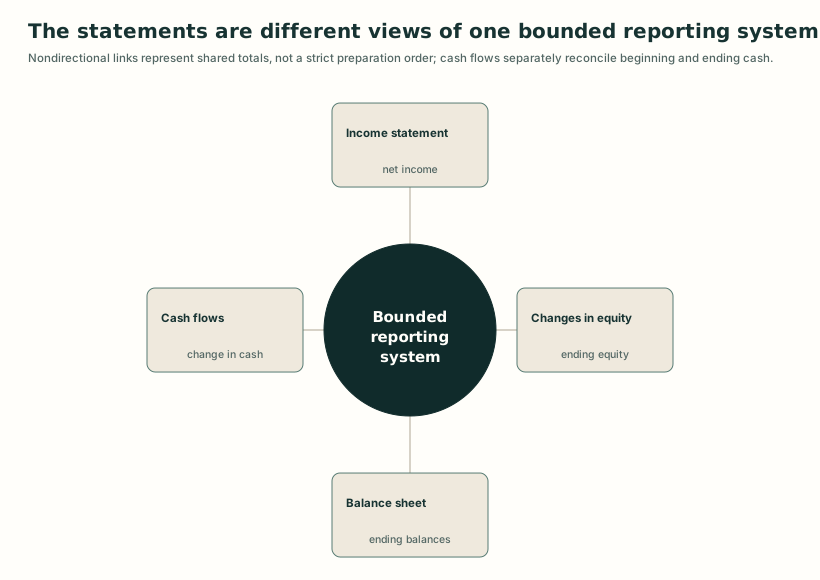
Four statements surround one bounded reporting system without sequence arrows. The income statement connects through net income; the statement of changes in equity through ending equity; the balance sheet through ending balances; and the cash-flow statement through the change in cash. The cash-flow statement separately reconciles beginning and ending cash rather than following the balance sheet as a final preparation stage.
Put the concept to work
Understand this concept
- Explain how net income, owner transactions, ending equity, and the ending accounting equation link across basic financial statements.
Analyze this concept
- Diagnose basic cross-statement inconsistencies in net income, retained earnings, total equity, or the ending accounting equation and identify the mismatched scope or amount.
Learning resources
Choose a lesson, try an application, or inspect the sources behind this concept.
Build on these ideas
- Balance sheet — Analyze
To understand this concept: Required. Ending equity must appear consistently within a balanced ending position.
- Financial statement articulation — Understand
To analyze this concept: Required. Diagnosis requires a declared chain of expected equalities before locating its break.
- Income statement — Analyze
To understand this concept: Required. The period's net-income result supplies one equity-rollforward input.
Show 2 more prerequisites
- Statement of changes in equity — Analyze
To understand this concept: Required. The equity statement bridges performance and owner transactions to ending components.
- Trial balance — Analyze
To analyze this concept: Required. Statement mappings must remain traceable to adjusted ending account balances.
Lessons
Worked examples and cases
Practice
Common mistaken ideas
Sources
Related concepts
Use this idea next
- Cash-flow articulation — Analyze
Required level here: analyze. Required. A statement can be arithmetically coherent yet conflict with another statement or the underlying records.
- Financial ratio analysis — Understand
Required level here: understand. Helpful. Articulation helps a learner challenge numbers that cannot coexist across statements.
- Financial statement articulation — Analyze
Required level here: understand. Required. Diagnosis requires a declared chain of expected equalities before locating its break.
Show 3 more next steps
- Financial statements — Analyze
Required level here: understand. Required. Cross-statement analysis must preserve the links among performance, equity, and financial position.
- Liquidity — Analyze
Required level here: analyze. Helpful. Liquidity evidence must share entity scope, date, period, unit, and version across statements.
- Ratio comparability — Analyze
Required level here: analyze. Helpful. Cross-statement ties can expose inconsistent entity, period, or version inputs.
Used in these readings
These chapters explain or apply this concept. The label states how the chapter uses it.