An income statement reports the revenue, gains, expenses, and losses included in net income over a stated period. Recognition includes an item in the financial statements; merely noticing an event does not.
Give the amounts a period
The heading identifies the company and period, such as the year ended December 31, 2026. A date alone does not say whether the statement covers a month, a quarter, or a year. State the currency and units too.
A balance sheet answers a different question: what assets, liabilities, and equity exist at the ending date. Its account balances are not additional revenue or expenses on the income statement.
Use adjusted accounts
Revenue and expense balances must include the adjustments belonging to the period. After deciding that an amount belongs in period performance, use income statement classification to place it in the applicable component, caption, and subtotal. Formatting cannot repair an omitted expense or revenue recorded before it was earned.
Dividends are distributions to owners, not expenses. Equipment purchases normally create assets whose costs are assigned to expense over their use, rather than becoming expenses simply because cash was paid.
The standalone statement example provides adjusted balances and explains each calculation. It uses a simplified statement without income taxes or gains and losses.
Explain what the total leaves out
Net income is not a cash-receipts-and-payments total. Credit sales, unpaid expenses, and depreciation can separate income from cash movement. Other comprehensive income contains certain income items reported outside net income; more detailed reporting explains those items separately.
Before comparing statements, match the periods, units, and company being reported. Then examine the revenue and expense components rather than treating an equal final total as proof of equal performance.
Income statement in the learning graph
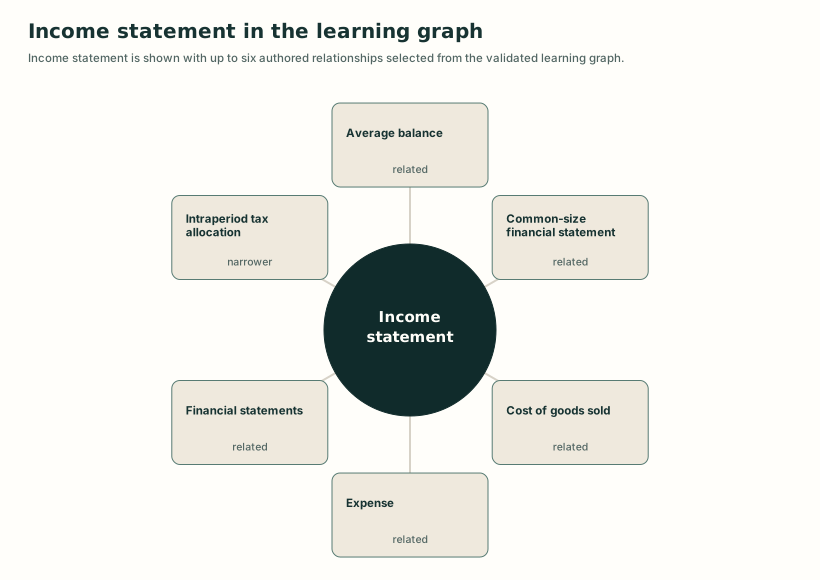
Detailed visual description
A structural map places Income statement at the center and connects it to related concepts, prerequisite concepts, or lessons from the knowledge graph. Edge labels distinguish broader, narrower, related, prerequisite, and teaching relationships where present.
Put the concept to work
Understand this concept
- Explain the income statement as a period report of recognized performance components and subtotals rather than a cash-receipts-and-payments schedule.
Analyze this concept
- Prepare a basic income statement from classified adjusted balances and analyze the composition of net income without importing owner transactions or balance-sheet stocks.
Learning resources
Choose a lesson, try an application, or inspect the sources behind this concept.
Build on these ideas
- Financial statements — Understand
To understand this concept: Required. The income statement is one part of a linked statement set with a specified period and scope.
- Income statement — Understand
To analyze this concept: Required. Preparation depends on the statement's period-performance scope.
- Net income — Analyze
To analyze this concept: Required. The classified components must reconcile to the reported performance residual.
Show 2 more prerequisites
- Net income — Understand
To understand this concept: Required. The statement's basic residual must be distinguished from revenue, cash flow, and equity.
- Trial balance — Analyze
To analyze this concept: Required. Adjusted revenue and expense account balances supply the basic statement inputs.
Lessons
Worked examples and cases
Practice
Common mistaken ideas
Sources
More specific topics
Related concepts
Use this idea next
- Adjusted trial balance — Apply
Required level here: understand. Required. The revenue and expense balances are read off into the income statement.
- Average balance — Understand
Required level here: understand. Required. Sales and net income accumulate over a period and create the timing mismatch to be repaired.
- Common-size financial statement — Understand
Required level here: analyze. Required. Income-statement lines and net sales cover the same reporting period.
Show 9 more next steps
- Financial statement articulation — Understand
Required level here: analyze. Required. The period's net-income result supplies one equity-rollforward input.
- Income from continuing operations — Understand
Required level here: understand. Required. Continuing operations is a component of the period performance statement.
- Income statement classification — Understand
Required level here: understand. Required. The learner should know the statement's period and performance role before analyzing its internal architecture.
- Income statement limitation — Analyze
Required level here: understand. Required. The diagnosis is a reading of the statement as a whole.
- Income statement limitation — Understand
Required level here: understand. Required. A limitation is stated against what the statement does report.
- Income statement — Analyze
Required level here: understand. Required. Preparation depends on the statement's period-performance scope.
- Multiple-step income statement — Analyze
Required level here: analyze. Required. The question is what the statement as a whole communicates.
- Multiple-step income statement — Understand
Required level here: understand. Required. The format is one way of presenting the statement.
- Net profit margin — Understand
Required level here: analyze. Required. The learner must identify same-period net sales and net income on a consistent statement basis.
Used in these readings
These chapters explain or apply this concept. The label states how the chapter uses it.