On this page
Revenue results from a company's ordinary activities, not simply from cash entering its bank account. A customer payment may accompany revenue, arrive after the revenue-producing activity, or precede it. Borrowed cash and an owner's capital contribution also increase cash, but neither is revenue.
Performance and the resource effect
In the conceptual model, revenue results from delivering goods, producing goods, providing services, or carrying out other activities. The activity can increase an asset, such as Cash or a receivable. It can also settle a liability, such as an obligation to provide a service for which the customer paid earlier. The asset or liability change shows how the company's financial position changed. Revenue identifies performance as the source of that change.
Assume a consulting company completes an agreed service for $2,000 and the customer pays immediately. Cash rises and revenue rises. If the customer will pay next month, a receivable can rise instead of Cash under the stated recognition assumptions. The performance can be the same even though the form and timing of the asset differ.
Now assume a bank lends the company $2,000. Cash again rises, but the company has a present obligation to repay the lender. Assets and liabilities increase; performance and revenue do not. If an owner contributes $2,000 for an ownership interest, assets and equity increase through an investment by an owner, not through revenue.
Cash can lead or lag
Cash received before performance can create a liability. The entity still owes goods, services, or another economic benefit. Cash collected after performance can settle a receivable that was recognized earlier. In both cases, using collection as the automatic revenue date can put performance in the wrong period or count it twice. Suppose the company records revenue for a March service and records it again when the customer pays in April. The company has reported one service twice.
These examples introduce accrual accounting; they do not provide a complete revenue-recognition rule. Contracts, enforceable rights and obligations, performance, collectibility, variable amounts, returns, and other facts can matter. The applicable authoritative guidance determines the conclusion.
Identify the balance beside revenue
For an ordinary customer contract, ask what has been transferred and what condition remains on payment. An unconditional right is accounts receivable. A right for transferred goods or services that still depends on another condition is a contract asset. Unearned revenue introduces the opposite timing: the customer pays before performance. The broader contract liability concept also covers payment due before transfer.
Those balances explain different timing relationships. They do not replace the recognition analysis. Use the cash-source example and independent practice to test why owner investment, borrowing, and completed customer service have different effects despite each bringing in cash.
Why the distinction matters
For an accounting student, separating revenue from cash is necessary before recording receivables, contract liabilities, or adjusting entries. For a finance student, it explains why revenue growth need not produce equal operating cash flow and why cash from borrowing cannot be treated as sales momentum.
It also protects interpretation of equity. Revenue can increase equity through performance, but an increase in equity from an owner contribution has a different source. A statement reader needs the ending amount and an explanation of whether it changed through owner transactions or performance.
Compare revenue with expense
Revenue follows the resource increase or obligation settlement produced by the entity's activities. Expense follows resources used or obligations incurred in those activities. Each changes equity through performance, but in the opposite direction.
One sale does not require an equal expense in the same entry or period. Some events create revenue without a related current expense, and some expenses do not accompany current revenue. Apply the recognition and measurement guidance that governs each item.
Boundaries
Revenue is not every increase in assets or equity. Borrowing, owner investment, and asset exchanges have other explanations. It is also not a claim that a particular customer arrangement meets authoritative recognition or measurement requirements. This article establishes the element and its basic economic distinction; later concepts govern specific recognition models.
Sources and currency
FASB Concepts Statement No. 8, Chapter 4. supports the definition. Concepts Statements are nonauthoritative and do not replace the Accounting Standards Codification for a specific revenue arrangement.
ASC 606-10-25-23 connects revenue recognition to satisfaction of a performance obligation. The basic service examples assume that required conclusion. They do not establish that a contract exists or set and allocate its transaction price. They also do not decide the pattern or date of performance.
Record the activity and the later cash event
Detailed visual description
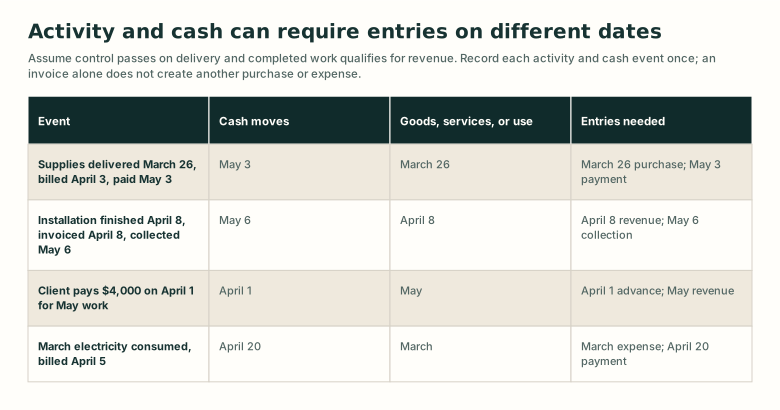
Four standalone timing examples assume qualifying recognition and control on delivery. Supplies received March 26 are recorded then; payment May 3 settles the payable. Installation completed and billed April 8 creates revenue and a receivable; May 6 collection settles it. A $4,000 April 1 advance creates a liability; May work earns the revenue. March electricity creates expense and a payable; April 20 payment settles it. Every row includes separate accounting for the activity and cash event.
Revenue in the learning graph
Detailed visual description
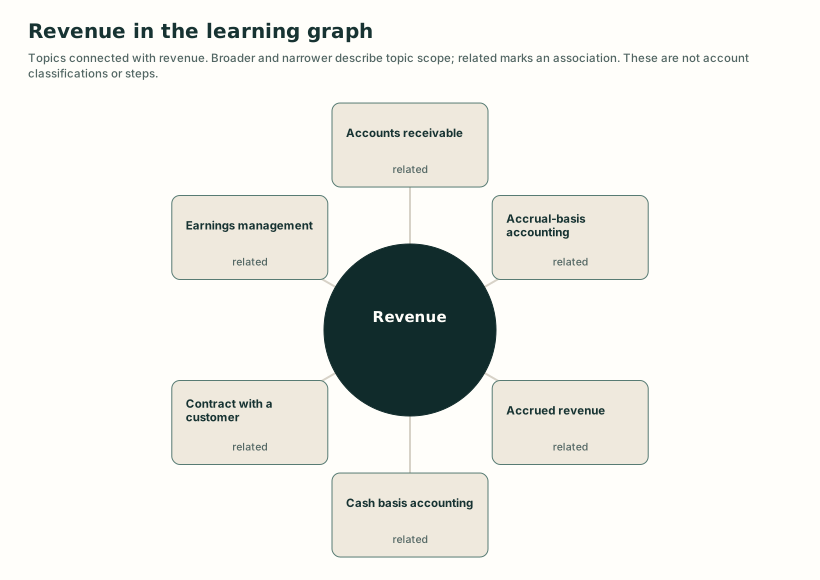
A structural map places Revenue at the center and connects it to related concepts, prerequisite concepts, or lessons from the knowledge graph. Edge labels distinguish broader, narrower, related, prerequisite, and teaching relationships where present.
What changes equity
Detailed visual description
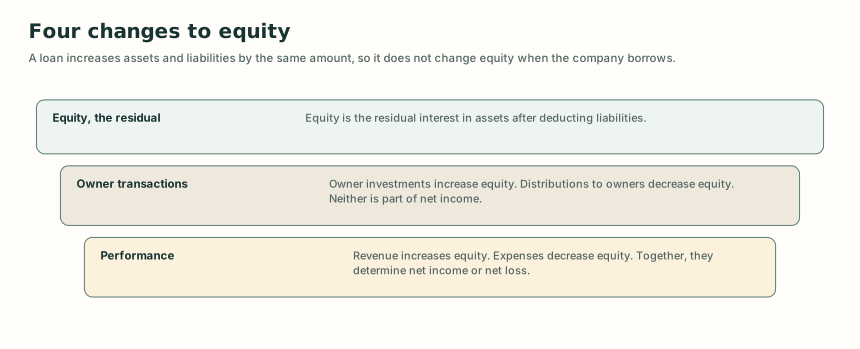
Three nested rectangles show equity and the two sources that change it. Owner investments increase equity, and owner distributions decrease it. Revenue increases equity, and expenses decrease it. Borrowing increases assets and liabilities by equal amounts, so it does not change equity when the loan begins.
Put the concept to work
Understand this concept
- Explain why revenue arises from the entity's activities rather than from every receipt of cash, borrowing, or owner contribution.
Apply this concept
- Classify basic revenue effects when performance and cash collection occur together or at different times.
Learning resources
Choose a lesson, try an application, or inspect the sources behind this concept.
Build on these ideas
- Accounting transaction — Understand
To apply this concept: Required. The learner must identify what the entity did before selecting the revenue and asset effects.
- Asset — Understand
To understand this concept: Required. Revenue can enhance assets, so the learner must recognize the resource effect separately from its source.
- Equity — Understand
To understand this concept: Required. Revenue is one source of nonowner change in the residual interest.
Show 2 more prerequisites
- Liability — Understand
To understand this concept: Helpful. Some revenue effects settle liabilities, while borrowing creates rather than settles an obligation.
- Revenue — Understand
To apply this concept: Required. Application depends on separating performance from the timing and source of cash.
Lessons
Worked examples and cases
- Classify five cash transactions
- Compute Linden midpoint demand elasticity
- Define the Linden market and its transaction layers
Show 9 more examples and cases
- Reconcile Cedar expenditure GDP
- Reconcile Granite Harbor's multiple-step income statement
- Reconcile Linden consumer, producer, and total surplus
- Record an early-payment discount
- Record payment due before service
- Sunbeam: pull tomorrow's sales into today?
- Update an expired discount before collection
- When to record routine transactions
- Xerox: decompose the lease before moving revenue
Practice
- Cash before and after customer work
- Cash received before the service
- Equal receipts from owner, bank, and customer
Show 3 more practice items
Common mistaken ideas
- Mistaken idea: An economic surplus area is accounting profit or cash
- Mistaken idea: Cash recovery on a written-off account is new revenue
- Mistaken idea: Every cash receipt is revenue
Show 1 more mistaken ideas
Sources
Standard references
Broader topics
More specific topics
Related concepts
Show 20 more related concepts
- Cash basis accounting
- Contract with a customer
- Earnings management
- Equity
- Expense
- Expense recognition and matching
- Gross domestic product
- Income statement
- Investment by owner
- Net income
- Net profit margin
- Operating cash flow
- Peripheral gain or loss
- Price elasticity of demand
- Principal-versus-agent revenue presentation
- Retained earnings
- Sales discount
- Sales tax payable
- Temporary account
- Unearned revenue
Use this idea next
- Accounts receivable — Apply
Required level here: understand. Required. The derivation starts from revenue for the period.
- Accounts receivable — Understand
Required level here: understand. Required. Credit performance can create revenue and a receivable before collection.
- Accrual-basis accounting — Understand
Required level here: understand. Required. Revenue must be understood as a performance-related change rather than a synonym for cash receipt.
Show 13 more next steps
- Accrued revenue — Understand
Required level here: understand. Required. The learner must distinguish performance-related revenue from cash receipt.
- Cash basis accounting — Understand
Required level here: understand. Required. The two bases disagree about when revenue belongs to a period.
- Contract with a customer — Understand
Required level here: understand. Required. The contract model applies to a specified source of revenue rather than every cash inflow.
- Gross profit — Understand
Required level here: understand. Required. The subtotal starts from net sales.
- Net credit sales — Understand
Required level here: understand. Required. The numerator begins with recognized sales rather than cash receipts.
- Net income — Understand
Required level here: understand. Required. Recognized revenue and gains contribute to the performance residual.
- Operating cash flow — Apply
Required level here: understand. Helpful. Customer collections often relate to revenue activity even when recognition and collection occur in different periods.
- Peripheral gain or loss — Understand
Required level here: understand. Required. A gain is defined by not being revenue.
- Retained earnings — Understand
Required level here: understand. Required. Revenue contributes to period earnings before the net performance effect closes into equity.
- Revenue — Apply
Required level here: understand. Required. Application depends on separating performance from the timing and source of cash.
- Sales tax payable — Apply
Required level here: understand. Required. The learner must distinguish the entity's consideration from amounts collected for another party.
- Temporary account — Understand
Required level here: understand. Required. Revenue is a primary temporary account family whose period activity affects equity through performance.
- Unearned revenue — Understand
Required level here: understand. Required. Revenue follows qualifying performance rather than the direction of Cash.
Used in these readings
These chapters explain or apply this concept. The label states how the chapter uses it.