On this page
Accrual-basis accounting reports economic activity in the appropriate period, even when payment or collection occurs in another period. In this context, recognition means including an item and its amount in the statements.
Compare the activity date with the cash date
These introductory patterns assume that the applicable recognition requirements are met.
| Sequence | Accounting before the later event |
|---|---|
| Perform services now, collect later | Revenue and a receivable |
| Use services now, pay later | Expense and a payable |
| Collect now, perform later | Cash and an unearned-revenue liability |
| Pay now, use the benefit later | Cash decreases and a prepaid asset remains |
An accrual recognizes revenue or expense before the related cash event. A deferral begins with a cash event and postpones the related revenue or expense until the appropriate activity occurs. Both are part of accrual-basis accounting.
Keep December activity in December
Alder Services completes $4,800 of work on December 30, bills January 3, and collects January 20. Assume the customer has accepted the work and only the passage of time is required before payment is due. December includes Accounts Receivable and Service Revenue of $4,800. January collection increases Cash and reduces Accounts Receivable; it does not create new revenue.
Separately, Alder's employees provide $2,700 of December services that will be paid in January. December includes Wages Expense and Wages Payable of $2,700. January payment reduces the payable and Cash, without recording December's expense again.
Waiting for cash would put both events in the wrong period. A receivable or payable must still be supported by the facts and applicable accounting requirements; an expectation of future business is not enough.
Move from event to statements
Use four dates when they differ: performance or consumption, billing, Cash receipt or payment, and the reporting date. Identify the right or obligation at the reporting date before preparing an entry. The later Cash event normally settles the recognized balance instead of repeating revenue or expense.
The why-adjust lesson develops this sequence. The two-accrual example shows its effect on the adjusted trial balance, and the timing practice tests the separate settlement entries.
Boundaries
This page supplies basic service facts and known amounts. Revenue, inventory, leases, credit losses, contingencies, taxes, pensions, and other topics have their own recognition and measurement requirements. Accrual-basis accounting does not authorize an unsupported estimate or preferred income result.
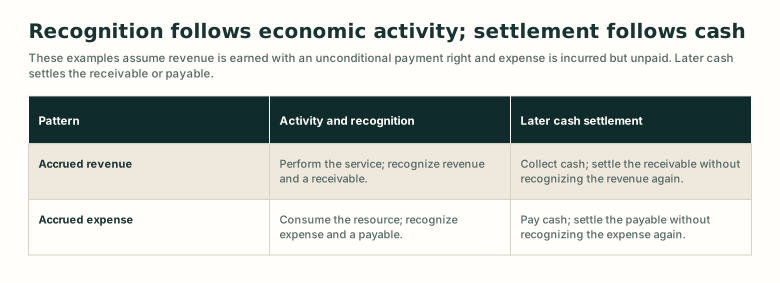
Accrual recognition and cash settlement occupy different clocks
Detailed visual description
For accrued revenue, performing the service creates revenue and a receivable; later collection settles the receivable. For accrued expense, consuming the resource creates expense and a payable; later payment settles the payable. Neither later cash event repeats the earlier revenue or expense recognition.
Put the concept to work
Understand this concept
- Explain why revenue and expense recognition can precede or follow the related cash receipt or payment under accrual-basis accounting.
Analyze this concept
- Analyze a basic fact pattern to separate the period of economic activity from the dates of billing, collection, and payment.
Learning resources
Choose a lesson, try an application, or inspect the sources behind this concept.
Build on these ideas
- Accounting transaction — Apply
To analyze this concept: Required. The learner must identify the event or condition and its effects before assigning them to a reporting period.
- Accrual-basis accounting — Understand
To analyze this concept: Required. Period analysis depends on understanding that cash timing is evidence but not the recognition rule.
- Expense — Understand
To understand this concept: Required. Expense must be understood as consumption or another equity-decreasing effect rather than a synonym for cash payment.
Show 1 more prerequisites
- Revenue — Understand
To understand this concept: Required. Revenue must be understood as a performance-related change rather than a synonym for cash receipt.
Lessons
Worked examples and cases
Practice
Common mistaken ideas
- Mistaken idea: An adjusting entry requires cash to move
- Mistaken idea: Every cash receipt is revenue
- Mistaken idea: Net income equals operating cash flow
Show 1 more mistaken ideas
Sources
Related concepts
Use this idea next
- Accounting estimate — Understand
Required level here: understand. Required. Accrual-basis reporting can require amounts before final settlement or complete future outcomes are known.
- Accounts payable — Analyze
Required level here: analyze. Required. Cost recognition or asset receipt and payment can occur on different dates.
- Accounts receivable — Analyze
Required level here: analyze. Required. The revenue and cash dates can differ without changing the validity of either supported event.
Show 10 more next steps
- Accrual-basis accounting — Analyze
Required level here: understand. Required. Period analysis depends on understanding that cash timing is evidence but not the recognition rule.
- Accrued expense — Understand
Required level here: understand. Required. Recognition precedes settlement because the consumption or obligation belongs in the current period.
- Accrued revenue — Understand
Required level here: understand. Required. Recognition precedes settlement because the performance belongs in the current period.
- Adjusting entry — Understand
Required level here: understand. Required. The purpose of the update follows from recognizing economic activity in the appropriate period.
- Cash basis accounting — Understand
Required level here: understand. Required. The cash basis is defined by what the accrual basis does differently.
- Cash — Analyze
Required level here: understand. Required. Noncash recognition and timing differences must not be inserted into a Cash rollforward.
- Deferral — Understand
Required level here: understand. Required. A deferral is one cash-versus-economic-activity timing pattern within accrual-basis accounting.
- Expense recognition and matching — Understand
Required level here: understand. Required. Accrual accounting separates economic timing from settlement timing.
- Operating cash flow — Understand
Required level here: understand. Required. The distinction between recognition and cash timing explains why operating cash flow can differ from net income.
- Operating cycle — Analyze
Required level here: understand. Helpful. Recognition, settlement, and cash collection can occur at different points in the operating cycle.
Used in these readings
These chapters explain or apply this concept. The label states how the chapter uses it.