On this page
The accounting cycle connects transaction records with period-end financial statements. Each stage records, organizes, or checks information used in the next stage.
A foundational sequence
A simplified period can be organized as:
- Analyze transactions.
- Record journal entries.
- Post to ledger accounts.
- Compile the unadjusted trial balance.
- Record adjusting entries.
- Complete the adjusted trial balance.
- Prepare the financial statements.
- Record closing entries.
- Verify the post-closing trial balance.
Systems can automate or combine steps, and organizations can use different workflows. Posting, for example, may occur immediately when an entry is accepted, and a configured system may generate closing entries. The logical distinctions remain: an entry is not a ledger, a trial balance is not a statement, and closing is not the same as deleting history.
Why the period boundary matters
Cash and performance do not always share a date. Resources can be consumed before payment, customers can pay before performance, estimates can change, and some activity becomes visible only through period-end analysis. The cycle creates a deliberate checkpoint for these facts before statements are issued.
Without that checkpoint, a perfectly balanced ledger can report the wrong period's revenue, expense, assets, or liabilities. Balance and cutoff answer different questions. Here, cutoff means assigning transactions to the correct reporting period.
Controls link the stages
Review an entry against its supporting documents. Trace each posting to that entry, compare account balances with supporting records, and check the amounts shared across statements. Retain the original entries and later corrections. No single check proves that the entire cycle worked.
The sequence also supports correction. If a statement amount is questionable, a reviewer can trace it to ledger accounts, posted lines, source entries, and underlying evidence. That path can show where the reasoning or transfer failed.
Continuous systems still have reporting cycles
Cloud and enterprise systems can record and post continuously. That does not eliminate reporting periods or the need to review estimates, transaction dates, account balances, and notes at defined dates. “Real time” describes processing speed, not automatic reporting correctness.
Identify which version you are using
An unadjusted trial balance can differ from an adjusted one because period-end entries have changed the accounts. A post-closing trial balance omits the temporary balances that were transferred to equity. Identify which stage produced a report before comparing its amounts with another version.
Boundaries
The sequence is a foundational model, not one mandatory software workflow. Industry, jurisdiction, entity complexity, reporting frequency, consolidation, and control design can add or reorganize steps. The labels and evidence for the actual process should be explicit.
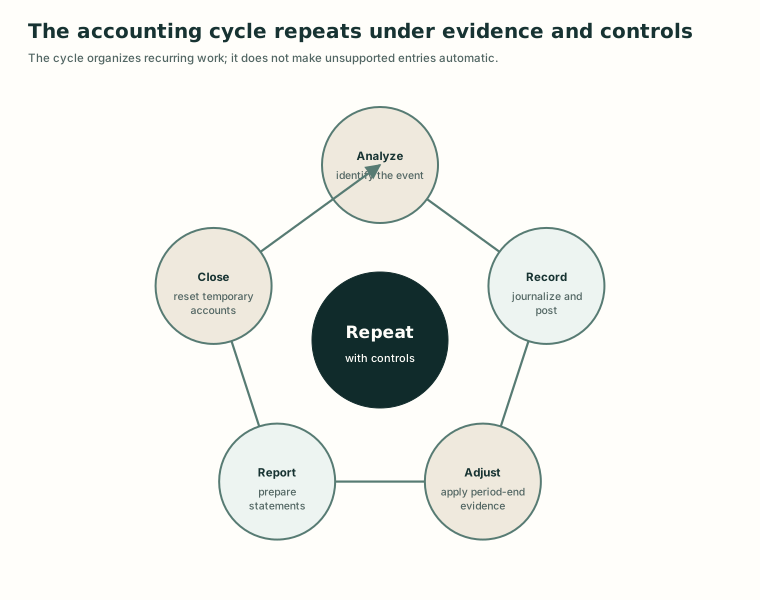
The accounting cycle as a controlled loop
Detailed visual description
The circular sequence begins with analyzing supported events, then recording and posting, applying period-end adjustments, preparing reports, and closing temporary accounts before the next period.
Put the concept to work
Understand this concept
- Explain how journalizing, posting, trial balances, adjustments, statements, and closing form linked period controls rather than interchangeable reports.
Learning resources
Choose a lesson, try an application, or inspect the sources behind this concept.
Build on these ideas
- Accounting transaction — Apply
To understand this concept: Required. The cycle begins with accepted analysis of events and conditions affecting the entity.
- Journal entry — Apply
To understand this concept: Required. Analyzed effects enter the records through balanced and supported entries.
- Posting — Understand
To understand this concept: Required. Journal activity must accumulate in accounts before balances can support period-end work.
Show 1 more prerequisites
- Trial balance — Understand
To understand this concept: Required. Trial balances are named checkpoints before and after later period-end procedures.
Lessons
Worked examples and cases
Practice
Common mistaken ideas
Sources
Related concepts
Use this idea next
- Accounting estimate — Understand
Required level here: understand. Required. Period-end reporting includes information and judgments not fully captured by routine cash and transaction processing.
- Adjusting entry — Understand
Required level here: understand. Required. An adjusting entry must be located between the unadjusted and adjusted reporting checkpoints.
- Closing entry — Understand
Required level here: understand. Required. Closing occurs after adjusted balances and statements in the period-control sequence.
Show 2 more next steps
- Financial statements — Understand
Required level here: understand. Required. The statement set follows adjusted account balances and precedes or accompanies later closing and publication steps.
- Internal control over financial reporting — Understand
Required level here: understand. Required. Controls operate across transaction authorization, recording, adjustment, close, and reporting processes.
Used in these readings
These chapters explain or apply this concept. The label states how the chapter uses it.