On this page
The general ledger organizes recorded amounts by account. It contains the posted history and balance of Cash, Receivables, Equipment, Payables, Equity, Revenue, Expense, and every other account in the entity's chart of accounts.
From journal sequence to account sequence
A journal can show an owner contribution, equipment purchase, customer service, collection, and utility payment in chronological order. The general ledger reorganizes their lines so all Cash effects appear together, all Accounts Receivable effects appear together, and so on.
For a debit-normal account, a basic rollforward is:
Opening balance + posted debits − posted credits = ending balance
For a credit-normal account, credits ordinarily increase and debits decrease the normal balance. The arithmetic follows the account's normal side; the ledger retains the individual lines that explain the result.
A balance is a compressed history
With no opening Cash balance, $30,000 of receipts less $10,500 of payments leaves $19,500. That ending balance alone does not show the $30,000 of receipts and $10,500 of payments. The balance is a position at a date. Posted debits and credits are activity during a period. A reader needs both to explain how the position changed.
This difference matters in finance as much as bookkeeping. Balance-sheet amounts are stocks at a point in time; revenue, expense, and many cash-flow measures are flows over a period. The ledger connects those views but does not make them interchangeable.
General and subsidiary detail
The general ledger may contain a control account such as Accounts Receivable, while a subsidiary ledger retains balances by customer. The control total and subsidiary detail should reconcile. Similar structures can support payables, inventory, fixed assets, payroll, and other high-volume areas.
The existence of subsidiary detail does not turn the general ledger into an approximation. It establishes different levels of aggregation with a required control relationship.
Entity, period, currency, and dimensions
Modern ledgers can attach dimensions such as legal entity, currency, cost center, and counterparty to a line. Those fields support consolidation and analysis, but their presence does not change the basic account identity or debit-credit effect.
A finance analyst joining ledger data must preserve these dimensions. If two
entities both use account 1000 for Cash, joining only on account code combines
balances belonging to different reporting entities. If currency is also lost,
equal-looking amounts may not even share a unit. A mechanically balanced
dataset can therefore be analytically incoherent after a bad join.
Boundaries
The general ledger is not the same as the journal, trial balance, subsidiary ledger, or published financial statements. It is the central account-level record from which those views are connected or derived. Its balances still depend on complete, authorized, correctly classified, and properly posted entries.
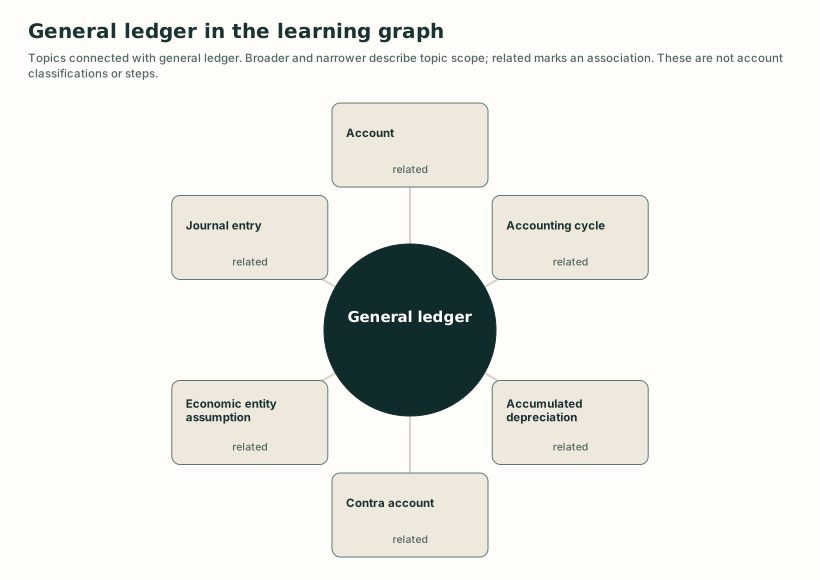
General ledger in the learning graph
Detailed visual description
A structural map places General ledger at the center and connects it to related concepts, prerequisite concepts, or lessons from the knowledge graph. Edge labels distinguish broader, narrower, related, prerequisite, and teaching relationships where present.
Put the concept to work
Understand this concept
- Explain how the general ledger organizes posted activity and balances by account while retaining links to journal entries.
Apply this concept
- Compute and explain a basic account rollforward from opening balance through posted debits and credits to ending balance.
Learning resources
Choose a lesson, try an application, or inspect the sources behind this concept.
Build on these ideas
- Account — Understand
To understand this concept: Required. The ledger is an organized collection of accounts rather than a single undifferentiated balance.
- General ledger — Understand
To apply this concept: Required. A rollforward requires understanding the ledger as an account-oriented accumulation.
- Journal entry — Understand
To understand this concept: Required. Posted ledger lines originate in dated entries and remain traceable to them.
Show 1 more prerequisites
- Posting — Apply
To apply this concept: Required. The activity must be transferred to the correct account and side before its balance can be computed.
Lessons
Worked examples and cases
Practice
- Compute the ending trial-balance totals
- Ending balance in Accounts Receivable
- Post 3 entries to Cash
Show 1 more practice items
Common mistaken ideas
Sources
Related concepts
Show 9 more related concepts
Use this idea next
- Accounts payable — Analyze
Required level here: apply. Required. Opening balance and gross credits and debits explain the account movement.
- Accounts receivable — Analyze
Required level here: apply. Required. Opening balance and period debits and credits provide the account-level movement.
- Accumulated depreciation — Analyze
Required level here: apply. Required. The cumulative contra balance must be reconciled from opening balance through current-period activity and other supported changes.
Show 7 more next steps
- Changes in operating assets and liabilities — Analyze
Required level here: apply. Required. Opening balance, gross activity, and ending balance provide the evidence behind each net movement.
- General ledger — Apply
Required level here: understand. Required. A rollforward requires understanding the ledger as an account-oriented accumulation.
- Inventory — Analyze
Required level here: apply. Required. Opening balance and gross additions and reductions explain the net balance movement.
- Recording error — Apply
Required level here: apply. Required. A correction is posted to the same accounts the error reached.
- Retained earnings — Analyze
Required level here: apply. Required. Opening balance and closing activity must reconcile to the ending continuing account.
- Trial balance — Analyze
Required level here: apply. Required. Account rollforwards provide the activity evidence needed to investigate ending balances.
- Trial balance — Understand
Required level here: understand. Required. The trial balance summarizes ending balances drawn from the ledger accounts.
Used in these readings
These chapters explain or apply this concept. The label states how the chapter uses it.