On this page
Changes in operating accounts explain timing and measurement gaps; they are not cash flows merely because a balance rose or fell. Start with the account's rollforward, identify which accrual-basis amount affected net income, and solve for the related cash activity under a clearly bounded set of facts.
Derive the signs from two rollforwards
For a simple trade receivable with no write-offs or other movements:
Opening Accounts Receivable + credit revenue − customer collections
= ending Accounts Receivable
If Accounts Receivable increases $2,000, recognized credit revenue exceeded collections by $2,000. Revenue is already in net income, so subtract the $2,000 increase to reach the lower cash amount.
For a simple trade payable:
Opening Accounts Payable + credit purchases or costs − supplier payments
= ending Accounts Payable
If Accounts Payable increases $1,000, payment was $1,000 lower than the credit amount included in the bounded accrual path. Add the $1,000 increase when bridging from net income to cash.
This logic produces the introductory pattern:
| Bounded operating balance | Increase | Decrease |
|---|---|---|
| Asset | Subtract | Add |
| Liability | Add | Subtract |
The table is a result of the rollforwards, not a substitute for them. Before using a sign from the table, name the account, write its cash-versus-accrual path, and verify that its change contains no excluded noncash movement.
Inventory needs both sides of the operating chain
An Inventory increase is subtracted in this bounded indirect reconciliation. More operating cost remains in the asset instead of passing through the simplified accrual-to-cash bridge. The increase does not equal purchases or cash paid for inventory. Accounts Payable and other supplier balances help explain why purchases and payments differ.
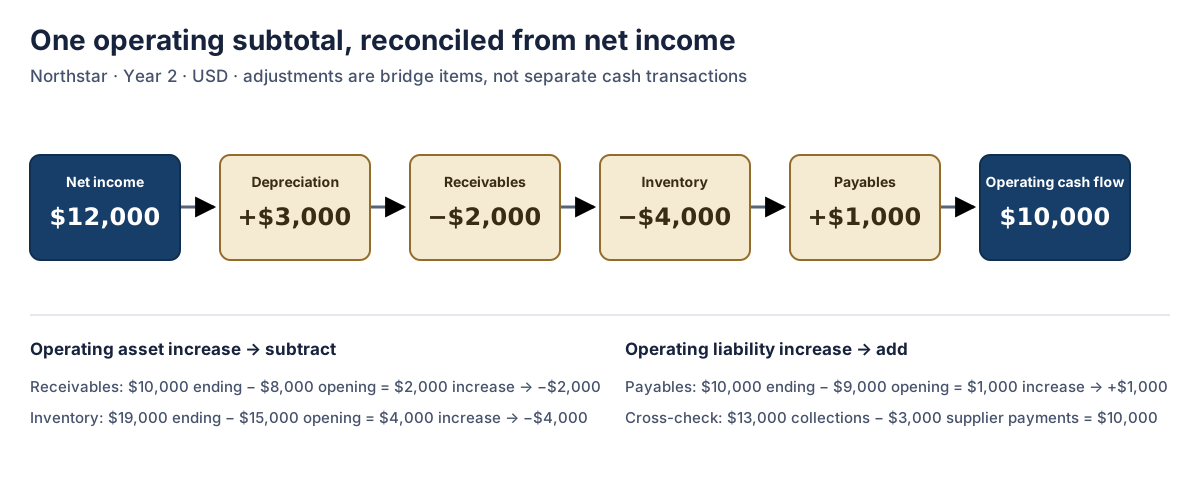
Northstar's $4,000 Inventory increase and $1,000 Accounts Payable increase produce a net negative $3,000 adjustment under the stated facts. The result does not claim that Northstar paid exactly $4,000 or borrowed $1,000.
Net changes can conceal noncash movements
A receivable can change through write-offs, acquisitions, disposals, returns, foreign-currency translation, or reclassification. Inventory can change through write-downs or business combinations. A payable can move through supplier- finance classification or noncash settlement. If those effects are present, opening minus ending alone does not isolate an operating cash difference.
The accounting learner should reconcile the subsidiary and general ledgers. The finance learner should ask whether the published adjustment represents cash conversion, business growth, shrinking activity, collection pressure, delayed payments, or a scope change. The same sign can arise from different economics.
Boundaries
This foundation uses ordinary trade Accounts Receivable, merchandise Inventory, and Accounts Payable. It excludes taxes, interest, contract balances, prepayments, accrued compensation, acquisitions, disposals, write-offs, currency effects, and classification changes. “Working capital” in an indirect-method disclosure may not match the current-assets-minus-current-liabilities metric, so the included accounts and framework must be explicit.
Follow the reconciliation authority
ASC 230-10-45-28 requires an indirect presentation to adjust net income for deferrals, accruals, and specified other items. Those adjustments explain its difference from operating cash flow. ASC 230-10-45-29 requires major classes of reconciling items to be shown separately. Its minimum classes include changes in operating receivables, inventory, and payables. These requirements do not make every balance change a cash adjustment. The account rollforward must first exclude movements outside the stated reconciliation.
Northstar indirect operating cash-flow bridge
Detailed visual description
The first dark box is $12,000 net income. Four light adjustment boxes follow: positive $3,000 depreciation, negative $2,000 Receivables, negative $4,000 Inventory, and positive $1,000 Payables. The final dark box is $10,000 operating cash flow. Notes below derive the asset-increase subtraction and liability-increase addition from opening and ending balances and show the $13,000 collections less $3,000 supplier-payments direct cross-check.
Put the concept to work
Understand this concept
- Explain from account rollforwards why an increase in a bounded operating asset is subtracted and an increase in a bounded operating liability is added when reconciling net income to operating cash flow.
Analyze this concept
- Compute signed operating-balance adjustments from opening and ending balances and diagnose when acquisitions, write-offs, reclassifications, foreign-currency effects, or other noncash and scope changes make a net-change shortcut incomplete.
Learning resources
Choose a lesson, try an application, or inspect the sources behind this concept.
Build on these ideas
- Accounts payable — Analyze
To understand this concept: Required. The payable rollforward connects credit purchases or costs with supplier payments and the ending obligation.
- Accounts receivable — Analyze
To understand this concept: Required. The receivable rollforward connects recognized customer revenue with collections and the ending claim.
- Changes in operating assets and liabilities — Understand
To analyze this concept: Required. The sign must follow the account's cash-versus-accrual bridge rather than an isolated mnemonic.
Show 3 more prerequisites
- General ledger — Apply
To analyze this concept: Required. Opening balance, gross activity, and ending balance provide the evidence behind each net movement.
- Inventory — Analyze
To understand this concept: Required. The inventory rollforward separates the net asset movement from gross purchases and supplier settlement.
- Statement of cash flows — Apply
To analyze this concept: Required. The adjustments belong inside a prepared operating reconciliation, not a balance-sheet ratio calculation.
Lessons
Worked examples and cases
Practice
Common mistaken ideas
Sources
Standard references
Related concepts
Show 4 more related concepts
Use this idea next
- Changes in operating assets and liabilities — Analyze
Required level here: understand. Required. The sign must follow the account's cash-versus-accrual bridge rather than an isolated mnemonic.
- Indirect method — Apply
Required level here: analyze. Required. Signed balance adjustments require classified opening and ending balances plus scope controls.