On this page
The indirect method explains why an accrual-basis performance subtotal differs from an operating cash subtotal. It does not convert every income-statement line into cash, and its adjustments are not additional receipts or payments.
Read the bridge in layers
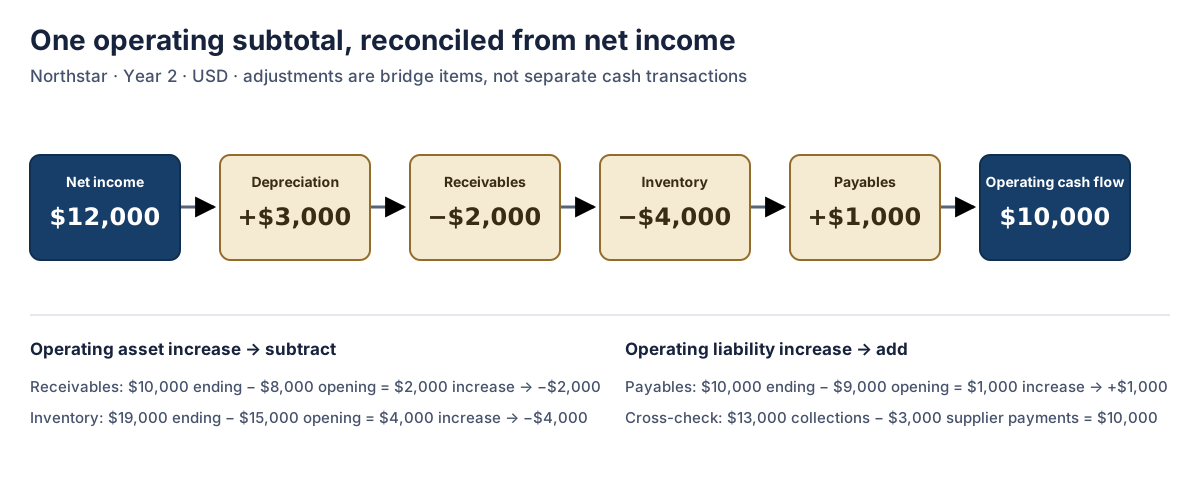
Northstar's bounded Year 2 reconciliation has three layers. Read the complete bridge first as a map; the paragraphs that follow unpack why each sign belongs:
$12,000 net income
+  3,000 noncash depreciation expense
−  2,000 increase in Accounts Receivable
−  4,000 increase in Inventory
+  1,000 increase in Accounts Payable
= $10,000 net cash provided by operating activities
Net income is the starting accrual-basis result. Adding depreciation removes its negative current-period income effect from the bridge because the allocation did not itself use current-period Cash. The three operating-balance adjustments then translate stipulated timing differences. They sum to negative $5,000, so the full bridge is $12,000 + $3,000 − $5,000 = $10,000.
An addback does not undo the accounting
The $3,000 depreciation expense remains in net income, and accumulated depreciation remains in the balance sheet. The indirect addback does not reverse the entry or create $3,000 Cash. Cash paid to acquire equipment belongs to the acquisition period and, under the bounded facts, the investing section.
Other reconciliations can adjust gains, losses, impairment, deferred taxes, equity-method effects, stock compensation, or other items. Their signs require analysis of how the item entered net income and where any cash effect belongs; “noncash means add” is not a valid universal rule. For example, an asset-sale gain is already included in net income while the full cash proceeds belong in the applicable cash-flow section. Removing the gain's income effect keeps part of an investing result out of the operating subtotal. A later disposal wave will develop the complete entry and cash path.
Cross-check, do not double count
If same-entity, same-period direct evidence reports $13,000 customer collections and $3,000 of supplier, employee, and other operating payments, it yields the same $10,000 operating subtotal. Agreement is a useful cross-check. Presenting both $10,000 totals as separate operating cash sources would double count one subtotal described by two methods.
The reconciliation also does not replace investing and financing sections. A depreciation addback is not an investing inflow, and a payable increase is not a financing receipt.
Use the reconciliation analytically
For accounting students, every adjustment should map to a supported account rollforward and the income effects already included in net income. For finance students, the bridge opens questions about cash conversion. Receivable growth may reflect sales growth or collection weakness. Inventory growth may support demand or signal slow movement. Payables growth may reflect volume, terms, or payment pressure. Direction alone does not settle quality or sustainability.
Boundaries
This introductory bridge stipulates one depreciation amount and three ordinary operating balances. It excludes gains and losses, taxes, interest, contract and prepaid balances, provisions, stock compensation, leases, acquisitions, disposals, foreign-currency effects, restricted cash, and framework-specific classification questions. A complete statement requires current guidance and the entity's actual account mappings.
Follow the reconciliation authority
ASC 230-10-45-28 requires an indirect operating presentation to reconcile net income to operating cash flow. The adjustments cover deferrals, accruals, and items tied to investing or financing cash effects. ASC 230-10-45-29 requires the major reconciling classes to appear separately. These requirements support the bridge. They do not make an addback a second source of cash.
Northstar indirect operating cash-flow bridge
Detailed visual description
The first dark box is $12,000 net income. Four light adjustment boxes follow: positive $3,000 depreciation, negative $2,000 Receivables, negative $4,000 Inventory, and positive $1,000 Payables. The final dark box is $10,000 operating cash flow. Notes below derive the asset-increase subtraction and liability-increase addition from opening and ending balances and show the $13,000 collections less $3,000 supplier-payments direct cross-check.
Put the concept to work
Understand this concept
- Explain how the indirect method bridges net income to operating cash flow while preserving the distinction between reconciliation adjustments and the investing or financing cash flows to which some items relate.
Apply this concept
- Prepare a bounded indirect-method operating cash-flow reconciliation from net income, noncash depreciation, and opening-to-ending operating balances, then cross-check it against same-scope direct operating cash evidence.
Learning resources
Choose a lesson, try an application, or inspect the sources behind this concept.
Build on these ideas
- Changes in operating assets and liabilities — Analyze
To apply this concept: Required. Signed balance adjustments require classified opening and ending balances plus scope controls.
- Depreciation — Apply
To apply this concept: Required. A supported noncash expense illustrates removal of a current-period income effect without inventing Cash.
- Indirect method — Understand
To apply this concept: Required. Preparation must preserve each adjustment's role in a bridge rather than treating adjustments as new transactions.
Show 4 more prerequisites
- Net income — Analyze
To apply this concept: Required. The starting amount must be a supported period result with known included effects.
- Net income — Understand
To understand this concept: Required. The reconciliation begins with an accrual-basis performance result rather than a Cash balance.
- Operating cash flow — Understand
To understand this concept: Required. The target is a classified operating cash subtotal, not total cash change.
- Statement of cash flows — Apply
To understand this concept: Required. The operating reconciliation sits within a statement whose other sections and ending-Cash tie remain intact.
Lessons
Worked examples and cases
- Derecognize a delivery vehicle and trace the sale
- One operating subtotal through two presentation paths
- Reconcile operating cash before judging income conversion
Show 1 more examples and cases
Practice
Common mistaken ideas
- Mistaken idea: An operating-asset increase is a cash inflow
- Mistaken idea: Cash above income proves earnings quality
- Mistaken idea: Net income equals operating cash flow
Show 1 more mistaken ideas
Sources
Standard references
Related concepts
Use this idea next
- Direct–indirect operating cross-check — Understand
Required level here: apply. Required. The learner can already prepare a bounded indirect reconciliation.
- Gain or loss on disposal — Analyze
Required level here: understand. Required. The learner must understand why removing a gain from the operating bridge is not reversing the sale or its cash.
- Indirect method — Apply
Required level here: understand. Required. Preparation must preserve each adjustment's role in a bridge rather than treating adjustments as new transactions.
Show 1 more next steps
- Operating cash-to-income comparison — Analyze
Required level here: apply. Required. The bridge explains how noncash income effects and operating balances create the difference.