On this page
Depreciation allocates an asset's depreciable cost over its useful life. It is not an appraisal of the asset's current selling price.
Calculate a straight-line amount
In this standalone example, Alder Services acquires equipment for $36,000. Estimated residual value, the amount expected to remain at the end of use, is $6,000. The equipment is ready for use at the start of the year. Its estimated useful life is five years, with benefits provided evenly. Assume no impairment, disposal, or estimate changes.
$36,000 cost - $6,000 residual value = $30,000 depreciable cost.
$30,000 ÷ 5 years = $6,000 annual depreciation.
After one full year, accumulated depreciation is $6,000 and carrying amount is $36,000 - $6,000 = $30,000. After three full years, accumulated depreciation is 3 × $6,000 = $18,000 and carrying amount is $36,000 - $18,000 = $18,000.
Carrying amount means the reported asset amount after applicable adjustments. In this example it is cost less accumulated depreciation.
Record the annual expense
Assume the equipment is used in administrative work, so depreciation is reported as current-period expense:
The Equipment cost account stays at $36,000. Accumulated Depreciation is a contra-asset account, an account deducted from the related asset to show its carrying amount. Cash does not change.
Interpret the result carefully
The $30,000 first-year carrying amount does not establish a $30,000 selling price or a particular degree of physical wear. The schedule allocates cost using estimates; actual use and market conditions may differ.
Recording depreciation also does not set aside cash for replacement. Buying another machine and financing that purchase are separate decisions. Production equipment can have depreciation included in inventory cost before expense recognition; the administrative-use assumption keeps this example focused on the basic entry.
Depreciation in the learning graph
Detailed visual description
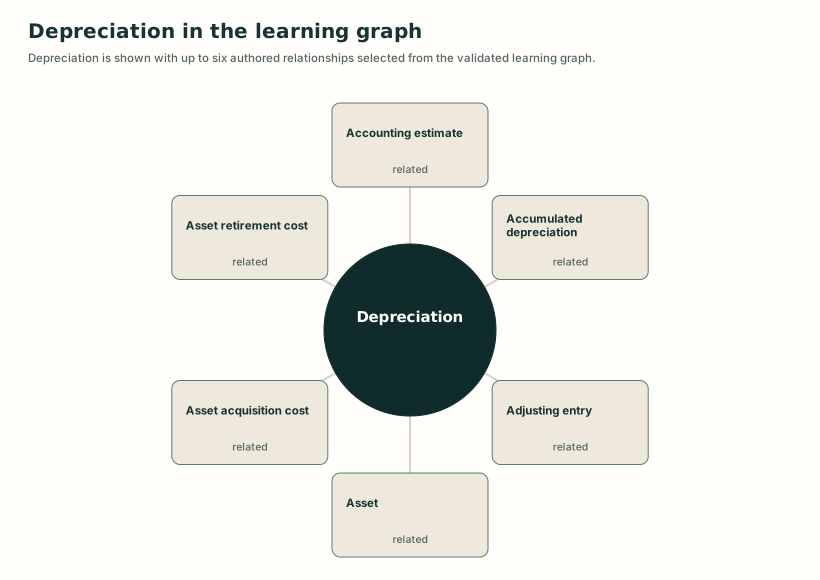
A structural map places Depreciation at the center and connects it to related concepts, prerequisite concepts, or lessons from the knowledge graph. Edge labels distinguish broader, narrower, related, prerequisite, and teaching relationships where present.
Put the concept to work
Understand this concept
- Explain depreciation as systematic cost allocation rather than direct measurement of market value, physical condition, or cash accumulation.
Apply this concept
- Compute and explain a basic straight-line depreciation schedule from cost, residual value, useful-life periods, and elapsed periods.
Learning resources
Choose a lesson, try an application, or inspect the sources behind this concept.
Build on these ideas
- Accounting estimate — Analyze
To apply this concept: Required. The learner must identify how useful life and residual value drive the computed amount.
- Accounting estimate — Understand
To understand this concept: Required. Useful life, residual value, and service pattern rely on supported estimates and method selection.
- Asset — Apply
To understand this concept: Required. The asset and its future service potential must be identified before allocating a depreciable amount.
Show 2 more prerequisites
- Depreciation — Understand
To apply this concept: Required. The formula must be interpreted as allocation over service periods rather than a price forecast.
- Expense — Understand
To understand this concept: Required. Periodic depreciation is an expense effect even though the acquisition cash flow occurred earlier.
Lessons
Worked examples and cases
Practice
Common mistaken ideas
Sources
More specific topics
Show 1 more more specific topics
Related concepts
Show 16 more related concepts
- Asset
- Asset acquisition cost
- Asset retirement cost
- Building
- Change in accounting estimate
- Depletion
- Expense
- Held-for-sale long-lived asset
- Indirect method
- Investing cash flow
- Land
- Land improvement
- Long-lived asset impairment
- Lump-sum asset acquisition
- Self-constructed asset
- Subsequent expenditure on property, plant, and equipment
Use this idea next
- Accumulated depreciation — Understand
Required level here: understand. Required. The contra balance accumulates prior periodic allocations rather than independent obligations or cash.
- Building — Understand
Required level here: understand. Required. Unlike land, the account is depreciated.
- Change in accounting estimate — Apply
Required level here: apply. Required. The learner reuses straight-line allocation after revising its remaining inputs.
Show 12 more next steps
- Change in accounting estimate — Understand
Required level here: understand. Helpful. Useful life and residual value provide a concrete estimate context without requiring a specialized valuation model.
- Depreciation method — Apply
Required level here: apply. Required. All schedules must preserve depreciable amount and carrying-amount controls.
- Depreciation method — Understand
Required level here: understand. Required. Method selection makes sense only after depreciation is understood as allocation rather than valuation.
- Depreciation — Apply
Required level here: understand. Required. The formula must be interpreted as allocation over service periods rather than a price forecast.
- Indirect method — Apply
Required level here: apply. Required. A supported noncash expense illustrates removal of a current-period income effect without inventing Cash.
- Investing cash flow — Apply
Required level here: understand. Helpful. Separating the acquisition cash flow from later cost allocation prevents depreciation from being presented as a current cash payment.
- Land improvement — Apply
Required level here: apply. Required. The improvements are depreciated like any other limited-life asset.
- Land — Understand
Required level here: understand. Required. The exception from depreciation is part of what defines the account.
- Long-lived asset impairment — Understand
Required level here: understand. Required. Impairment must not be mistaken for the routine systematic allocation already reflected in carrying amount.
- Partial-period depreciation — Understand
Required level here: understand. Required. The learner applies the allocation model to a fractional reporting period.
- Salvage value — Understand
Required level here: understand. Required. Salvage bounds the amount that gets allocated.
- Useful life — Understand
Required level here: understand. Required. A life is the period cost is allocated over.
Used in these readings
These chapters explain or apply this concept. The label states how the chapter uses it.