On this page
Expense is not accounting's word for “cash went down.” A cash payment can buy equipment, settle a payable, repay loan principal, or distribute resources to an owner. It can also pay for a service used in the current period. Under the stated facts, only that last payment records a current expense.
Resource use and obligations incurred
In the conceptual model, expense results from delivering or producing goods, rendering services, or carrying out other activities. It can appear as an asset being used or flowing out, a liability being incurred, or both. Expense therefore describes the activity-related source of a decrease in equity, while the affected asset or liability describes how that decrease enters the financial position.
Suppose a company uses $600 of electricity during March and pays the bill in March. Cash falls and expense reduces equity. If the company will pay in April, the March activity can instead create an obligation and expense under the stated recognition assumptions. The resource use is associated with March even though cash moves later.
Contrast a $600 cash payment for supplies that remain unused. Cash falls, but another asset rises. The company changed the form of its resources rather than using them in the activity described. When the supplies are later consumed, the accounting analysis changes. The acquisition date and expense date need not be the same.
Payment can settle an earlier event
Paying a liability usually removes an obligation recognized from an earlier event. If the company recorded March electricity expense and a payable, the April payment reduces Cash and Accounts Payable. Recording expense again in April would duplicate the cost and place it in two periods.
The same reasoning separates an expense from a distribution to an owner. A distribution reduces assets and equity, but the owner receives resources in the capacity of owner. It is not a cost of delivering goods, rendering services, or carrying out the entity's activities.
Why the distinction matters
The difference supports accruals, prepayments, depreciation, cost allocation, and closing entries. It also explains why a capital expenditure is not the same as an expense and why cash paid can differ from reported expense. For example, a company can use electricity in March and pay for it in April.
The distinction also prevents a weak analytical shortcut. A fall in cash does not tell a reader whether the entity consumed resources, acquired another asset, reduced leverage, or returned capital to owners. Those paths have different implications for performance and future cash flows.
Compare expense with revenue
Revenue and expense both describe performance-related changes in assets or liabilities. Revenue identifies an increase in assets or a decrease in liabilities from the entity's activities. Expense identifies a decrease in assets or an increase in liabilities from those activities.
The two elements need not arise in equal amounts or at the same time. Their relationship also does not require one revenue entry to be paired with one expense entry. Recognition and measurement follow the facts and the applicable guidance for each element.
Boundaries
This concept does not decide whether a particular cost is capitalized, expensed, allocated across periods, or excluded from the current measurement. Those questions require the applicable authoritative requirements and facts. It also does not cover every loss or other decrease in equity. The concept supplies the basic element distinction needed before those rules can be applied.
Sources and currency
The definition follows FASB Concepts Statement No. 8, Chapter 4. The Concepts Statement is nonauthoritative. Standards-dependent recognition, measurement, and presentation require current authoritative guidance.
Compensation or distribution
Detailed visual description
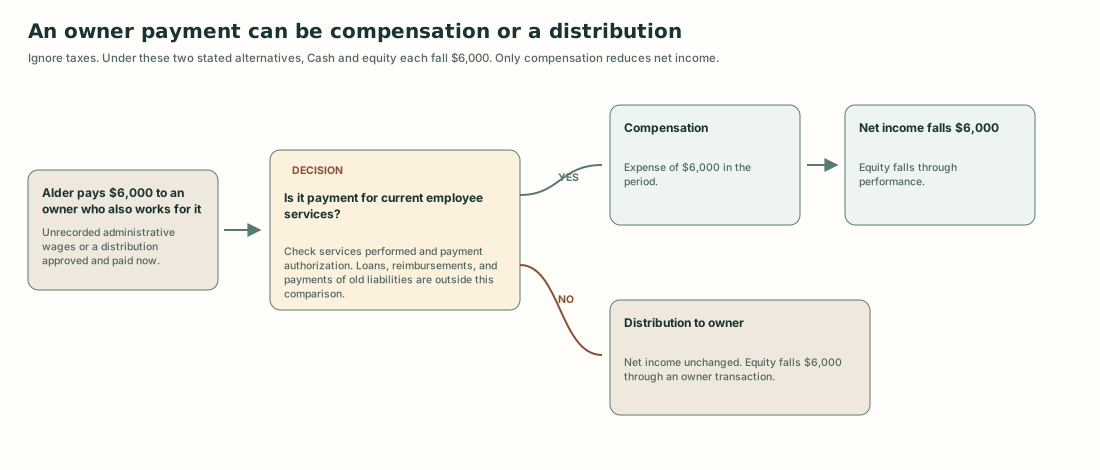
Alder pays an owner who also works for the company. The comparison is limited to two previously unrecorded events: current administrative wages, or a distribution approved and paid now. Ignore taxes. Compensation creates $6,000 expense, reducing income and equity by $6,000. A distribution reduces equity by $6,000 without reducing income. Both reduce Cash by $6,000. Loans, reimbursements, capitalized employee costs, and settlement of previously recorded liabilities require different analysis.
Expense in the learning graph
Detailed visual description
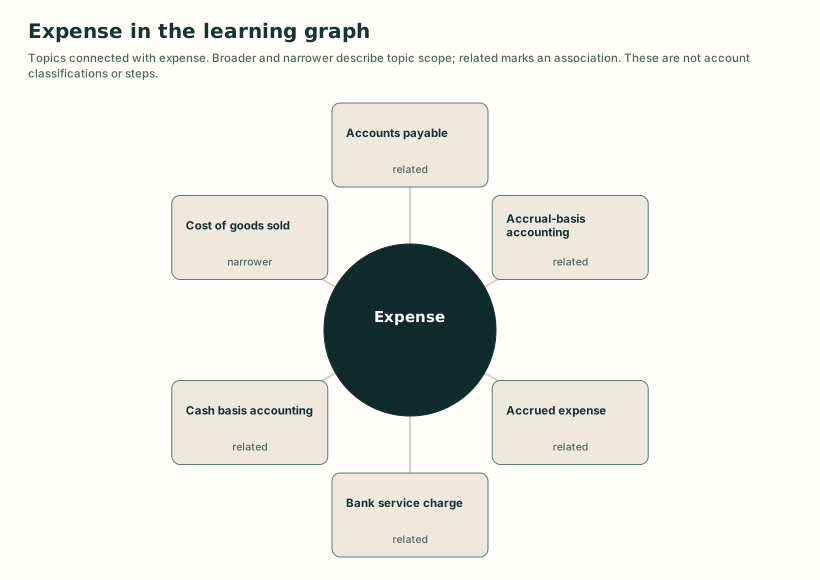
A structural map places Expense at the center and connects it to related concepts, prerequisite concepts, or lessons from the knowledge graph. Edge labels distinguish broader, narrower, related, prerequisite, and teaching relationships where present.
Record the activity and the later cash event
Detailed visual description
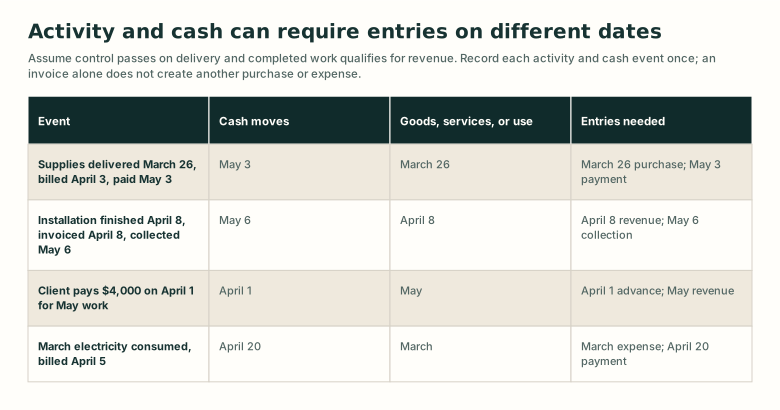
Four standalone timing examples assume qualifying recognition and control on delivery. Supplies received March 26 are recorded then; payment May 3 settles the payable. Installation completed and billed April 8 creates revenue and a receivable; May 6 collection settles it. A $4,000 April 1 advance creates a liability; May work earns the revenue. March electricity creates expense and a payable; April 20 payment settles it. Every row includes separate accounting for the activity and cash event.
What changes equity
Detailed visual description
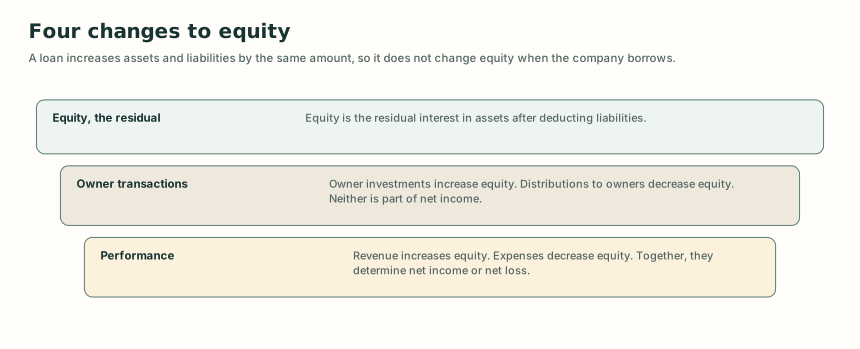
Three nested rectangles show equity and the two sources that change it. Owner investments increase equity, and owner distributions decrease it. Revenue increases equity, and expenses decrease it. Borrowing increases assets and liabilities by equal amounts, so it does not change equity when the loan begins.
Put the concept to work
Understand this concept
- Explain why expense reflects activities that use assets or incur liabilities rather than every payment, asset purchase, or owner distribution.
Apply this concept
- Classify basic expense effects when resource use and cash payment occur together or at different times.
Learning resources
Choose a lesson, try an application, or inspect the sources behind this concept.
Build on these ideas
- Accounting transaction — Understand
To apply this concept: Required. The learner must identify what was consumed or incurred before selecting the expense effect.
- Asset — Understand
To understand this concept: Required. The learner must distinguish acquiring or exchanging a resource from using one in the entity's activities.
- Equity — Understand
To understand this concept: Required. Expense reduces the residual through performance rather than through an owner distribution.
Show 2 more prerequisites
- Expense — Understand
To apply this concept: Required. Application depends on separating resource use from the timing and purpose of cash payment.
- Liability — Understand
To understand this concept: Helpful. An expense can arise through an incurred obligation before the related cash payment.
Lessons
Worked examples and cases
- A five-year straight-line depreciation schedule
- Classify five cash transactions
- When to record routine transactions
Show 1 more examples and cases
Practice
Common mistaken ideas
Sources
Broader topics
More specific topics
Show 16 more more specific topics
- Depletion
- Equity-classified share award
- Graded vesting
- Grant-date fair value
- Liability-classified share award
- Market condition on a share award
- Net periodic pension cost
- Net periodic postretirement benefit cost
- Performance condition on a share award
- Requisite service period
- Research and development cost
- Service condition
- Share-award forfeiture
- Share-award modification
- Share-based payment award
- Unrecognized compensation cost
Related concepts
Show 16 more related concepts
Use this idea next
- Accrual-basis accounting — Understand
Required level here: understand. Required. Expense must be understood as consumption or another equity-decreasing effect rather than a synonym for cash payment.
- Accrued expense — Understand
Required level here: understand. Required. The learner must distinguish current-period consumption from cash payment.
- Bank service charge — Understand
Required level here: understand. Required. The charge is an expense of the period the bank levied it in.
Show 15 more next steps
- Cost of goods sold — Understand
Required level here: understand. Required. The transfer affects period performance rather than representing an asset purchase or cash payment by itself.
- Depreciation — Understand
Required level here: understand. Required. Periodic depreciation is an expense effect even though the acquisition cash flow occurred earlier.
- Distribution to owner — Understand
Required level here: understand. Helpful. Contrasting owner capacity with entity activity makes the nonexpense classification visible.
- Expense recognition and matching — Understand
Required level here: understand. Required. The learner must identify resource use or an incurred obligation before assigning it to a period.
- Expense — Apply
Required level here: understand. Required. Application depends on separating resource use from the timing and purpose of cash payment.
- Inventory — Understand
Required level here: understand. Helpful. Asset acquisition must be separated from the later cost recognized when the resource leaves or is consumed.
- Net income — Understand
Required level here: understand. Required. Recognized expenses and losses reduce the performance residual.
- Operating cash flow — Apply
Required level here: understand. Helpful. Supplier, employee, and overhead payments often relate to expense activity even when recognition and payment timing differ.
- Operating income — Understand
Required level here: understand. Required. The operating expenses are what separate the two subtotals.
- Peripheral gain or loss — Understand
Required level here: understand. Required. A loss is defined by not being an expense.
- Prepaid expense — Understand
Required level here: understand. Required. Expense represents the current-period consumption rather than the date cash left.
- Research and development cost — Apply
Required level here: apply. Helpful. The learner must distinguish current-period recognition from an asset cost without treating cash timing as decisive.
- Retained earnings — Understand
Required level here: understand. Required. Expenses reduce period earnings before the net performance effect closes into equity.
- Share-based payment award — Apply
Required level here: understand. Required. This earlier idea supplies the scope, timing, or measurement basis needed here.
- Temporary account — Understand
Required level here: understand. Required. Expense is a primary temporary account family whose period activity affects equity through performance.
Used in these readings
These chapters explain or apply this concept. The label states how the chapter uses it.