On this page
A distribution to an owner returns value from the entity to an owner in the owner's capacity as owner. Assets can fall and equity can fall, yet the transfer is not automatically an expense. The reason for the payment is an owner transaction rather than a cost of the entity's activities.
Capacity determines the classification
Assume a company transfers $1,000 cash to its sole owner as an owner distribution. Cash and equity both decrease. If the company instead pays that person $1,000 for services, the person is acting as an employee or vendor. The facts may then support an expense. The amount, recipient, and cash direction can match even though the two transactions differ.
That is why “money paid to a shareholder” is not a complete accounting description. A shareholder can also be an employee, lender, landlord, customer, or supplier. The analysis asks why the transfer occurred and which rights or obligations it settles.
Distribution, dividend, and repurchase
A dividend is a familiar form of owner distribution, but the broader concept also includes other transfers to owners in their ownership capacity. The conceptual framework also includes some reacquisitions of an entity's own ownership interests. A later concept covers share repurchases because their legal form and reporting requirements determine the specific treatment.
Declaration and payment can also occur on different dates. Once an entity has incurred a present obligation to transfer assets to owners, the equity reduction and creditor claim can arise before the later cash settlement. The payment then reduces Cash and the liability rather than reducing equity a second time.
Why the distinction matters
The distinction keeps dividends and draws out of operating expense. It also supports the statement of changes in equity, which explains changes during the period. For financial analysis, it separates operating performance from payout policy. A company can return more cash to owners without changing its operating results.
The classification also disciplines ratio and valuation analysis. Treating a distribution as expense understates measures built from performance and hides the financing decision. Treating an expense as a distribution would do the opposite.
Boundaries
Not every transfer involving an owner is a distribution. Compensation, loan repayment, asset purchases, and other exchanges need analysis in the capacity in which the owner acts. This foundational concept does not decide dividend legality, tax classification, share-repurchase accounting, or presentation for a particular legal form.
Sources and currency
The definition follows FASB Concepts Statement No. 8, Chapter 4. The applicable authoritative, legal, and tax requirements govern a specific distribution.
Compensation or distribution
Detailed visual description
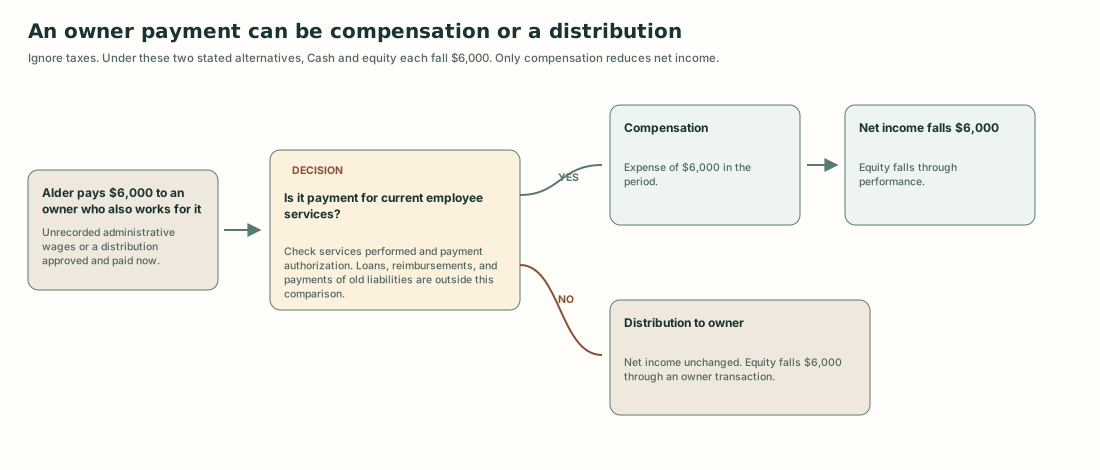
Alder pays an owner who also works for the company. The comparison is limited to two previously unrecorded events: current administrative wages, or a distribution approved and paid now. Ignore taxes. Compensation creates $6,000 expense, reducing income and equity by $6,000. A distribution reduces equity by $6,000 without reducing income. Both reduce Cash by $6,000. Loans, reimbursements, capitalized employee costs, and settlement of previously recorded liabilities require different analysis.
Put the concept to work
Understand this concept
- Distinguish a transfer to an owner acting as owner from an expense, liability settlement, or purchase of goods or services.
Learning resources
Choose a lesson, try an application, or inspect the sources behind this concept.
Build on these ideas
- Equity — Understand
To understand this concept: Required. A distribution is a reduction of the residual ownership interest rather than a performance cost.
- Expense — Understand
To understand this concept: Helpful. Contrasting owner capacity with entity activity makes the nonexpense classification visible.
Lessons
Worked examples and cases
Practice
Common mistaken ideas
Sources
Broader topics
Related concepts
Show 4 more related concepts
Use this idea next
- Financing cash flow — Apply
Required level here: understand. Required. A cash distribution is a financing outflow outside expense and net income.
- Net income — Understand
Required level here: understand. Required. Owner distributions reduce equity outside net income and must not be classified as performance expense.
- Retained earnings — Understand
Required level here: understand. Required. Distributions can reduce retained earnings but remain owner transactions outside net income.
Show 2 more next steps
- Statement of changes in equity — Understand
Required level here: understand. Required. Owner distribution changes equity outside net income.
- Temporary account — Apply
Required level here: understand. Helpful. Owner distributions close through equity but are not expenses or part of net income.