On this page
Financing cash flow shows specified cash movements between the entity and its capital providers. It keeps raising and returning capital separate from selling goods or services.
Two sides of capital
Northstar borrows $4,000 cash from a bank and distributes $2,000 cash to owners:
$4,000 borrowing − $2,000 owner distribution
= $2,000 net cash provided by financing activities
The borrowing increases Cash and a liability. It is not revenue because Northstar has a repayment obligation. The distribution reduces Cash and equity. It is not expense because it transfers value to owners outside period performance.
Owner investment for an ownership interest would also be a financing inflow in this basic model. Repayment of borrowed principal would be a financing outflow.
Separate the three sections
Operating cash flow follows cash consequences of the entity's basic revenue-producing and related activities under the stated framework. Investing cash flow covers specified productive-asset, loan, and investment transactions. Financing cash flow focuses on specified transactions with capital providers.
The same receipt sign can appear in any section. Customer collection, asset-sale proceeds, and borrowing proceeds are all cash inflows, but their underlying activities differ. Classification follows the transaction, not the sign.
A positive subtotal can signal dependence
Positive financing cash flow may fund expansion or bridge a temporary need, but it can also show reliance on external capital. Negative financing cash flow may reflect debt repayment, share repurchases, or distributions, but it does not by itself establish strength: an entity can return capital while operations weaken.
Finance readers compare the section with maturities, liquidity, leverage, capital expenditure, distributions, and covenant disclosures. Accounting readers trace proceeds and repayments to debt and equity rollforwards rather than inferring capital structure from the net subtotal alone.
Boundaries
This foundation limits debt activity to a cash borrowing and principal repayment and limits owner activity to cash investment and distribution. Interest, debt issuance costs, lease payments, supplier finance, derivative financing elements, noncontrolling interests, convertible instruments, and contingent consideration require current Topic 230 research. A financing label in ordinary business speech does not settle the accounting classification.
Follow the classification authority
ASC 230-10-45-14 identifies specified financing cash inflows. Borrowing proceeds are one listed class. Proceeds from issuing equity instruments are another. ASC 230-10-45-15 identifies financing cash outflows. Its list includes owner distributions and repayment of amounts borrowed. ASC 230-10-45-26 requires separate presentation of financing inflows and outflows, subject to its exceptions. Northstar uses only the uncomplicated parts of that guidance.
Financing cash flow in the learning graph
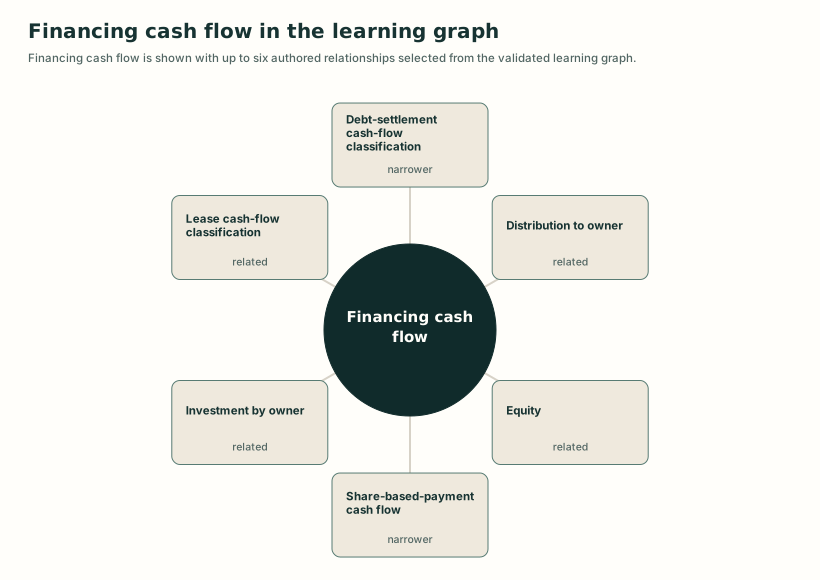
Detailed visual description
A structural map places Financing cash flow at the center and connects it to related concepts, prerequisite concepts, or lessons from the knowledge graph. Edge labels distinguish broader, narrower, related, prerequisite, and teaching relationships where present.
Put the concept to work
Understand this concept
- Explain the basic financing section as specified cash transactions with owner and creditor capital providers rather than as revenue or operating performance.
Apply this concept
- Classify unambiguous cash borrowing, principal repayment, owner investment, and owner distribution and compute a basic financing cash-flow subtotal.
Learning resources
Choose a lesson, try an application, or inspect the sources behind this concept.
Build on these ideas
- Distribution to owner — Understand
To apply this concept: Required. A cash distribution is a financing outflow outside expense and net income.
- Financing cash flow — Understand
To apply this concept: Required. Computation depends on identifying capital-provider transactions before summing their signs.
- Investment by owner — Understand
To understand this concept: Required. Owner-provided capital is an equity financing source outside revenue.
Show 2 more prerequisites
- Liability — Apply
To understand this concept: Required. Borrowing creates a creditor claim rather than operating performance.
- Statement of cash flows — Understand
To understand this concept: Required. Financing is one statement category whose scope must be separated from operating and investing.
Lessons
Worked examples and cases
Practice
Common mistaken ideas
Sources
Standard references
More specific topics
Related concepts
Use this idea next
- Financing cash flow — Apply
Required level here: understand. Required. Computation depends on identifying capital-provider transactions before summing their signs.
- Noncash investing and financing activity — Analyze
Required level here: apply. Required. The learner must contrast cash borrowing with direct issuance of an obligation for an asset.
- Statement of cash flows — Apply
Required level here: understand. Required. Financing receipts and payments must be isolated before computing the section subtotal.