On this page
The statement of cash flows explains a period's change in cash-related resources without pretending that every change is operating performance. Its three sections preserve economically different paths to the same ending Cash.
The statement has two simultaneous jobs
First, it classifies cash receipts and payments:
- Operating activities show cash consequences of the entity's basic revenue- producing and related activities under the applicable framework.
- Investing activities show specified lending and investment transactions and changes involving productive assets.
- Financing activities show specified transactions with capital providers, including owners and creditors.
Second, it reconciles the sections to the balance-sheet movement:
Beginning Cash + operating cash flow + investing cash flow
+ financing cash flow = ending Cash
A statement can pass that equation and still contain a classification error. Moving a $4,000 borrowing from financing to operating leaves net change and ending Cash untouched while overstating operating cash flow by $4,000.
Direct and indirect operating presentation
The direct method reports major classes of operating receipts and payments, such as customer collections and payments to suppliers or employees. The indirect method begins with net income and adjusts for noncash items and timing differences to reach net cash from operating activities. Both methods address the operating section; investing and financing classification remains a separate task.
This foundation first prepares a small direct-method statement because each cash event remains visible. The connected indirect-method lesson then reconciles the same operating subtotal from net income, noncash income effects, and bounded changes in operating assets and liabilities.
What readers can and cannot infer
Accounting students use the statement to trace cash transactions, test classification, and tie the period rollforward to Cash. Finance students use the sections to examine cash conversion, reinvestment, external funding, and payout. Neither group should treat one positive subtotal as proof of earnings quality, solvency, sustainable growth, or valuation.
Scope and authority
The Beacon teaching model contains only unrestricted Cash and unambiguous US- GAAP examples. An actual Topic 230 statement may involve cash equivalents, restricted amounts, foreign-currency effects, direct or indirect operating presentation, and detailed disclosures. Classification of interest, taxes, derivatives, acquisitions, leases, supplier finance, and other arrangements requires paragraph-level current research. The simple category cues here are not a substitute.
ASC 230-10-45-1 requires the statement to report cash effects in three activity classes. They are operating, investing, and financing activities.
ASC 230-10-45-24 requires the net effect and the three section totals to connect the opening and closing cash-related totals.
ASC 230-10-45-2 also requires a bridge from net income to operating cash flow. These paragraphs do not settle every detailed classification question listed above.
Statement of cash flows in the learning graph
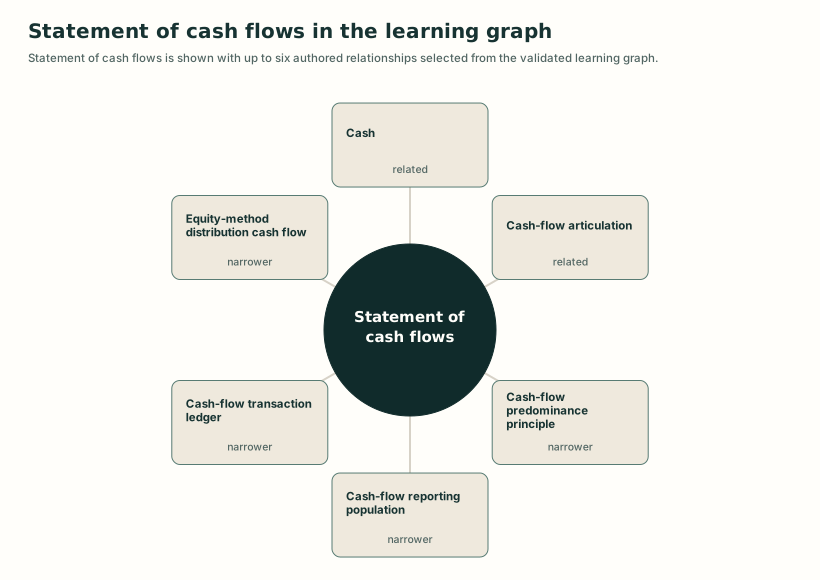
Detailed visual description
A structural map places Statement of cash flows at the center and connects it to related concepts, prerequisite concepts, or lessons from the knowledge graph. Edge labels distinguish broader, narrower, related, prerequisite, and teaching relationships where present.
Put the concept to work
Understand this concept
- Explain the period, purpose, three activity sections, beginning-to-ending reconciliation, and noncash boundary of a basic statement of cash flows.
Apply this concept
- Prepare a basic direct-method statement of cash flows from classified signed receipts and payments and reconcile net change to ending Cash.
Learning resources
Choose a lesson, try an application, or inspect the sources behind this concept.
Build on these ideas
- Cash — Analyze
To understand this concept: Required. The statement reconciles a date-specific resource balance through period receipts and payments.
- Financial statements — Understand
To understand this concept: Required. The cash-flow statement is one period report within a linked statement set.
- Financing cash flow — Understand
To apply this concept: Required. Financing receipts and payments must be isolated before computing the section subtotal.
Show 3 more prerequisites
- Investing cash flow — Understand
To apply this concept: Required. Investing receipts and payments must be isolated before computing the section subtotal.
- Operating cash flow — Understand
To apply this concept: Required. Operating receipts and payments must be isolated before computing the section subtotal.
- Statement of cash flows — Understand
To apply this concept: Required. Preparation requires the statement's period, section, and reconciliation structure.
Lessons
Worked examples and cases
Practice
Common mistaken ideas
Sources
Standard references
Broader topics
More specific topics
Related concepts
Use this idea next
- Cash-flow articulation — Understand
Required level here: apply. Required. The section subtotals and net change supply the period side of the articulation.
- Cash-flow reporting population — Understand
Required level here: apply. Required. The learner already knows the statement's three-section architecture.
- Changes in operating assets and liabilities — Analyze
Required level here: apply. Required. The adjustments belong inside a prepared operating reconciliation, not a balance-sheet ratio calculation.
Show 9 more next steps
- Financing cash flow — Understand
Required level here: understand. Required. Financing is one statement category whose scope must be separated from operating and investing.
- Foreign-currency cash flow — Understand
Required level here: apply. Required. Foreign currency adds a measurement rail to ordinary classification.
- Indirect method — Understand
Required level here: apply. Required. The operating reconciliation sits within a statement whose other sections and ending-Cash tie remain intact.
- Investing cash flow — Understand
Required level here: understand. Required. Investing is one statement category whose scope must be separated from operating and financing.
- Lease cash-flow classification — Analyze
Required level here: apply. Required. Lease components enter operating, financing, or noncash disclosure through existing cash-flow architecture.
- Noncash investing and financing activity — Understand
Required level here: understand. Required. The statement's cash boundary determines why a noncash transaction cannot enter its section sums.
- Operating cash flow — Understand
Required level here: understand. Required. Operating is one section of a three-category cash-flow statement and not a standalone definition of all cash change.
- Separately identifiable cash flow — Understand
Required level here: apply. Required. The learner can already classify ordinary transactions.
- Statement of cash flows — Apply
Required level here: understand. Required. Preparation requires the statement's period, section, and reconciliation structure.
Used in these readings
These chapters explain or apply this concept. The label states how the chapter uses it.