On this page
Cash is one asset at a date. A cash flow is a change during a period. This distinction between a balance and changes in that balance prevents common substitutions: Cash is not revenue, net income, retained earnings, total equity, or enterprise value.
One balance, several causes
Northstar begins the year with $20,000 Cash. During the year it collects $13,000 from customers, pays $5,000 rent, buys equipment for $6,000, borrows $4,000, and distributes $2,000 to owners:
$20,000 + $13,000 − $5,000 − $6,000 + $4,000 − $2,000
= $24,000 ending Cash
The equation proves the $4,000 net increase. It does not yet explain which receipts and payments arose from operations, investment in productive capacity, or financing. The statement-of-cash-flows concepts deliberately reuse these six amounts and supply that second layer.
A Cash debit or credit is not a statement category
Every cash receipt debits the Cash account in a basic journal entry, yet a customer collection, bank borrowing, and owner investment have different economic roles. Every cash payment credits Cash, yet rent, equipment purchase, debt repayment, and owner distribution do not belong in one statement section.
Account direction answers how the Cash balance changed. Cash-flow classification answers why it changed.
Recognition can move without Cash
Credit revenue can increase net income before collection. Depreciation can reduce net income without a current cash payment. Acquiring equipment by issuing debt can change assets and liabilities without changing Cash at all. A Cash rollforward excludes those noncash changes even when another statement reports them.
Follow customer cash to the other account
A receipt can accompany current revenue, settle existing accounts receivable, or precede service and create unearned revenue. Identify the contract and prior entries before deciding what to credit. The same increase in cash can have different accounting explanations.
Suppose a customer pays a receivable already recorded when an unconditional payment became due before service. The receipt reduces that receivable. It does not create another contract liability or establish that the service has now been provided.
The cash-flow statement example reconciles the Northstar cash amounts above. Use the cash-source practice to distinguish the reasons for receipts before choosing their accounting effects.
Boundaries
This foundation uses an unrestricted Cash account denominated in US dollars. Cash equivalents, restricted cash, overdrafts, foreign currency, compensating balances, custodial arrangements, and digital assets require their own facts and current guidance. A bank statement balance may also differ from the ledger balance because of timing and errors; bank reconciliation is a later concept.
Follow the cash-flow authority
ASC 230-10-45-24 requires a reconciliation of the opening and closing cash-related totals. Those totals cover cash, cash equivalents, restricted cash, and restricted cash equivalents. This page isolates one unrestricted Cash account. It makes the basic rollforward visible before the other amounts are added. ASC 230-10-45-10 supplies the three-part classification framework used by the connected example. Neither paragraph says that every change in another account is a cash flow.
Cash in the learning graph
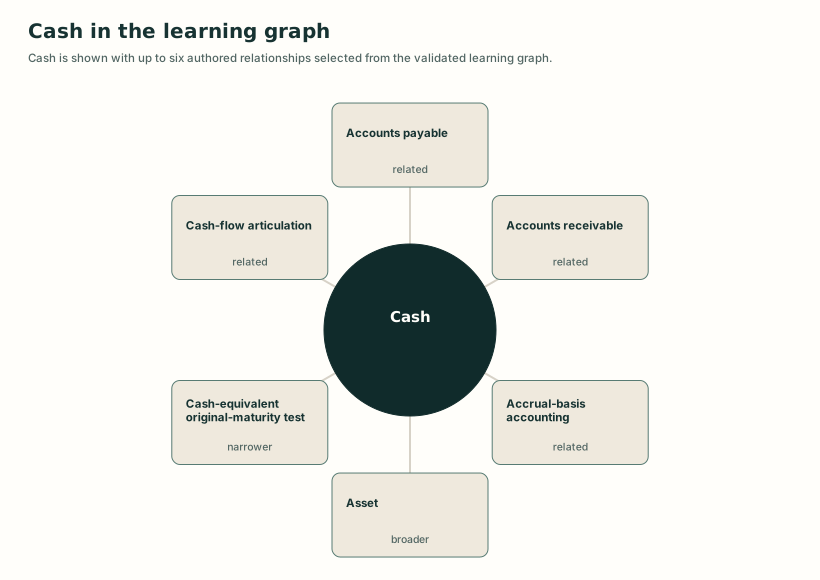
Detailed visual description
A structural map places Cash at the center and connects it to related concepts, prerequisite concepts, or lessons from the knowledge graph. Edge labels distinguish broader, narrower, related, prerequisite, and teaching relationships where present.
Put the concept to work
Understand this concept
- Explain Cash as a date-specific asset balance and distinguish it from a cash receipt, cash payment, net cash flow, revenue, net income, and equity.
Analyze this concept
- Reconcile a basic beginning Cash balance to an ending Cash balance using signed cash receipts and payments while excluding noncash events.
Learning resources
Choose a lesson, try an application, or inspect the sources behind this concept.
Build on these ideas
- Accrual-basis accounting — Understand
To analyze this concept: Required. Noncash recognition and timing differences must not be inserted into a Cash rollforward.
- Asset — Understand
To understand this concept: Required. Cash is one recognized resource within assets rather than a synonym for resources, value, or equity.
- Cash — Understand
To analyze this concept: Required. A balance rollforward depends on separating the stock of Cash from the flows that change it.
Lessons
Worked examples and cases
Practice
Common mistaken ideas
- Mistaken idea: An economic surplus area is accounting profit or cash
- Mistaken idea: Cash recovery on a written-off account is new revenue
- Mistaken idea: Net income equals operating cash flow
Show 1 more mistaken ideas
Sources
Standard references
Broader topics
More specific topics
Related concepts
Show 14 more related concepts
Use this idea next
- Bank reconciliation — Understand
Required level here: understand. Required. The schedule reconciles the entity's own cash balance.
- Cash equivalent — Understand
Required level here: understand. Required. A cash equivalent is reported together with cash.
- Cash — Analyze
Required level here: understand. Required. A balance rollforward depends on separating the stock of Cash from the flows that change it.
Show 6 more next steps
- Cash-equivalent original-maturity test — Understand
Required level here: understand. Required. Cash equivalents are a bounded extension of the cash population.
- Compensating balance — Understand
Required level here: understand. Required. The obligation is a limit on the entity's own cash.
- Liquidity — Understand
Required level here: understand. Required. Cash is the immediate settlement resource but does not exhaust the entity's available or convertible resources.
- Operating cycle — Understand
Required level here: analyze. Required. Final cash realization closes the bounded resource-to-cash sequence without making every intermediate event a cash event.
- Restricted cash — Understand
Required level here: understand. Required. Restriction is a limit placed on cash the entity holds.
- Statement of cash flows — Understand
Required level here: analyze. Required. The statement reconciles a date-specific resource balance through period receipts and payments.