On this page
Net income is the period's revenue and gains less expenses and losses included in income. Items reported in other comprehensive income are excluded. That separate category contains certain income items that accounting rules place outside net income.
Calculate the period's result
Start with adjusted revenue and expense balances, so the period's required adjustments are included. Subtract expenses once, keeping owner transactions outside the calculation. A negative result is a net loss.
The income-to-equity lesson supplies a complete numerical example. It distinguishes the current period's income from beginning retained earnings and dividends.
Keep three different amounts separate
Revenue is an input to net income, not its synonym. Retained earnings accumulates income and losses across periods, reduced by dividends and other changes charged to that equity account. Cash is one asset balance.
Income can be earned before collection. Expenses can be recorded before payment, and depreciation allocates cost without a current cash payment. Net income therefore does not determine either ending Cash or the change in Cash.
Read the components as well as the total
Equal net income can result from different revenue, expense, and gain amounts. Inspect those components and the notes before concluding that two companies performed in the same way. Compare the same reporting periods and units.
More detailed income statements distinguish additional subtotals and tax effects. Do not assume that every figure labelled earnings uses the same definition; check what the report includes and excludes.
Net income in the learning graph
Detailed visual description
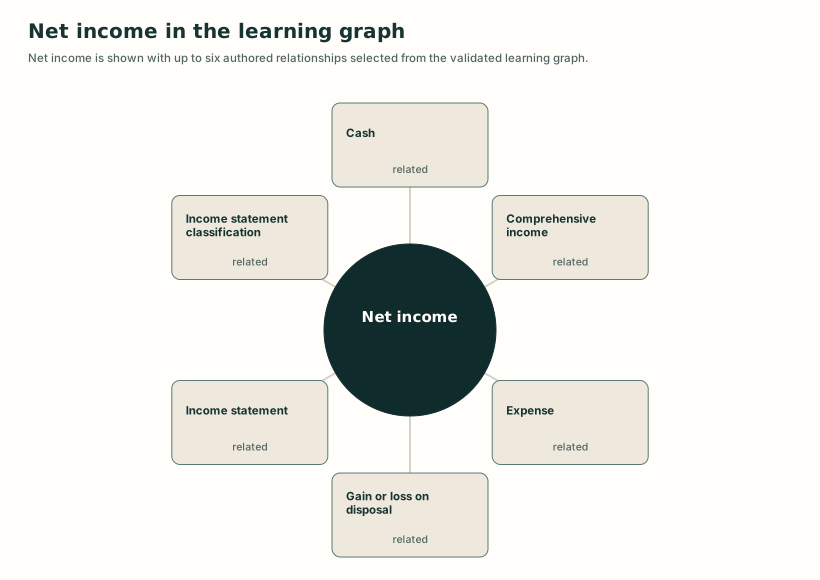
A structural map places Net income at the center and connects it to related concepts, prerequisite concepts, or lessons from the knowledge graph. Edge labels distinguish broader, narrower, related, prerequisite, and teaching relationships where present.
Put the concept to work
Understand this concept
- Explain net income as a period performance residual distinct from revenue, cash flow, owner contributions, distributions, and ending retained earnings.
Analyze this concept
- Compute basic net income and reconcile its effect through retained earnings without equating it with cash generated or total equity change.
Learning resources
Choose a lesson, try an application, or inspect the sources behind this concept.
Build on these ideas
- Distribution to owner — Understand
To understand this concept: Required. Owner distributions reduce equity outside net income and must not be classified as performance expense.
- Expense — Understand
To understand this concept: Required. Recognized expenses and losses reduce the performance residual.
- Net income — Understand
To analyze this concept: Required. The calculation must retain its period-performance scope.
Show 2 more prerequisites
- Retained earnings — Analyze
To analyze this concept: Required. Net income is one input to accumulated equity alongside opening balance and owner distributions.
- Revenue — Understand
To understand this concept: Required. Recognized revenue and gains contribute to the performance residual.
Lessons
Worked examples and cases
Practice
Common mistaken ideas
Sources
Related concepts
Show 15 more related concepts
- Financial statement articulation
- Gain or loss on disposal
- Income statement
- Income statement classification
- Income statement limitation
- Income summary
- Indirect method
- Net profit margin
- Operating cash flow
- Operating cash-to-income comparison
- Retained earnings
- Return on assets
- Return on equity
- Revenue
- Statement of changes in equity
Use this idea next
- Comprehensive income — Understand
Required level here: understand. Required. Comprehensive income begins with the net-income component already understood.
- Gain or loss on disposal — Understand
Required level here: understand. Helpful. The gain or loss enters period performance even though its related cash receipt follows a separate cash-flow classification path.
- Income statement — Analyze
Required level here: analyze. Required. The classified components must reconcile to the reported performance residual.
Show 9 more next steps
- Income statement — Understand
Required level here: understand. Required. The statement's basic residual must be distinguished from revenue, cash flow, and equity.
- Indirect method — Apply
Required level here: analyze. Required. The starting amount must be a supported period result with known included effects.
- Indirect method — Understand
Required level here: understand. Required. The reconciliation begins with an accrual-basis performance result rather than a Cash balance.
- Net income — Analyze
Required level here: understand. Required. The calculation must retain its period-performance scope.
- Net profit margin — Understand
Required level here: understand. Required. The numerator includes the recognized effects that produce the period residual.
- Operating cash-to-income comparison — Understand
Required level here: understand. Required. The accrual-basis period result is one side of the comparison.
- Return on assets — Understand
Required level here: understand. Required. The numerator is an accrual-basis period residual rather than cash generated.
- Return on equity — Understand
Required level here: understand. Required. The numerator is the entity's accrual-basis period result under the declared scope.
- Statement of changes in equity — Analyze
Required level here: analyze. Required. The income-statement result is one input to the retained-earnings rollforward.
Used in these readings
These chapters explain or apply this concept. The label states how the chapter uses it.