On this page
Operating cash flow is a section subtotal, not another name for profit. In a direct presentation, the learner can see the receipts and payments that create it. In an indirect presentation, a reconciliation explains why accrual-basis net income differs from it.
A visible direct-method subtotal
Northstar collects $13,000 from customers and pays $5,000 cash for rent during the year. Under the bounded facts, both are operating:
$13,000 customer collections − $5,000 rent paid
= $8,000 net cash provided by operating activities
The $13,000 receipt is not necessarily the period's revenue. It can include collection of a prior receivable or exclude current credit revenue. The $5,000 payment is not necessarily identical to rent expense if a prepaid or payable balance changed.
Why net income can differ
Accrual accounting recognizes effects when the relevant recognition conditions are met, not simply when Cash moves. The expanded Northstar worked-example facts add $15,000 revenue, $5,000 rent expense, $2,000 depreciation expense, and a $2,000 Accounts Receivable increase. Those amounts produce $8,000 net income. The same $8,000 operating cash subtotal is coincidental: adding back $2,000 of noncash depreciation and subtracting the $2,000 receivable increase offset in this simplified year.
Equal totals do not prove equal composition. A useful diagnostic asks for the bridge, not just the endpoints.
Separate the three sections
Operating cash flow is distinct from investing cash flow and financing cash flow. Buying equipment for cash is an investing outflow in the basic model. Borrowing principal is a financing inflow. Neither amount enters the operating subtotal merely because cash changed.
An operating subtotal can equal a financing or investing subtotal by chance. That numerical match does not merge their purposes or prove their classifications. Trace each line to its transaction evidence.
Interpretation
Positive operating cash flow can help fund reinvestment, debt service, or owner distributions. Analysts compare it with earnings, working-capital movements, capital expenditure, contractual needs, and trends. A single positive period can also reflect delayed supplier payments, customer prepayments, shrinking operations, asset sales misclassified as operating, or other unsustainable conditions.
Boundaries
This page uses only customer collections and rent payments. Interest, income taxes, trading securities, insurance settlements, supplier-finance programs, derivatives, and transaction costs can require specific Topic 230 analysis. “Operating” is not a label assigned merely because an event happens often or because management considers it part of the business.
Follow the presentation authority
ASC 230-10-45-25 encourages a direct presentation of major operating cash receipts and payments. Its minimum classes include customer collections. Payments to employees and suppliers are another class.
ASC 230-10-45-28 requires the same operating subtotal under the indirect method when the direct presentation is not used. The equal subtotal does not make net income and operating cash flow the same measure.
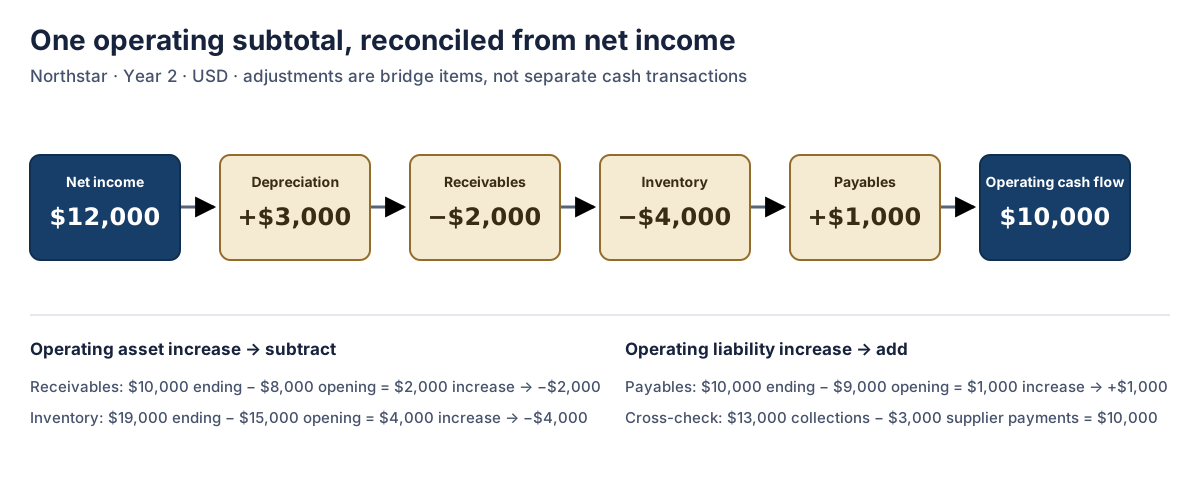
Northstar indirect operating cash-flow bridge
Detailed visual description
The first dark box is $12,000 net income. Four light adjustment boxes follow: positive $3,000 depreciation, negative $2,000 Receivables, negative $4,000 Inventory, and positive $1,000 Payables. The final dark box is $10,000 operating cash flow. Notes below derive the asset-increase subtraction and liability-increase addition from opening and ending balances and show the $13,000 collections less $3,000 supplier-payments direct cross-check.
Put the concept to work
Understand this concept
- Explain operating cash flow as a classified cash subtotal distinct from revenue, expense, net income, and the total change in Cash.
Apply this concept
- Classify unambiguous customer, supplier, employee, and operating-overhead cash receipts or payments and compute a basic direct-method operating subtotal.
Learning resources
Choose a lesson, try an application, or inspect the sources behind this concept.
Build on these ideas
- Accrual-basis accounting — Understand
To understand this concept: Required. The distinction between recognition and cash timing explains why operating cash flow can differ from net income.
- Expense — Understand
To apply this concept: Helpful. Supplier, employee, and overhead payments often relate to expense activity even when recognition and payment timing differ.
- Operating cash flow — Understand
To apply this concept: Required. Computation depends on the economic scope of the operating section.
Show 2 more prerequisites
- Revenue — Understand
To apply this concept: Helpful. Customer collections often relate to revenue activity even when recognition and collection occur in different periods.
- Statement of cash flows — Understand
To understand this concept: Required. Operating is one section of a three-category cash-flow statement and not a standalone definition of all cash change.
Lessons
Worked examples and cases
Practice
Common mistaken ideas
Sources
Standard references
More specific topics
Related concepts
Show 7 more related concepts
Use this idea next
- Direct-method operating cash flow — Understand
Required level here: understand. Required. The direct method presents the operating subtotal already defined.
- Free cash flow — Apply
Required level here: understand. Required. The computation starts from operating cash flow.
- Free cash flow — Understand
Required level here: understand. Required. The common presentation begins with a GAAP statement-of-cash-flows subtotal.
Show 4 more next steps
- Indirect method — Understand
Required level here: understand. Required. The target is a classified operating cash subtotal, not total cash change.
- Operating cash flow — Apply
Required level here: understand. Required. Computation depends on the economic scope of the operating section.
- Operating cash-to-income comparison — Understand
Required level here: understand. Required. The cash subtotal must share entity, period, and operating scope.
- Statement of cash flows — Apply
Required level here: understand. Required. Operating receipts and payments must be isolated before computing the section subtotal.