On this page
Investing cash flow tracks specified uses and recoveries of cash involving productive assets, loans, and investments. The word does not mean “anything management hopes will help the future.” Advertising, employee training, and routine operating inputs do not become investing cash flows through rhetoric.
Productive asset example
Northstar pays $6,000 cash for equipment. The purchase is a $6,000 investing cash outflow and increases Equipment; it is not $6,000 of current depreciation expense.
If Northstar later recognizes $2,000 depreciation, the allocation reduces net income and the equipment's carrying amount but creates no cash flow in that later period. If Northstar acquired equipment by issuing $3,000 debt directly, the acquisition would be noncash and excluded from the three cash section totals.
Direction does not determine category
A purchase can be an investing outflow, while sale proceeds can be an investing inflow. Both remain investing because of the transaction's role. Conversely, cash paid for rent is an operating cash flow. Repayment of loan principal is a financing cash flow. The outflow sign does not select the section.
The three categories are parts of one statement, not quality labels. An investing outflow can support productive capacity. An operating inflow can be temporary, and a financing inflow creates or enlarges a capital-provider claim.
Interpretation
Negative investing cash flow can reflect expansion, replacement, acquisitions, or purchases of investments; it is not automatically bad. Positive investing cash flow can reflect productive asset sales or loan collections; it is not automatically good. Finance analysis asks what was bought or sold, why, at what scale, and whether the pattern supports future operations. Accounting analysis ties the cash lines to asset rollforwards and disposal records.
Boundaries
The Northstar foundation uses only a cash purchase of equipment. Securities held for trading, cash equivalents, loans made by financial institutions, business combinations, contingent consideration, seller financing, and settlement of complex instruments require transaction-specific guidance. Gross versus net presentation and related gains or losses also require more facts than the cash proceeds alone.
Follow the classification authority
ASC 230-10-45-12 identifies specified investing cash inflows. The list includes proceeds from selling property, plant, and equipment. ASC 230-10-45-13 identifies specified investing cash outflows. Its list includes payments to acquire property, plant, and equipment. ASC 230-10-45-26 requires separate presentation of investing inflows and outflows, subject to its exceptions. The equipment example applies the basic cash-purchase case.
Investing cash flow in the learning graph
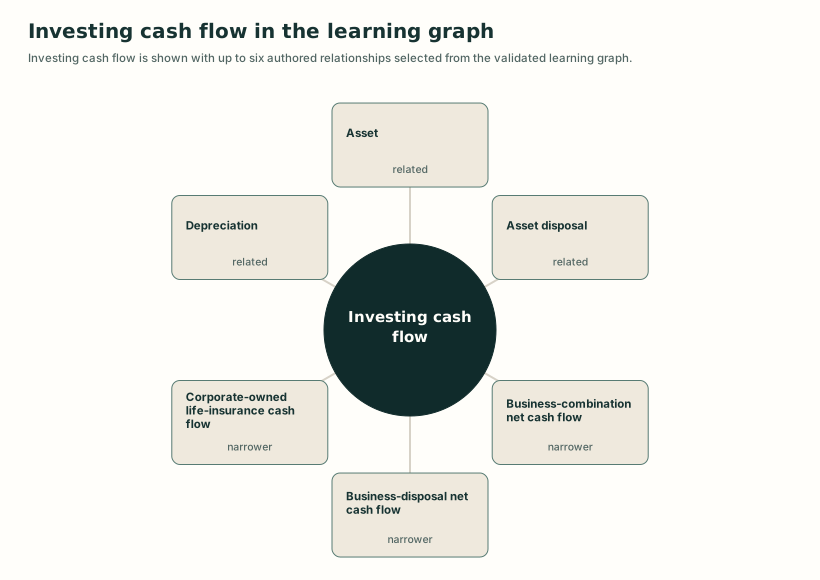
Detailed visual description
A structural map places Investing cash flow at the center and connects it to related concepts, prerequisite concepts, or lessons from the knowledge graph. Edge labels distinguish broader, narrower, related, prerequisite, and teaching relationships where present.
Put the concept to work
Understand this concept
- Explain the basic investing section as cash deployment into or recovery from productive assets, loans, and eligible investments rather than as any expenditure called an investment.
Apply this concept
- Classify unambiguous cash purchases and sales of productive long-lived assets and compute a basic investing cash-flow subtotal.
Learning resources
Choose a lesson, try an application, or inspect the sources behind this concept.
Build on these ideas
- Asset — Apply
To understand this concept: Required. The learner must distinguish acquiring an asset from immediately recognizing an expense.
- Depreciation — Understand
To apply this concept: Helpful. Separating the acquisition cash flow from later cost allocation prevents depreciation from being presented as a current cash payment.
- Investing cash flow — Understand
To apply this concept: Required. Classification must follow the investing activity rather than the direction or size of Cash.
Show 1 more prerequisites
- Statement of cash flows — Understand
To understand this concept: Required. Investing is one statement category whose scope must be separated from operating and financing.
Lessons
Worked examples and cases
Practice
Common mistaken ideas
Sources
Standard references
More specific topics
- Business-combination net cash flow
- Business-disposal net cash flow
- Corporate-owned life-insurance cash flow
Show 1 more more specific topics
Related concepts
Show 3 more related concepts
Use this idea next
- Asset disposal — Understand
Required level here: understand. Helpful. The cash receipt has a statement-of-cash-flows path distinct from the income-statement residual.
- Business-combination net cash flow — Understand
Required level here: understand. Required. A business acquisition is an investing interface after scope is supplied.
- Corporate-owned life-insurance cash flow — Understand
Required level here: understand. Required. The learner knows the investing activity definition.
Show 3 more next steps
- Investing cash flow — Apply
Required level here: understand. Required. Classification must follow the investing activity rather than the direction or size of Cash.
- Noncash investing and financing activity — Analyze
Required level here: apply. Required. The learner must contrast a cash purchase of a productive asset with a noncash acquisition.
- Statement of cash flows — Apply
Required level here: understand. Required. Investing receipts and payments must be isolated before computing the section subtotal.