On this page
An asset is not simply “something valuable.” The conceptual question is more specific: does the entity have a present right to an economic benefit? Cash and equipment are familiar examples. An enforceable right can be an asset without having physical form. An employee's talent is not ordinarily the employer's asset.
Present right and economic benefit
The right must exist at the reporting date and have the capacity to provide a service or benefit to the entity. The combination lets the entity obtain that benefit and restrict others' access to it. Legal ownership can be strong evidence of a right, but the analysis cannot stop at whose name appears on a document. Contract terms, restrictions, and the substance of an arrangement can matter.
The requirement that the right be present keeps expectations from becoming assets by wish alone. A plan to buy equipment next month may be sensible and valuable, but the plan is not the equipment. A present right necessarily arose from a past transaction, event, or circumstance; once the entity acquires the right to use the equipment and its benefits, the analysis changes.
An exchange within assets
Suppose a new company pays $15,000 cash for equipment. Cash falls by $15,000; equipment rises by $15,000. Total assets do not change at that moment. The company exchanged one asset for another.
That result often surprises a learner who equates every cash payment with an expense. An expense concerns a reduction in assets or increase in liabilities that reduces equity, subject to the reporting model. Buying a resource that will serve the business beyond the immediate transaction is not automatically the same event as consuming that resource.
What an asset balance can—and cannot—say
An asset balance participates in the accounting equation, but it does not necessarily equal current market value or the cash the entity could collect today. Measurement rules, estimates, changes in expected benefits, and presentation choices affect reported amounts. One rule may use an adjusted historical cost, while another may use a current measure. A later event may require a reduction when expected benefits fall. Those mechanisms receive their own concepts later. For now, ask both what economic resource a line represents and how that amount was measured.
Boundaries and common confusions
Physical form is neither necessary nor sufficient. A patent right can be an asset; a machine held for someone else may not be the holder’s asset. A hoped-for future benefit is also insufficient without a present right. Meeting the conceptual definition does not by itself determine recognition or measurement, and the specific authoritative guidance controls standards-dependent conclusions.
Sources and currency
The definition is paraphrased from the FASB Conceptual Framework. That source is conceptual, not authoritative US GAAP for a particular transaction.
Asset in the learning graph
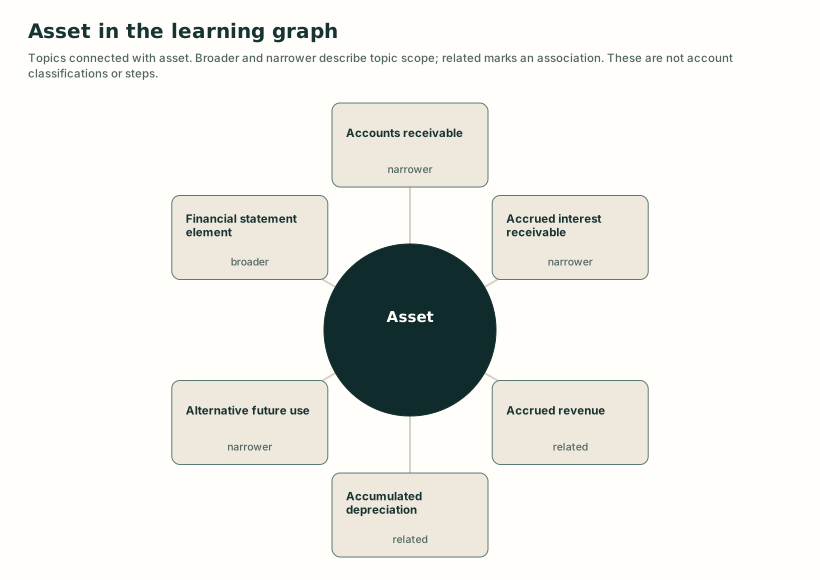
Detailed visual description
A structural map places Asset at the center and connects it to related concepts, prerequisite concepts, or lessons from the knowledge graph. Edge labels distinguish broader, narrower, related, prerequisite, and teaching relationships where present.
Put the concept to work
Understand this concept
- Explain why an asset depends on an entity's present right to an economic benefit rather than physical possession alone.
Apply this concept
- Classify the asset effects of a basic transaction and distinguish an exchange of assets from an expense.
Learning resources
Choose a lesson, try an application, or inspect the sources behind this concept.
Build on these ideas
- Asset — Understand
To apply this concept: Required. Classification requires a workable model of an economic resource and control.
- Financial statement element — Understand
To understand this concept: Helpful. The learner needs the difference between an element and the account or line item used to represent it.
Lessons
Worked examples and cases
Practice
- Cash before and after customer work
- Credit purchase and partial settlement
- Equipment received before the invoice
Show 3 more practice items
Common mistaken ideas
Sources
Broader topics
More specific topics
Show 22 more more specific topics
- Cash
- Cloud computing implementation cost
- Contract cost asset
- Current asset
- Debt security investment
- Deferred tax asset
- Equity security at fair value through earnings
- Equity-method investment
- Goodwill
- Held-for-sale long-lived asset
- Identifiable intangible asset
- Internal-use software
- Inventory
- Investment instrument scope
- Lease receivable and net investment
- Natural-resource asset
- Net operating loss carryforward
- Notes receivable
- Right-of-use asset
- Software to be sold, leased, or marketed
- Tax credit carryforward
- Trade and nontrade receivables
Related concepts
Use this idea next
- Accounting equation — Understand
Required level here: understand. Required. The left side of the equation represents recognized economic resources controlled by the entity.
- Accounts receivable — Understand
Required level here: understand. Required. The receivable is a recognized resource claim rather than Cash or performance itself.
- Accrued revenue — Understand
Required level here: understand. Required. The counterpart is a present customer claim rather than cash or owner investment.
Show 25 more next steps
- Asset acquisition cost — Understand
Required level here: apply. Required. The learner must identify the controlled resource and intended-use boundary before assigning cost.
- Asset — Apply
Required level here: understand. Required. Classification requires a workable model of an economic resource and control.
- Carrying amount — Understand
Required level here: understand. Required. The learner must identify the recognized resource before interpreting the amount attached to it.
- Cash — Understand
Required level here: understand. Required. Cash is one recognized resource within assets rather than a synonym for resources, value, or equity.
- Contract cost asset — Understand
Required level here: understand. Required. Capitalization requires a present economic resource, not merely a contract association.
- Contributed asset — Understand
Required level here: apply. Required. The recipient must first establish the resource, control, and transaction parties.
- Current asset — Analyze
Required level here: apply. Required. The learner must first establish that each item is an asset rather than an expense or unsupported resource.
- Current asset — Understand
Required level here: understand. Required. Only a recognized asset can be classified within the current asset section.
- Deferral — Understand
Required level here: understand. Required. A prepayment can leave a controlled right to future benefit after cash is paid.
- Depreciation — Understand
Required level here: apply. Required. The asset and its future service potential must be identified before allocating a depreciable amount.
- Equity — Understand
Required level here: understand. Required. A residual interest cannot be interpreted without understanding the resources from which claims are deducted.
- Expense — Understand
Required level here: understand. Required. The learner must distinguish acquiring or exchanging a resource from using one in the entity's activities.
- Goodwill — Understand
Required level here: understand. Required. Goodwill is reported as an asset and is defined against the identifiable ones.
- Identifiable intangible asset — Apply
Required level here: apply. Required. The learner must distinguish a controlled accounting resource from a valuable idea or activity.
- Identifiable intangible asset — Understand
Required level here: understand. Required. An identifiable intangible is first an asset.
- Internal-use software — Apply
Required level here: apply. Required. Software scope still begins with the controlled resource and its intended use.
- Inventory — Understand
Required level here: understand. Required. Inventory is a controlled resource before its cost is transferred out under the applicable accounting.
- Investing cash flow — Understand
Required level here: apply. Required. The learner must distinguish acquiring an asset from immediately recognizing an expense.
- Investment instrument scope — Analyze
Required level here: understand. Required. An investment is first a recognized resource with particular rights.
- Lease identification — Analyze
Required level here: understand. Required. The test concerns a right to use an economic resource rather than ownership of the underlying asset.
- Other-assets presentation — Understand
Required level here: understand. Required. An item must first be recognized as an asset before a presentation category is considered.
- Permanent account — Understand
Required level here: understand. Required. Assets remaining at period end continue as resources or rights into the next period.
- Prepaid expense — Understand
Required level here: apply. Required. The unconsumed portion must qualify as a present right to future economic benefit under the stated facts.
- Revenue — Understand
Required level here: understand. Required. Revenue can enhance assets, so the learner must recognize the resource effect separately from its source.
- Total asset turnover — Understand
Required level here: understand. Required. The denominator aggregates recognized resources measured under the reporting basis.
Used in these readings
These chapters explain or apply this concept. The label states how the chapter uses it.