Impairment is not accelerated depreciation. Under the bounded Topic 360 model, an entity first identifies a supported held-and-used asset group and an indicator. Carrying amount then enters a recoverability screen against the applicable undiscounted cash-flow measure.
ASC 360-10-35-21 lists events and changes in circumstances that can trigger testing. ASC 360-10-35-23 sets the asset-group boundary, and ASC 360-10-35-17 states the recoverability and loss-measurement sequence.
Use a transfer case distinct from Beacon's lesson numbers. A $75,000 carrying amount exceeds $68,000 applicable undiscounted cash flows, so the screen fails. Supplied fair value of $51,000 measures the loss:
$75,000 carrying amount − $51,000 fair value
= $24,000 impairment loss
The resulting carrying amount is $51,000. The $7,000 gap in the screen is not the loss; it establishes that the separate measurement stage is required. The different numbers test whether the learner can transfer the sequence rather than recall Beacon's $60,000, $52,000, and $44,000 inputs. The magnitudes change; the procedure remains screen first and measure against fair value only after failure.
Judgment and controls
Before accepting the arithmetic, verify the unit of account, held-and-used classification, indicator date, cash-flow scope, consistency with budgets, terminal assumptions, and fair-value evidence. A spreadsheet can implement the sequence correctly while its asset group or forecasts remain unsupported.
Accounting and finance views
Accounting learners must distinguish recognition, measurement, entry, and later depreciation. Finance learners should treat the charge as evidence that expected benefits and prior carrying amounts diverged. They can then investigate operating causes, cash-flow revisions, valuation assumptions, covenant effects, and replacement plans. The charge itself is noncash in the recognition period, but the economic problem can be very real.
Boundary
This concept excludes goodwill, indefinite-lived intangibles, held-for-sale assets, valuation techniques, tax effects, restoration questions, abandonment, and disclosures. It supplies no IFRS comparison.
Held-and-used long-lived asset impairment decision flow
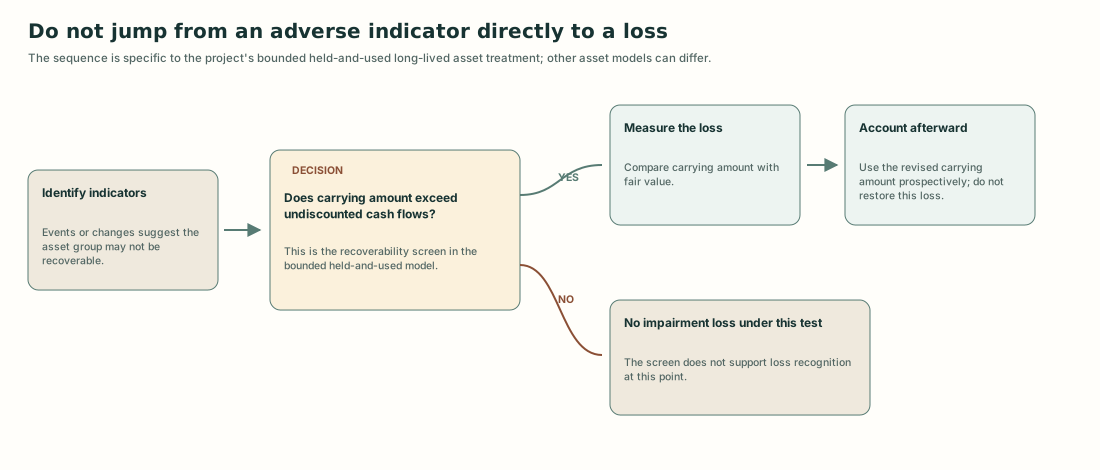
Detailed visual description
The figure preserves the two-step ordering used in the project's held-and-used long-lived asset materials and explicitly warns that other impairment models may differ.
Put the concept to work
Understand this concept
- Explain the bounded US GAAP sequence from an impairment indicator through a held-and-used recoverability screen to loss measurement.
Apply this concept
- Apply the recoverability and measurement sequence to a bounded held-and-used asset group and compute the supported loss and new carrying amount.
Learning resources
Choose a lesson, try an application, or inspect the sources behind this concept.
Build on these ideas
- Accounting estimate — Analyze
To understand this concept: Required. Cash-flow and fair-value inputs require evidence, sensitivity awareness, and separation of computation from judgment.
- Carrying amount — Analyze
To understand this concept: Required. The test and measurement begin with a supported carrying amount for the correctly identified asset group.
- Depreciation — Understand
To understand this concept: Required. Impairment must not be mistaken for the routine systematic allocation already reflected in carrying amount.
Show 2 more prerequisites
- Long-lived asset impairment — Understand
To apply this concept: Required. The learner must preserve scope and sequence before performing either comparison.
- Recoverability test — Analyze
To apply this concept: Required. The recoverability decision determines whether fair value becomes the loss-measurement input.
Lessons
Worked examples and cases
Practice
- Preserve the held-and-used impairment sequence
- Research the path from an impairment indicator to a new cost basis
- Run the screen before measuring an impairment
Show 1 more practice items
Common mistaken ideas
Sources
Standard references
More specific topics
Related concepts
Show 4 more related concepts
Use this idea next
- Lease impairment and sublease boundary — Understand
Required level here: apply. Required. Topic 360 provides the impairment route for ROU assets.
- Long-lived asset impairment — Apply
Required level here: understand. Required. The learner must preserve scope and sequence before performing either comparison.
- Recoverability test — Analyze
Required level here: understand. Required. The larger impairment sequence explains what a failed screen unlocks and what a passed screen stops.