On this page
“Current” is a presentation classification, not a claim that an asset is cash, risk-free, or available today. It groups resources expected to participate in the near-term operating or realization horizon under the applicable framework.
A bounded classified section
Northstar's teaching balance sheet includes:
| Current asset | Amount | Stated basis for the bounded classification |
|---|---|---|
| Unrestricted Cash | $30,000 | Available for current operations |
| Trade Accounts Receivable | 50,000 | Collectible within the ordinary short cycle |
| Operating Inventory | 40,000 | Expected to be sold within that cycle |
| Total current assets | $120,000 |
This $120,000 total deliberately returns in the later working-capital and current-ratio articles, where its compression and interpretation are tested. The classification does not say that all $120,000 can pay an invoice today. Receivables carry timing and credit risk; inventory requires sale and may face markdown, obsolescence, or operational constraints.
The account label is only a starting point
Restricted Cash may not be available for current operations. A receivable can be long term or doubtful. Inventory may involve an operating cycle longer than one year. A prepaid amount may be consumed within the current horizon but cannot usually settle a creditor directly. Complete rights, timing, restriction, collectibility, and use facts matter.
Why analysts disaggregate
Summing produces the current-assets numerator used in working capital and the current ratio. Analysis then reopens the total. Cash, collectible receivables, and saleable inventory have different conversion paths, uncertainty, and decision value. A ratio can improve because slow inventory rose, even if near-term payment capacity did not.
Boundaries
This foundation stipulates ordinary classifications for a nonfinancial teaching entity. Marketable securities, assets held for sale, deferred taxes, contract assets, restricted resources, loans, biological assets, and sector-specific formats require their own current guidance. “Short term” in a contract or data field is evidence, not a universal classification rule.
Source
Read ASC 210-10-45-1 for the general current-asset categories, ASC 210-10-45-3 for the operating-cycle horizon, and ASC 210-10-45-4 for important exclusions. These paragraphs support classification. They do not prove collectibility, saleability, or unrestricted availability.
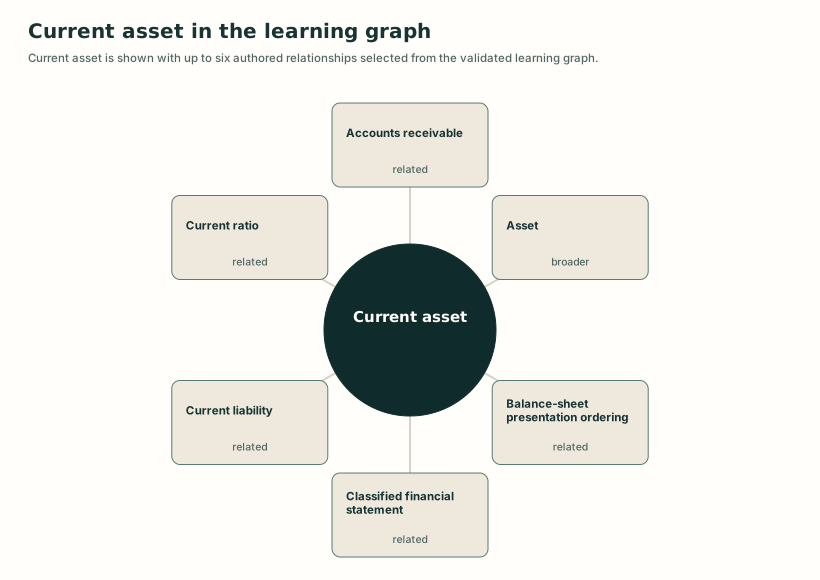
Current asset in the learning graph
Detailed visual description
A structural map places Current asset at the center and connects it to related concepts, prerequisite concepts, or lessons from the knowledge graph. Edge labels distinguish broader, narrower, related, prerequisite, and teaching relationships where present.
Put the concept to work
Understand this concept
- Explain current-asset classification on a classified balance sheet using availability, realization, sale, consumption, and operating-cycle boundaries rather than account-name memorization alone.
Analyze this concept
- Classify ordinary unrestricted Cash, collectible short-term trade receivables, operating inventory, and prepaid operating costs as current in a bounded fact pattern and identify facts that could change the conclusion.
Learning resources
Choose a lesson, try an application, or inspect the sources behind this concept.
Build on these ideas
- Asset — Apply
To analyze this concept: Required. The learner must first establish that each item is an asset rather than an expense or unsupported resource.
- Asset — Understand
To understand this concept: Required. Only a recognized asset can be classified within the current asset section.
- Current asset — Understand
To analyze this concept: Required. Classification requires applying the current-section criteria to each resource's facts.
Show 2 more prerequisites
- Operating cycle — Analyze
To analyze this concept: Required. Expected realization or consumption must be evaluated against the bounded operating horizon.
- Operating cycle — Understand
To understand this concept: Required. The normal operating cycle supplies a relevant classification horizon.
Lessons
Worked examples and cases
Practice
Common mistaken ideas
Sources
Standard references
Broader topics
Related concepts
Use this idea next
- Current asset — Analyze
Required level here: understand. Required. Classification requires applying the current-section criteria to each resource's facts.
- Current ratio — Understand
Required level here: analyze. Required. The numerator must come from supported current-asset classifications.
- Liquidity — Understand
Required level here: understand. Required. Current assets differ in availability, conversion time, and risk.
Show 2 more next steps
- Working capital — Apply
Required level here: understand. Required. The computation needs a current-asset total.
- Working capital — Understand
Required level here: analyze. Required. The measure depends on a supported current-asset total.
Used in these readings
These chapters explain or apply this concept. The label states how the chapter uses it.