On this page
Liquidity is a capacity under timing and uncertainty. More current assets than current liabilities do not prevent a payment problem. Assets may convert slowly, obligations may cluster early, Cash may be restricted, or funding may disappear.
Read resources against claims and time
Northstar reports $120,000 current assets and $80,000 current liabilities. The $40,000 difference and 1.50 current ratio are useful screens. They do not state when $50,000 receivables will be collected, how readily $40,000 inventory can be sold, when the liabilities mature, or whether $30,000 Cash is unrestricted.
A basic review therefore asks:
- What cash is available now?
- Which receivables are collectible, and when?
- How saleable is inventory without damaging price or operations?
- When are payables, payroll, taxes, and debt actually due?
- What operating cash is expected before those dates?
- What committed funding or covenant headroom remains?
Flow evidence can contradict a comfortable snapshot
A year-end balance sheet can be seasonally strong or temporarily managed. A positive current ratio alongside repeated negative operating cash flow, overdue payables, or a near-term debt maturity deserves investigation. Conversely, a business with predictable daily cash receipts and reliable committed funding may operate safely with a lower ratio than an inventory-heavy peer.
Accounting and finance perspectives
Preparers must classify and disclose the balances correctly before analysis. Analysts must challenge quality, timing, restrictions, concentration, and comparability after calculation. Credit decisions, treasury planning, covenant monitoring, and valuation assumptions use related evidence but may define their own measures under contracts or models.
Boundaries
Liquidity is not solvency, profitability, or market value. This foundation does not forecast daily cash, model a borrowing base, test covenants, or calculate a quick ratio. It uses one date and a small set of current balances, then insists that the learner name the missing evidence before reaching a broader conclusion.
Source boundary
ASC 210 supplies the current classifications used in the two basic screens. It does not turn either screen into a liquidity verdict. Read ASC 210-10-45-1 and ASC 210-10-45-5 for those classified totals. Read ASC 230-10-10-2 for the role of cash-flow information in assessing future cash generation, obligation payment, and external-financing needs.
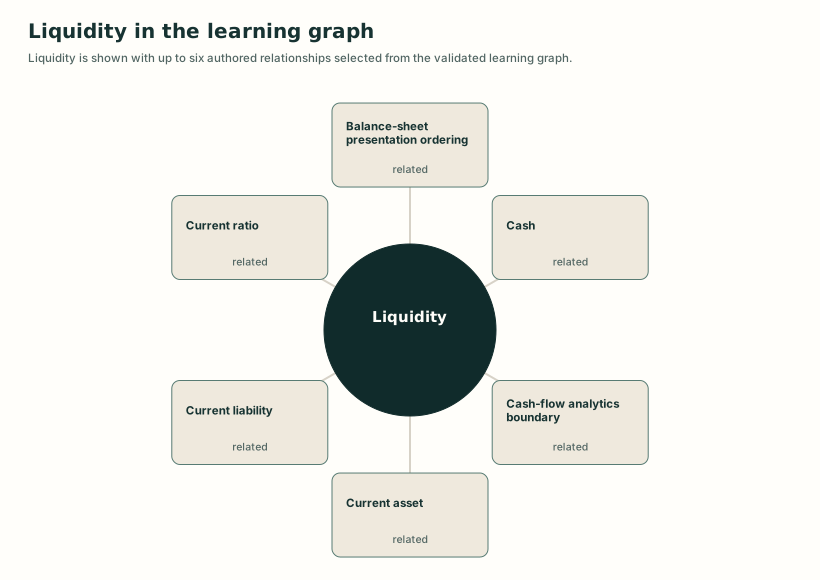
Liquidity in the learning graph
Detailed visual description
A structural map places Liquidity at the center and connects it to related concepts, prerequisite concepts, or lessons from the knowledge graph. Edge labels distinguish broader, narrower, related, prerequisite, and teaching relationships where present.
Put the concept to work
Understand this concept
- Explain liquidity as time-sensitive payment capacity supported by resources, cash flows, funding access, and obligation timing rather than as one balance or ratio.
Analyze this concept
- Analyze a bounded short-term liquidity position using current-balance composition, operating cash flow, maturity timing, restrictions, and funding access while identifying unsupported conclusions.
Learning resources
Choose a lesson, try an application, or inspect the sources behind this concept.
Build on these ideas
- Cash — Understand
To understand this concept: Required. Cash is the immediate settlement resource but does not exhaust the entity's available or convertible resources.
- Cash-flow articulation — Analyze
To analyze this concept: Required. Current balances need the period cash-flow path and transaction evidence for interpretation.
- Current asset — Understand
To understand this concept: Required. Current assets differ in availability, conversion time, and risk.
Show 3 more prerequisites
- Current liability — Understand
To understand this concept: Required. Liquidity is evaluated against the timing and terms of obligations.
- Financial statement articulation — Analyze
To analyze this concept: Helpful. Liquidity evidence must share entity scope, date, period, unit, and version across statements.
- Liquidity — Understand
To analyze this concept: Required. Analysis must preserve the capacity-and-timing question rather than substitute a metric.
Lessons
Worked examples and cases
Practice
Common mistaken ideas
Sources
Standard references
Related concepts
Use this idea next
- Current ratio — Analyze
Required level here: analyze. Required. A ratio comparison must be tested against broader payment-capacity evidence.
- Going concern assumption — Understand
Required level here: understand. Helpful. Near-term payment capacity is relevant evidence but does not alone decide the assessment.
- Liquidity — Analyze
Required level here: understand. Required. Analysis must preserve the capacity-and-timing question rather than substitute a metric.
Show 1 more next steps
- Working capital — Analyze
Required level here: understand. Required. Interpretation must reopen composition and timing rather than treat the difference as payment capacity.
Used in these readings
These chapters explain or apply this concept. The label states how the chapter uses it.