On this page
Working capital compresses two classified balance-sheet totals into a dollar difference. Northstar's $120,000 current assets less $80,000 current liabilities produce $40,000 working capital.
$120,000 − $80,000 = $40,000
The $40,000 is not a Cash account, reserve, spending budget, or pile of funds. It is a residual between heterogeneous resources and obligations at one date.
Equal working capital, different scale
| Position | Current assets | Current liabilities | Working capital |
|---|---|---|---|
| Northstar | $120,000 | $80,000 | $40,000 |
| Smaller peer | 60,000 | 20,000 | 40,000 |
The dollar cushions are equal, but Northstar supports much more current liability with each dollar of current assets. The current ratios are 1.50 and 3.00, respectively. Neither measure alone reveals asset quality or maturity timing.
A transaction can leave the difference unchanged
Northstar pays $20,000 Accounts Payable with Cash. Current assets fall to $100,000 and current liabilities fall to $60,000. Working capital remains $40,000:
Before: $120,000 − $80,000 = $40,000
After:  $100,000 − $60,000 = $40,000
The unchanged difference does not mean nothing happened. Immediate Cash and a supplier obligation both fell $20,000, and the current ratio changed.
Definition discipline matters
Corporate-finance and valuation models often use “net working capital” to mean operating current assets minus operating current liabilities, commonly excluding Cash, debt, or other financing items. Contracts and data vendors may use still other definitions. State the formula and included accounts before comparing a number called NWC.
Boundaries
Working capital can be positive, zero, or negative. Its adequacy depends on the business model, operating cycle, seasonality, asset quality, obligation timing, cash flows, and funding access. This page does not establish a universal target or treat management's desired minimum as an accounting requirement.
Source boundary
Working capital uses amounts produced by current classification. Its arithmetic is separate from the Codification's presentation requirements, and US GAAP does not set one favorable amount. The general asset inputs begin in ASC 210-10-45-1. The required current-liability total appears in ASC 210-10-45-5.
Working capital is a difference, not a ratio
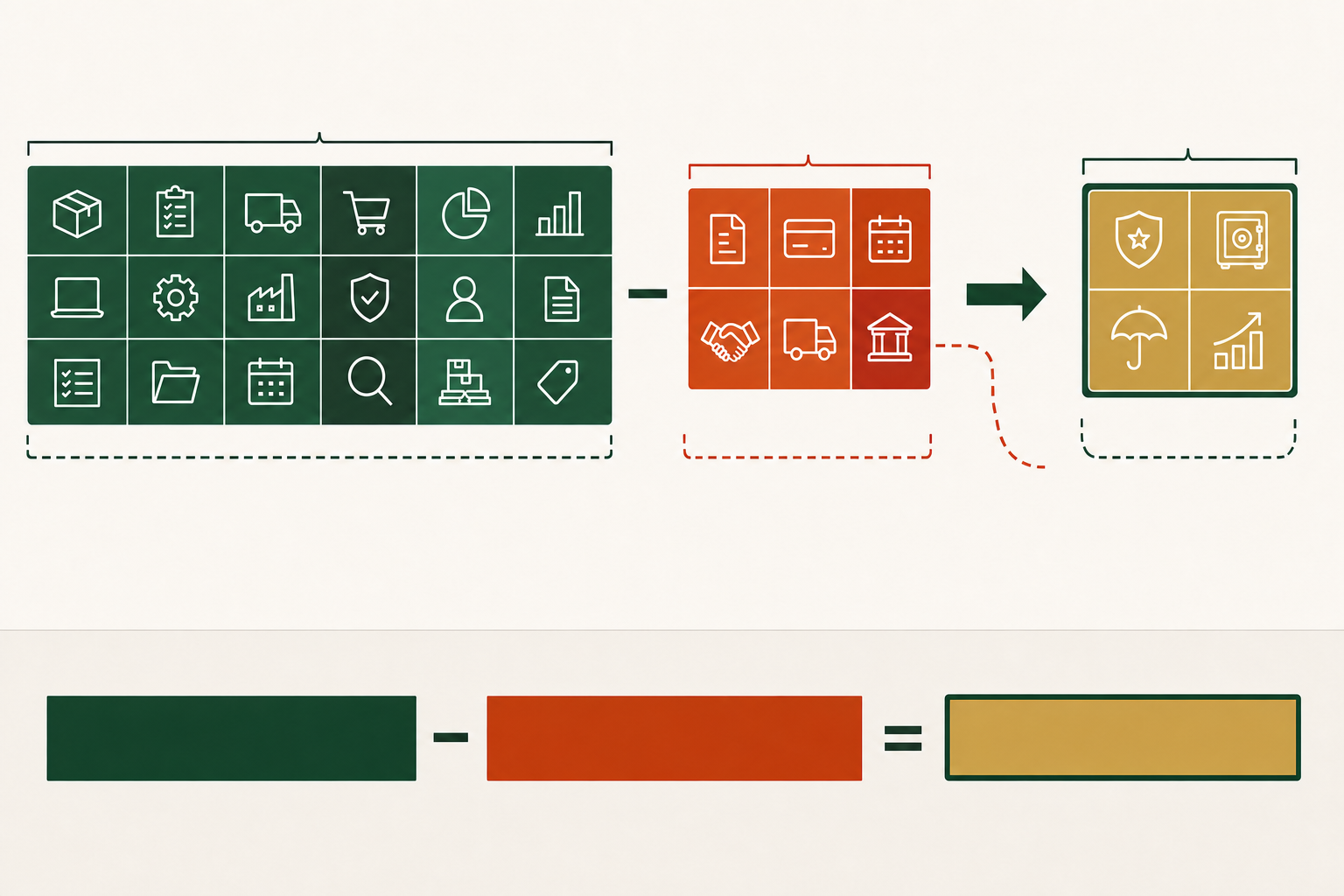
Detailed visual description
The selected illustration uses three aligned pictogram groups: a large deep-green current-assets group, a smaller orange-red current-liabilities group, and a remaining gold working-capital group. The presentation layer supplies the exact labels and equation as accessible HTML beneath the illustration. The values are a bounded teaching example, not a claim about a real entity.
Put the concept to work
Understand this concept
- Explain working capital as a date-specific arithmetic difference between classified current assets and current liabilities, distinct from Cash and from model-specific operating working capital.
Apply this concept
- Compute working capital and the current ratio from a classified balance sheet, and restate both when one item moves between current and noncurrent.
Analyze this concept
- Compute and compare basic working-capital positions, trace changes to classified components, and identify why an equal difference does not establish equal liquidity.
Learning resources
Choose a lesson, try an application, or inspect the sources behind this concept.
Build on these ideas
- Current asset — Analyze
To understand this concept: Required. The measure depends on a supported current-asset total.
- Current asset — Understand
To apply this concept: Required. The computation needs a current-asset total.
- Current liability — Analyze
To understand this concept: Required. The measure depends on a supported current-liability total.
Show 2 more prerequisites
- Liquidity — Understand
To analyze this concept: Required. Interpretation must reopen composition and timing rather than treat the difference as payment capacity.
- Working capital — Understand
To analyze this concept: Required. Comparison must preserve the measure's subtraction, date, unit, and classification basis.
To apply this concept: Required. Computing the measure requires knowing what it subtracts.
Lessons
Worked examples and cases
Practice
Common mistaken ideas
- Mistaken idea: A higher current ratio always means better liquidity
- Mistaken idea: A shorter cash conversion cycle is always better
- Mistaken idea: Positive working capital proves going concern
Show 1 more mistaken ideas
Sources
Standard references
Related concepts
Show 5 more related concepts
Use this idea next
- Current ratio — Analyze
Required level here: analyze. Required. The dollar difference provides a complementary scale view and exposes transaction effects the ratio can obscure.
- Restricted cash — Analyze
Required level here: analyze. Required. The effect shows up in working capital and the ratios built on it.
- Working capital — Analyze
Required level here: understand. Required. Comparison must preserve the measure's subtraction, date, unit, and classification basis.
Show 1 more next steps
- Working capital — Apply
Required level here: understand. Required. Computing the measure requires knowing what it subtracts.
Used in these readings
These chapters explain or apply this concept. The label states how the chapter uses it.