The operating cycle adds Inventory days and receivable days. The cash conversion cycle subtracts the period supported by ordinary trade payables.
For Aster Year 3:
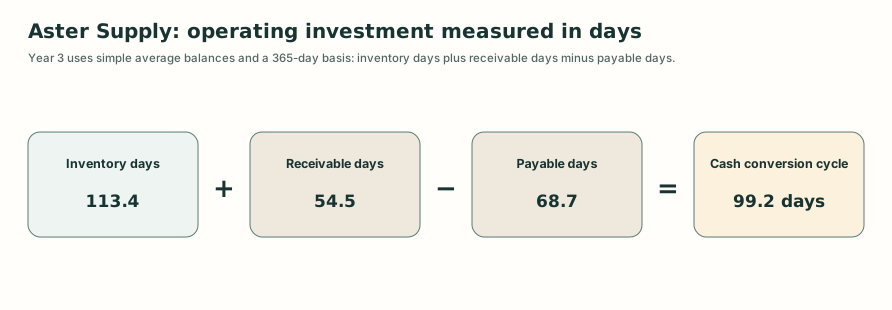
operating cycle = 113.38 DIO + 54.47 DSO = 167.85 days
cash conversion cycle = 167.85 − 68.65 DPO = 99.20 days
When goods are purchased on credit, the company can hold and sell them while the supplier invoice remains unpaid. DIO plus DSO counts the gross interval from holding Inventory through collecting the customer; DPO approximates the part of that interval before the company's cash leaves to settle the supplier claim. Subtracting DPO leaves the estimated self-financed interval. The negative sign does not make Accounts Payable a negative operating activity.
Attribute arithmetic before cause
Aster's cycle lengthens over the packet while Birchline's shortens. The calculation can attribute the movement to Inventory, receivable, and payable days. It cannot explain why those components moved. That requires demand, stockout, aging, terms, write-off, purchase, supplier, payment, and seasonality evidence.
A shorter cycle can release working capital, but it is not always better. It can result from stockouts, constrained customer credit, lost supplier discounts, delayed payment, or a change in business model. For example, a retailer that receives customer cash at sale but settles ordinary supplier invoices later can have a negative cycle. That timing pattern is not automatically a defect or a guarantee of liquidity. The present module confines its calculations to two wholesalers with positive cycles; cross-business-model evaluation remains outside its evidence packet.
Use as a bridge, not a cash forecast
The cycle links accrual statement flows and average balances. It does not specify the dates or amounts of future receipts and payments. A cash budget or forecast needs invoice schedules, terms, seasonality, commitments, financing, and scenarios.
Boundary
This module uses positive annual flows, continuous ordinary operations, exact credit sales and credit purchases, simple averages, and one 365-day convention. Supplier finance, factoring, manufacturing stages, services without Inventory, negative or zero denominators, acquisitions, interim seasonality, and forecast applications require different inputs or models.
Aster Supply cash conversion cycle
Detailed visual description
The generator reads Aster Supply's checked Year 3 opening and ending operating balances, flow denominators, and 365-day basis from the same dataset used by the multi-period worked examples.
Put the concept to work
Understand this concept
- Explain the cash conversion cycle as Inventory days plus receivable days less payable days, distinct from the operating cycle, accounting cycle, and a direct cash forecast.
Analyze this concept
- Reconcile a multi-period cash conversion cycle from its three days components, attribute mathematical changes, and identify service, terms, aging, demand, supplier, and cash evidence needed before evaluation.
Learning resources
Choose a lesson, try an application, or inspect the sources behind this concept.
Build on these ideas
- Cash conversion cycle — Understand
To analyze this concept: Required. Analysis requires the role and sign of each component.
- Days inventory outstanding — Analyze
To analyze this concept: Required. The Inventory component must be controlled and evidenced.
- Days payables outstanding — Analyze
To analyze this concept: Required. The supplier-financing offset must be controlled and evidenced.
Show 3 more prerequisites
- Days sales outstanding — Analyze
To analyze this concept: Required. The customer-collection component must be controlled and evidenced.
- Operating cycle — Understand
To understand this concept: Required. The gross resource-to-collection interval precedes the supplier-financing offset.
- Operating efficiency analysis — Understand
To understand this concept: Required. Every component inherits an aligned flow, average balance, scope, and day convention.
Lessons
Worked examples and cases
Practice
Common mistaken ideas
Sources
Related concepts
Show 3 more related concepts
Use this idea next
- Cash conversion cycle — Analyze
Required level here: understand. Required. Analysis requires the role and sign of each component.