On this page
A current liability is a near-term classified obligation, not simply any credit balance or any amount management intends to pay soon. The liability must exist, and the applicable settlement and classification facts determine its section.
A bounded classified section
Northstar reports:
| Current liability | Amount | Stated basis for the bounded classification |
|---|---|---|
| Accounts Payable | $50,000 | Ordinary supplier obligations in the short operating cycle |
| Short-term bank debt | 30,000 | Contractually due within the stated current horizon |
| Total current liabilities | $80,000 |
The two lines are both current but economically different. Payables arise from operating purchases; the bank debt is financing. Their maturity concentration, counterparties, renewal options, covenants, and access to replacement funding matter beyond the $80,000 total.
Why debt needs the actual contract
A label such as “long-term debt” does not guarantee noncurrent presentation. Demand provisions, covenant breaches, callable terms, refinancing conditions, and amounts due within the next period can change classification. Topic 210 points to more specific debt guidance, including Topic 470, for relevant cases.
Likewise, management's hope to refinance does not erase the balance-sheet-date obligation without the facts required by current guidance.
Measurement and timing remain distinct
An accrued operating obligation can be current even when its exact amount is estimated. Classification asks where the liability belongs; measurement asks how much is recognized. Settlement timing, uncertainty, and source evidence should remain visible rather than compressed into one “short-term” flag.
Boundaries
This foundation stipulates ordinary Accounts Payable and explicitly short-term bank debt. Other cases require complete facts and their specific current guidance. These cases include maturing or callable debt, covenant violations, refinancing, leases, taxes, contingencies, contract liabilities, supplier finance, and obligations in disposal groups.
Source
Read ASC 210-10-45-5 for classified presentation, ASC 210-10-45-6 for estimated and accrued current obligations, and ASC 210-10-45-7 for the debt-guidance route. For example, ASC 470-10-45-10 addresses obligations due on demand, while ASC 470-10-45-14 requires both intent and evidence of ability in its refinancing lane. These paragraphs do not replace review of the complete agreement and reporting date.
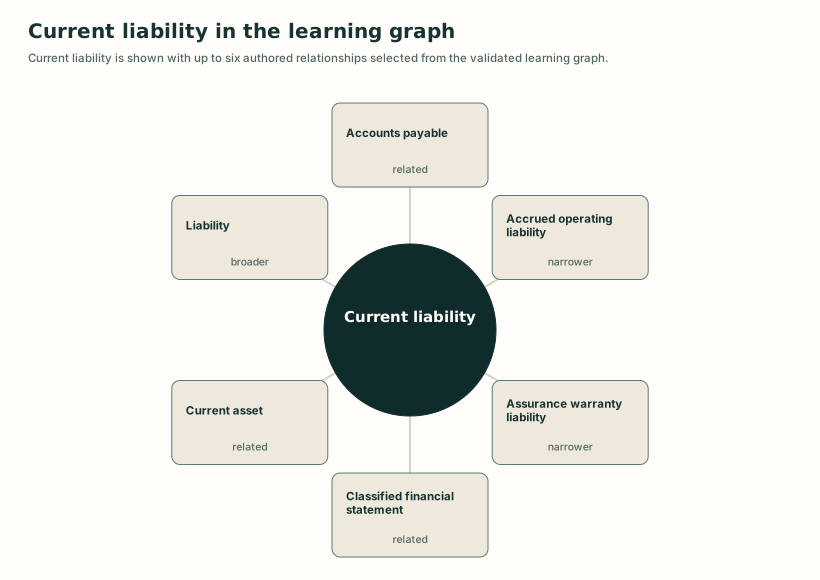
Current liability in the learning graph
Detailed visual description
A structural map places Current liability at the center and connects it to related concepts, prerequisite concepts, or lessons from the knowledge graph. Edge labels distinguish broader, narrower, related, prerequisite, and teaching relationships where present.
Put the concept to work
Understand this concept
- Explain current-liability classification using expected settlement, current-resource use, operating-cycle, maturity, and contract boundaries rather than account-name memorization alone.
Analyze this concept
- Classify ordinary Accounts Payable, accrued operating obligations, and explicitly short-term debt as current in a bounded fact pattern and identify contract or refinancing facts that could change the conclusion.
Learning resources
Choose a lesson, try an application, or inspect the sources behind this concept.
Build on these ideas
- Current liability — Understand
To analyze this concept: Required. Classification requires applying current-section criteria to each obligation's settlement facts.
- Liability — Apply
To analyze this concept: Required. The learner must first establish a present obligation rather than infer one from a future plan.
- Liability — Understand
To understand this concept: Required. Only a present obligation can be classified within the current liability section.
Show 2 more prerequisites
- Operating cycle — Analyze
To analyze this concept: Required. Ordinary operating settlement must be evaluated against the bounded operating horizon.
- Operating cycle — Understand
To understand this concept: Required. The operating cycle supplies context for ordinary operating obligations.
Lessons
Worked examples and cases
Practice
Common mistaken ideas
- Mistaken idea: A higher current ratio always means better liquidity
- Mistaken idea: Management intent makes short-term debt noncurrent
- Mistaken idea: The operating cycle is always one year
Show 1 more mistaken ideas
Sources
- FASB Accounting Standards Codification Topic 210, Balance Sheet
- FASB ASC Topic 470, Debt
- FASB Conceptual Framework
Show 1 more sources
Standard references
Broader topics
More specific topics
Show 2 more more specific topics
Related concepts
Show 5 more related concepts
Use this idea next
- Current liability — Analyze
Required level here: understand. Required. Classification requires applying current-section criteria to each obligation's settlement facts.
- Current portion of long-term debt — Apply
Required level here: analyze. Required. The current-section criteria provide the classification baseline.
- Current ratio — Understand
Required level here: analyze. Required. The denominator must come from supported current-liability classifications and cannot be zero for a defined ratio.
Show 2 more next steps
- Liquidity — Understand
Required level here: understand. Required. Liquidity is evaluated against the timing and terms of obligations.
- Working capital — Understand
Required level here: analyze. Required. The measure depends on a supported current-liability total.
Used in these readings
These chapters explain or apply this concept. The label states how the chapter uses it.