Lesson

Before the entry: event, element, and account

Separate what happened economically from the reporting elements affected and the accounts used to preserve the detail.

Updated Sep 6, 2026 Review due Nov 6, 2026

Listen to this lesson

20 min 17.9 MB 8 chapters Download the transcript

Transcript Includes practice answers
  1. 0:00 Every day, something happens. For most organizations, many things happen.
  2. 0:05 Regardless of their industry, employees, customers, investors, counterparties, and various other parties generate an overwhelming amount of activity when viewed under a microscope.
  3. 0:18 Clearly, not all of this activity "matters" for modeling the financial condition of an organization, even if some of it does. So how do we decide what matters?
  4. 0:30 And relatedly, how do we answer the rest of the Five W's we learned in grade school? Taken together, financial reporting boils down to answering the who, what, when, where, why of an organization's financial activities.
  5. 0:46 For better or worse, in the United States and most of the world, we are not making up the rules from scratch.
  6. 0:53 While financial reporting has and likely will always continue to leave broad discretion to the parties preparing a report, there are still clearly marked boundaries we must stay within.
  7. 1:07 And these boundaries begin with the basics - what are the types of events we must record? Let's start with the most basic version of the rule: The rule, first pass.
  8. 1:19 An event belongs in the records when it changes what the organization owns or what it owes. That test is clean enough, and it holds until we try it on an ordinary purchase.
  9. 1:32 A single purchase can carry three dates, and somebody inside the company will call each of them the real one. Beacon Design is a small architecture studio invented for this course.
  10. 1:45 It needs 3,000 dollars of drafting supplies.
  11. 1:48 Its office manager signs a purchase order on Monday. The order says Beacon pays within 30 days of delivery.
  12. 1:56 The vendor delivers on Wednesday and invoices Beacon, and Beacon pays 1,000 dollars on Friday against the 3,000 dollars it now owes. So which of those three dates does Beacon record?
  13. 2:09 Beacon's financial statements change on Wednesday and on Friday. Monday changes nothing in them, though it changes plenty in the records behind them.
  14. 2:20 Monday is also the date most of us would pick, which is why it is the one to work through first.
  15. 2:27 Why Monday looks like the right date. There are good reasons to think Monday counts. The order is signed, and on these terms the vendor could enforce it if Beacon backed out.
  16. 2:40 Inside the company the 3,000 dollars is already spent in every practical sense, and Beacon's books say so from Monday.
  17. 2:49 The order is on file, the amount is committed against a budget, and no other manager can spend the same 3,000 dollars on something else.
  18. 2:59 Bookkeeping is doing its job here, and a treasurer forecasting cash will count that 3,000 dollars weeks before any invoice shows up.
  19. 3:08 So a rule suggests itself: a signed obligation is an obligation, so put the signed contract in the liabilities. That rule isn't naive. If what we want to know is what Beacon has promised, Monday is the date to look at.
  20. 3:24 Here is where we have to be careful, because two different questions are hiding in one word. An accounting system records far more than a set of financial statements reports.
  21. 3:37 Beacon's records track the order, the budget, the vendor, and eventually the invoice number. The financial statements report a much smaller set: what Beacon owns, what it owes, and what happened to the owners' claim.
  22. 3:53 Recognition is the narrower question, and it is the one the first pass is really asking. Everything in this course sits on top of an assumption we should say out loud.
  23. 4:05 The records have to be complete, and each event has to appear once.
  24. 4:10 Get recognition perfectly right on top of books that double-count a sale or lose a payable, and the report is still wrong, because no rule about when to record something repairs a record of something that never happened.
  25. 4:26 The SEC's allegations in HealthSouth describe thousands of small false entries, each sized to stay under the threshold where anyone would look.
  26. 4:37 The law agrees: the Foreign Corrupt Practices Act requires issuers to keep accurate books and adequate internal accounting controls, separately from anything to do with bribery.
  27. 4:51 Recognition asks a narrower question than whether something happened that matters to Beacon.
  28. 4:58 The Financial Accounting Standards Board (FASB) defines the two elements we need here, and both definitions turn on the word present.
  29. 5:09 Quoting FASB Concepts Statement No. 8, Chapter 4, paragraphs E16 and E37.
  30. 5:19 An asset is a present right of an entity to an economic benefit. A liability is a present obligation of an entity to transfer an economic benefit.
  31. 5:36 Let's put those words into the first pass: The rule, tightened.
  32. 5:42 An event belongs in the records when it gives the organization a present right to an economic benefit, or leaves it with a present obligation to transfer one.
  33. 5:55 Owning has become a present right, owing has become a present obligation, and present is the word Monday fails, because on Monday Beacon holds neither the right nor the obligation.
  34. 6:11 What is missing on Monday. Neither side has performed on Monday. Beacon's duty to pay doesn't mature until the supplies arrive, and they haven't arrived.
  35. 6:21 The vendor's duty to deliver is outstanding too, so each side is holding nothing but the other's promise.
  36. 6:28 An exchange in that state, where both promises are outstanding and each is the price of the other, is what accountants call executory.
  37. 6:37 The same state shows up whenever any of us orders a couch for delivery next month, since the store still has the couch and we still have the cash. Notice how much work the payment terms just did.
  38. 6:50 We concluded that Beacon's duty had not matured because the order says payment comes 30 days after delivery.
  39. 6:57 Change that clause to payment on signing and the analysis changes, because Beacon would owe the 3,000 dollars on Monday no matter what the vendor did next.
  40. 7:08 That is an obligation with no condition left on it, which is exactly what the tightened rule asks about.
  41. 7:15 Whether it belongs in Monday's statements, and what would sit opposite it, is a question later units take up with prepayments.
  42. 7:23 What matters now is smaller and firmer: we read the terms before we pick the date, because the terms are what decide.
  43. 7:31 Recognizing one side of an executory contract while ignoring the matching right or duty would report half of an arrangement as though the other half did not exist.
  44. 7:42 Recognizing both sides would put 3,000 dollars of supplies on Beacon's balance sheet while those supplies sit in the vendor's warehouse.
  45. 7:51 Neither report describes where Beacon stood on Monday, so nothing goes into the records that day. None of that says Beacon has no legal duty on Monday. A signed order is a contract, and the duty is real.
  46. 8:05 What Beacon does not have yet is an obligation to transfer an economic benefit now, instead of a promise that becomes payable once the vendor delivers. Enforceability and a present obligation are two different questions.
  47. 8:20 The notes are a third place, between the records and the totals.
  48. 8:24 Some purchase commitments have to be disclosed, and a commitment whose price has turned against the buyer can require a loss before anything is delivered, which for inventory is an inventory purchase commitment question under Topic 330.
  49. 8:40 Both tests have conditions this lesson does not establish, and neither changes what Beacon records on Monday.
  50. 8:47 The Codification classifies the Conceptual Framework as nonauthoritative: it explains why the elements read the way they do, and cannot settle a question a Codification Topic answers directly.
  51. 9:01 The tightened rule describes the ordinary case, and a few arrangements land in the records before either side has performed. Where the rule stops, arrangements recorded before performance.
  52. 9:13 A derivative goes on the balance sheet from inception, a written guarantee creates an obligation while the guarantor has done nothing, and a purchase contract can create a liability before delivery once the agreed price has moved far enough above the asset's value.
  53. 9:31 Each gets its own unit later. They are named here because a signature does sometimes put an amount in the statements.
  54. 9:39 What changes when the supplies arrive. The vendor delivers on Wednesday, and Beacon now controls the supplies and holds a present right to the benefit its drafting staff will get from consuming them.
  55. 9:54 Beacon also owes 3,000 dollars with no condition left, because the only condition attached to its promise was that the vendor perform, and the vendor performed.
  56. 10:06 Beacon itself did nothing on Wednesday, so the other party's act is what moved the date. An executory promise ordinarily becomes a present obligation for the contract amount at the moment the other side performs.
  57. 10:22 Delivery is what makes the obligation present, so the accounting transaction is the delivery itself and not the invoice that reports it.
  58. 10:32 Satisfying a definition is necessary for recognition and not enough on its own, because the amount also has to be measurable and faithfully representable, and the agreed 3,000 dollars on the signed order supplies both.
  59. 10:48 Friday changes two amounts and nothing else. Beacon's cash falls by 1,000 dollars, and what it owes the vendor falls to 2,000 dollars.
  60. 10:58 Settling a payable reduces one asset and one liability, and it creates no expense, earns nothing, and brings in no new resource. That is why the date Beacon pays is a poor guide to the date Beacon took on the obligation.
  61. 11:14 A few elements, many accounts. We have the when for this purchase. The rest of the entry answers what, and that turns out to be two questions, not one.
  62. 11:25 The financial statements report a short list of categories, and there is no tenth one hiding somewhere.
  63. 11:32 Assets, liabilities, and equity, plus the revenues, expenses, gains, losses, owner investments, and owner distributions that explain how equity changed.
  64. 11:43 These are the financial statement elements, and every effect Beacon records lands inside one of them. Supplies and Accounts Payable are not on that list.
  65. 11:54 They are accounts, which are the individual records Beacon keeps so it can answer questions later: how much do we hold in drafting supplies, and how much do we owe Northline specifically.
  66. 12:07 A company has a handful of elements and can have hundreds of accounts, and every account it opens belongs to exactly one element. Accounts Payable is an account, and the element it belongs to is liabilities.
  67. 12:21 So how much does the choice of account decide? Less than most of us expect.
  68. 12:26 Suppose a second studio records Wednesday's delivery to an account called Drafting Materials and organizes its payables by vendor name instead of by category.
  69. 12:38 Its total assets and its total liabilities come out identical to Beacon's, because the accounts a company opens do not change how much lands in the element each account belongs to. Do not push that further than it goes.
  70. 12:53 Choosing between two accounts inside one element leaves total assets and total liabilities alone, and it can still move two numbers somebody relies on.
  71. 13:03 Current and noncurrent obligations are reported separately, so a lender computing working capital reads that split.
  72. 13:12 Supplies also get consumed within the period while equipment gets depreciated over several years, so an account that misdescribes what Beacon bought sends the cost out through the wrong route and in the wrong year.
  73. 13:27 What the asset is decides both the account and the treatment, and the title on the account does not decide the treatment on its own. So read the event, name the elements, then pick the accounts.
  74. 13:41 Work in the other order and we are deciding what happened from whatever account title came to hand, which is how a reported total ends up resting on a typing choice.
  75. 13:53 Why an account has two columns. Beacon's obligation to the vendor stood at 3,000 dollars on Wednesday and 2,000 dollars after Friday's payment, and an account has to preserve more than that closing figure.
  76. 14:08 A single running total answers how much Beacon owes today and nothing further, which is the difference between a bank balance and a bank statement.
  77. 14:18 Anyone tracing Friday's payment needs the increases and the decreases kept apart.
  78. 14:23 A T-account keeps them apart with a title, one column for each direction, and a balance read from the difference, so the 3,000 dollars delivery and the 1,000 dollars payment stay visible after they have been netted against each other.
  79. 14:40 Which direction goes in which column follows a convention, and debits and credits works through it.
  80. 14:46 Nothing here depends on that convention, because the analysis that the obligation rose on Wednesday and fell on Friday is complete before either amount is placed in a column.
  81. 14:58 The worked example credit purchase and partial settlement runs these three dates through the accounts if you want to see the entries before the next lesson.
  82. 15:09 Exit check. Beacon signs a 9,000 dollars equipment order on March 3, takes delivery on March 20, and pays 4,000 dollars on April 5. State the dates on which Beacon's recorded amounts change and what changes on each.
  83. 15:26 March 20 affects two elements, so name both, and name an account Beacon might reasonably use for each. Then separate the two decisions you just made: naming the elements is one, and choosing the accounts is the other.
  84. 15:42 A lender reading total liabilities sees the effect of the element decision and not the account decision, so say why, and then say how the account decision still changes numbers Beacon reports.
  85. 15:57 Finally, draw the payable as a T-account across both dates, and say what the two columns preserve that a single running balance would lose.
  86. 16:10 Two things to try before you go, in the words the practice bank uses.
  87. 16:16 Question. A company places a purchase order for office supplies. Two days later the vendor delivers the supplies on credit, and the company accepts them.
  88. 16:30 Under the stated terms, the order alone created no recognized asset or liability. Which statement correctly distinguishes the event, elements, and accounts?
  89. 16:45 A. The purchase order is the asset, and Supplies is the financial statement element. B.
  90. 16:54 Delivery creates the stated asset and obligation; Supplies and Accounts Payable are accounts that preserve detail about the asset and liability elements. C.
  91. 17:10 No accounting event occurs until cash is paid because only cash movements can be recorded. D. Accounts Payable is the economic event, and delivery is the account used to record it.
  92. 17:33 The answer is B. Delivery creates the stated asset and obligation; Supplies and Accounts Payable are accounts that preserve detail about the asset and liability elements.
  93. 17:49 Question. In a different fact pattern, a company begins with 5,000 dollars cash and 5,000 dollars equity. It receives 4,000 dollars of unused supplies on credit and later pays the vendor 1,500 dollars.
  94. 18:13 No other events occur. Which set of ending element totals is correct?
  95. 18:22 A. Assets 3,500 dollars; liabilities 0 dollars; equity 3,500 dollars. B. Assets 7,500 dollars; liabilities 2,500 dollars; equity 5,000 dollars. C. Assets 9,000 dollars; liabilities 4,000 dollars; equity 5,000 dollars. D.
  96. 19:01 Assets 7,500 dollars; liabilities 4,000 dollars; equity 3,500 dollars.
  97. 19:19 The answer is B. Assets 7,500 dollars; liabilities 2,500 dollars; equity 5,000 dollars.
On this page
  1. What is missing on Monday
  2. What changes when the supplies arrive
  3. A few elements, many accounts
  4. Why an account has two columns
  5. Check your understanding
About this lesson

Lesson details

Estimated study time
35 min

Recognition foundationUse this lesson when you need to decide whether an event belongs in the records or distinguish an element from an account.

Learning objectives (6)

Use this refresher when you want to separate an economic event from the accounts used to record it. Alder Design is an architecture studio. It orders drafting supplies, receives them, and then pays part of the amount owed. The facts below are complete for this example and do not depend on another lesson.

An asset is a present right to an economic benefit. A liability is a present obligation to transfer an economic benefit. Those definitions help identify the kinds of items reported, but the applicable accounting requirements also determine whether and when to include an item in the statements.

Recognition means including an item in the financial statements with a description and an amount. Keeping a purchase order in an office file is not the same as recognizing Supplies or Accounts Payable in the accounting records.

What is missing on Monday

Alder orders $3,000 of drafting supplies on Monday. Assume this is an ordinary purchase agreement: neither party has performed, no deposit has been paid, Alder does not yet control the supplies, and no special contract-accounting requirement applies. Payment is due 30 days after delivery. The vendor delivers the supplies on Wednesday, when Alder obtains control. Alder pays $1,000 on Friday.

The ordinary purchase order produces no journal entry on Monday. Wednesday's delivery increases Supplies and Accounts Payable by $3,000 each. Friday's payment reduces Cash and Accounts Payable by $1,000 each.

The mistaken idea is that signing a contract always requires recording the full purchase as an asset and a liability immediately. A signed order does matter: the purchasing department keeps it, and management may include the expected payment in its cash plans. Those uses explain why someone might expect the general ledger to record it too.

The correction is to distinguish those records from financial-statement recognition. A contract under which both parties still owe their promised performance is called an executory contract. Ordinary executory purchase agreements generally are not recorded as the purchased asset and a payable before performance. That does not mean the contract creates no legal rights or duties.

The payment deadline does not determine whether an obligation is present. After Wednesday's delivery, Alder has Accounts Payable even though payment is not due for another 30 days. Also, physical location alone does not always establish control; the example expressly states that Alder obtains control on Wednesday.

Some agreements require different accounting before delivery, and some commitments require note disclosure. A commitment is an agreement to take a future action, such as purchasing goods. Those questions require the actual contract terms and applicable guidance. The assumptions above keep them out of this ordinary purchase example.
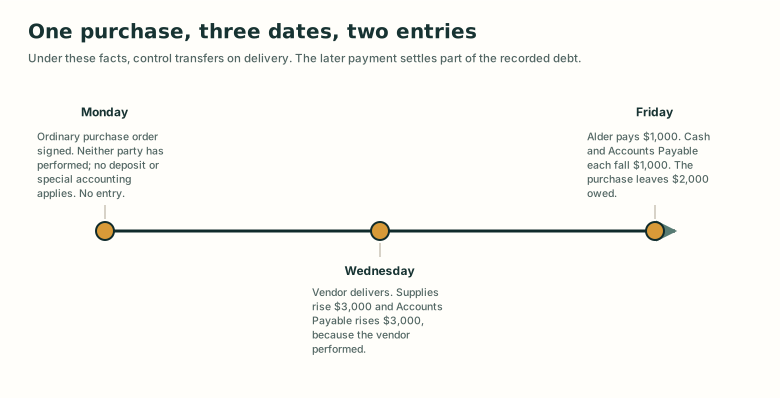
Under these facts, control transfers on delivery. The later payment settles part of the recorded debt.
Detailed visual description

Alder Design's teaching example assumes an ordinary purchase agreement, no deposit, no special contract accounting, and control transferring on Wednesday's delivery. Monday's signed order has no entry. Wednesday's delivery increases Supplies and Accounts Payable by $3,000 each. Friday's $1,000 payment reduces Cash and Accounts Payable by $1,000 each, leaving $2,000 owed for this purchase. The payment does not create an expense.

What changes when the supplies arrive

On Wednesday, Alder controls supplies it can use in its design work and owes the supplier $3,000. Assume the supplies have not yet been used. Their arrival increases an asset, Supplies, and a liability, Accounts Payable. It does not create an immediate supplies expense.

The vendor's invoice documents the amount owed. The accounting follows the delivery and control facts in this example, not a rule that the invoice date always creates a liability. If the invoice arrived later, Alder would still need to account for supplies already received and owed for.

Friday's payment settles part of that existing debt:

Effect of Friday's payment Amount
Decrease in Cash $1,000
Decrease in Accounts Payable $1,000
Remaining amount owed for this purchase $3,000 - $1,000 = $2,000

Paying the supplier does not record the purchase again or create an expense. The supplies become an expense as they are used under the stated facts. Payment and use answer different accounting questions.
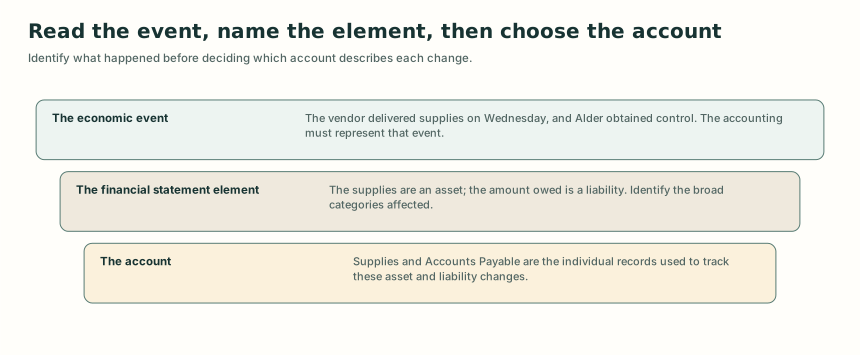
Identify what happened before deciding which account describes each change.
Detailed visual description

Three nested rectangles organize the analysis of Alder's delivery. The outer rectangle identifies Wednesday's receipt and control of supplies. The next identifies assets and liabilities as the affected elements. The inner rectangle identifies Supplies and Accounts Payable as the accounts used to record the changes. The display shows an order of analysis, not a claim that the event occurs inside an account.

A few elements, many accounts

A financial-statement element is a broad category, such as assets or liabilities. An account is the individual record that tracks a particular item within the accounting system. Supplies is an asset account; Accounts Payable is a liability account.

The Financial Accounting Standards Board (FASB) defines ten elements for business enterprises: assets, liabilities, equity, investments by owners, distributions to owners, comprehensive income, revenues, expenses, gains, and losses. The five account classes used in this course's recording work are assets, liabilities, equity, revenues, and expenses. They are a practical classification for the work, not a claim that FASB defines only five elements.

Comprehensive income describes the change in equity from nonowner sources. It includes net income and other comprehensive income. That broad description does not make it another ordinary account to select for every transaction. You do not need to calculate comprehensive income to classify this supplies purchase.

For Wednesday's delivery, first identify the changes in assets and liabilities, then choose accounts that describe the supplies and the debt. Another studio might call its asset account Drafting Materials. If it records the same purchase correctly, the increases in total assets and total liabilities are still $3,000 each. Those are changes caused by the purchase, not necessarily either company's entire asset or liability balance.

Account classification still matters. Recording supplies as Equipment may leave the immediate asset total unchanged but lead to incorrect later expense calculations. Current and noncurrent liability classifications can also affect subtotals even when total liabilities are unchanged. A different account name is harmless only when it continues to describe the item and its accounting correctly.
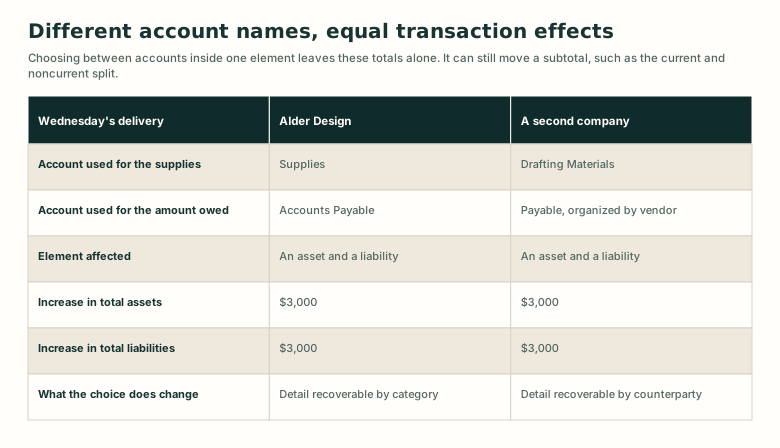
Choosing between accounts inside one element leaves these totals alone. It can still move a subtotal, such as the current and noncurrent split.
Detailed visual description

A comparison of Alder Design and another company recording the same teaching example. One uses Supplies and Accounts Payable; the other uses Drafting Materials and a payable organized by vendor. Both record an asset increase and a liability increase of $3,000 each. These are transaction effects, not complete company totals. Account organization preserves different detail; incorrect classification can also affect subtotals and later accounting.

Why an account has two columns

A T-account displays debits on the left and credits on the right. Accounts Payable increases with credits and decreases with debits. For this purchase, Wednesday's $3,000 increase is a credit and Friday's $1,000 decrease is a debit. The remaining credit balance is $3,000 - $1,000 = $2,000.

Keeping both entries visible lets a reader see how the balance formed. The ending balance alone would not show how much was purchased or how much was paid. The debits and credits refresher explains how increases and decreases work for the other account classes.

Check your understanding

Alder signs an ordinary $9,000 equipment order on March 3, receives and obtains control of the equipment on March 20, and pays $4,000 on April 5. Neither party performs before March 20, no deposit is required, and no special contract accounting applies. The equipment is ready for use when delivered.

Which dates require entries? Name the affected elements and accounts, and show the amount still owed after the payment. Explain why the payment does not create another equipment purchase.

Check your reasoning

March 3 has no entry under these assumptions. On March 20, Equipment and Accounts Payable each increase by $9,000: one asset and one liability increase. On April 5, Cash and Accounts Payable each decrease by $4,000. The remaining payable for this purchase is $9,000 - $4,000 = $5,000.

The payment settles an existing debt; it does not acquire the equipment again. In the Accounts Payable T-account, record a $9,000 credit on March 20 and a $4,000 debit on April 5, leaving a $5,000 credit balance. Any depreciation question would require additional information and is separate from recording the purchase and payment.