On this page
Lesson details
- Estimated study time
- 15 min
- Reading context
- Chapter 1
Intro-course refresherUse this lesson when you want to review which account types increase with a debit, which increase with a credit, and how each type decreases.
Learning objectives (3)
A debit is an amount on the left side of an account. A credit is an amount on the right. Neither word means increase or decrease by itself. The account type determines whether that side records an increase or a decrease.
Start with the account type
| Account type | Increase with | Decrease with | Normal balance |
|---|---|---|---|
| Asset | Debit | Credit | Debit |
| Expense | Debit | Credit | Debit |
| Distribution to owner | Debit | Credit | Debit |
| Liability | Credit | Debit | Credit |
| Equity | Credit | Debit | Credit |
| Revenue | Credit | Debit | Credit |
The normal balance is the side that ordinarily holds the account's ending balance. Cash is an asset, so it normally has a debit balance. Accounts Payable is a liability, so it normally has a credit balance.
A contra account normally has the opposite balance from its related account. For example, Accumulated Depreciation is a contra-asset. Assets normally have debit balances, but Accumulated Depreciation normally has a credit balance.
The accounting equation explains the pattern. Assets are on the left side of the equation and increase with debits. Liabilities and equity are on the right and increase with credits. Revenue increases equity, while expense and owner distributions reduce equity.
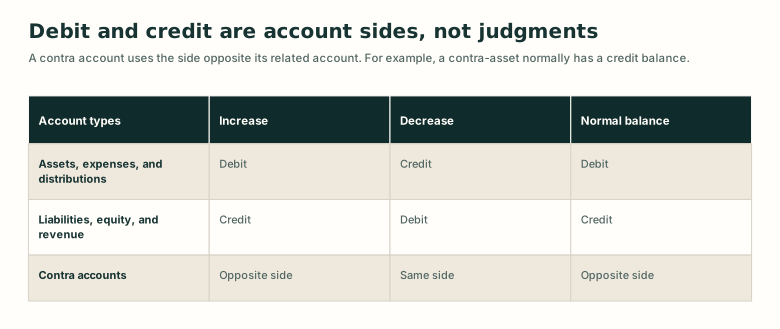
Detailed visual description
Assets, expenses, and owner distributions increase with debits, decrease with credits, and normally have debit balances. Liabilities, equity, and revenue increase with credits, decrease with debits, and normally have credit balances. A contra account increases and normally carries a balance on the side opposite its related account. It decreases on the same side that increases the related account. For example, Accumulated Depreciation is a contra-asset with a normal credit balance.
Apply the table to Alder's transactions
On January 2, shareholders invest $40,000 cash in Alder in exchange for no-par common stock. No-par shares have no stated par value, so Alder records the full investment in Common Stock:
Cash is an asset, and it increases with a debit. Common Stock is an equity account, and it increases with a credit.
Alder then pays $18,000 cash for equipment:
Equipment and Cash are both assets. The debit increases Equipment, and the credit decreases Cash. Because one asset replaces another, total assets remain $40,000 after the purchase.
On November 1, Alder receives a $6,000 customer advance:
The debit increases the Cash asset. The credit increases the liability for the support Alder still owes.
Quick checkIn the equipment purchase, why does a credit decrease Cash while a credit increases Unearned Revenue in the customer-advance entry?
Answer: Cash is an asset, and assets decrease with credits. Unearned Revenue is a liability, and liabilities increase with credits.
A debit can decrease a liability
Suppose a company previously borrowed money and now repays $2,000 of the amount borrowed. This payment is principal only; it does not include interest:
Notes Payable is a liability, so a debit decreases it. Cash is an asset, so a credit decreases it. The debit and credit both describe decreases because the accounts belong to different classes.
Bank statements use the bank's accounts
A bank statement can make debit sound like cash leaving and credit sound like cash arriving. The statement is written from the bank's perspective. A customer's deposit is a liability of the bank because the bank owes that money to the customer.
Alder's ledger uses Alder's perspective. Alder's Cash is an asset. Before using a debit or credit label, identify the reporting entity and the account.
Choose the side after the analysis
Use 3 questions for each account in an entry:
- What type of account is it?
- Is the account increasing or decreasing?
- Which side records that change for this account type?
Then confirm that total debits equal total credits. Equal totals are required, but they do not prove that the accounts or the date are correct.
Quick checkAlder completes $4,000 of design work on credit. Which accounts and sides belong in the entry?
Answer: Debit Accounts Receivable $4,000 and credit Service Revenue $4,000. The asset and the revenue both increase.
The worked example Debit and credit effects by account type provides more practice with the same table.