On this page
A credit means right. It is not automatically an increase, benefit, favorable event, or positive number. A credit increases some account classes and decreases others.
One side, different effects
Liabilities, equity, and revenue normally increase with credits. Assets, expenses, and owner distributions normally decrease with credits. For example:
- Credit Accounts Payable $1,000 increases a supplier obligation.
- Credit Cash $1,000 decreases an asset.
The account classification, not the word “credit,” determines the direction of the balance change.
Paired with debit, not opposed in value
Every balanced entry has equal total debits and credits. That does not make one side desirable and the other undesirable. When a company borrows $10,000, it debits Cash and credits a liability. The asset and obligation both increase. When it pays $2,000 of principal, it debits the liability and credits Cash. Both accounts decrease.
Debits and credits record the two-sided effects of a transaction. They are not plus and minus signs with fixed meanings across the ledger.
Revenue, equity, and creditor claims
The credit-normal classes on the right side of the expanded accounting equation include liabilities, equity, and revenue effects. Their common normal side does not make them economically interchangeable. Borrowing creates a repayment obligation; owner investment changes the residual interest; revenue arises through performance.
A finance reader who sees a credit balance therefore still needs the account name and context. Credit-normal does not mean debt, and a credit entry does not automatically improve profitability or cash flow.
The credit side can precede performance
Suppose a customer pays $3,000 before the company performs. Cash increases with a debit, and the obligation to the customer increases with a credit to Customer Advance. When the company later earns $1,200, it debits that liability and credits Revenue. The two credit lines occur at different dates and explain different economic effects: one increases an obligation; the other increases a performance-related equity effect.
Do not ask whether the cash receipt “is a credit.” Debit Cash when the company receives the money. Choose the credited account based on what the company owes or has performed. Equal totals can identify an arithmetic imbalance, but they cannot correct a misclassified account.
Boundaries
“Credit” also appears in lending, credit ratings, customer refunds, and bank interfaces. Those uses do not replace its technical role in a journal or ledger. Contra accounts and abnormal balances can also reverse the intuitive direction associated with a related account; they require an explicit account definition rather than a memorized shortcut.
Credit in the learning graph
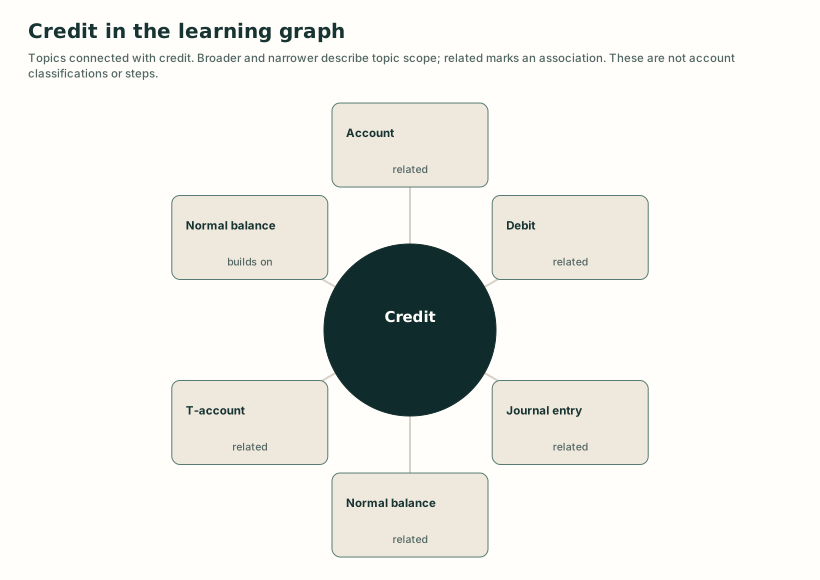
Detailed visual description
A structural map places Credit at the center and connects it to related concepts, prerequisite concepts, or lessons from the knowledge graph. Edge labels distinguish broader, narrower, related, prerequisite, and teaching relationships where present.
Put the concept to work
Understand this concept
- Explain that a credit records an amount on the right side of an account and that its increase-or-decrease effect depends on the account type.
Apply this concept
- Determine which classified account changes require credits in a basic transaction or adjustment.
Learning resources
Choose a lesson, try an application, or inspect the sources behind this concept.
Build on these ideas
- Account — Understand
To understand this concept: Required. The effect of a credit depends on the class and accumulated balance of the account.
- Credit — Understand
To apply this concept: Required. Application requires abandoning a universal increase or decrease meaning.
- Double-entry accounting — Understand
To understand this concept: Required. A credit is meaningful as one side of a balanced double-entry representation.
Show 1 more prerequisites
- Normal balance — Understand
To apply this concept: Required. The normal-side map determines whether a credit increases or decreases an account.
Lessons
Worked examples and cases
Practice
- Cash service followed by a wage payment
- Customer advance and refund before performance
- Ending balance in Accounts Receivable
Show 3 more practice items
Common mistaken ideas
Sources
Related concepts
Show 2 more related concepts
Use this idea next
- Credit — Apply
Required level here: understand. Required. Application requires abandoning a universal increase or decrease meaning.
- Journal entry — Apply
Required level here: apply. Required. The learner must assign credit effects after classifying each account change.
- Journal entry — Understand
Required level here: understand. Required. The learner must understand the right-side coordinate used on entry lines.
Show 2 more next steps
- Normal balance — Understand
Required level here: understand. Required. The learner must understand the right-side coordinate before using it as a normal side.
- T-account — Understand
Required level here: understand. Required. The right side must be identified independently of whether it increases the particular account.
Used in these readings
These chapters explain or apply this concept. The label states how the chapter uses it.