On this page
In double-entry accounting, every journal entry has equal total debits and credits. The word double does not mean that every transaction affects exactly 2 accounts.
Dual effect, not duplicate record
Suppose shareholders invest $20,000 cash in a company in exchange for no-par common stock. The entry records an increase in Cash and an increase in Common Stock:
The entry records both effects of one transaction. It does not record 2 transactions.
Now suppose a company buys $10,000 of equipment. It pays $3,000 cash and agrees to pay the remaining $7,000 later:
This transaction affects 3 accounts. The $10,000 debit equals the 2 credits, which total $10,000.
Connection to the accounting equation
The accounting equation groups reported amounts into assets, liabilities, and equity. Double entry records changes in the specific accounts within those classes. An exchange of one asset for another can leave total assets unchanged even though 2 asset accounts change. Borrowing can increase an asset and a liability. Earning revenue or incurring an expense can change an asset or liability and equity.
Debit and credit rules provide a consistent way to record these increases and decreases.
Equality is necessary, not sufficient
An entry can have equal debits and credits and still be wrong. It can use the wrong account, omit the transaction entirely, record an unsupported amount, duplicate a valid event, or place it in the wrong period. Equal sides prove arithmetic balance, not faithful representation.
Suppose a company pays $5,000 for a machine that it expects to use beyond the current period. Debiting Equipment and crediting Cash for $5,000 balances. Debiting an expense and crediting Cash for $5,000 would also balance, but it would use the wrong account. Equal totals are necessary, but they are only one check.
Boundaries
Double entry does not decide whether the company should record an event, how much to record, or which period to use. The company must answer those questions before it prepares the entry. Equal debit and credit totals also do not prove that the financial statements are complete or correct.
Continue the learning path
Use the journal construction lesson to connect event analysis with debit and credit lines. The coordinate-map example shows why each side depends on the account class. The entry-evidence task tests what equal totals establish and what they leave unproved.
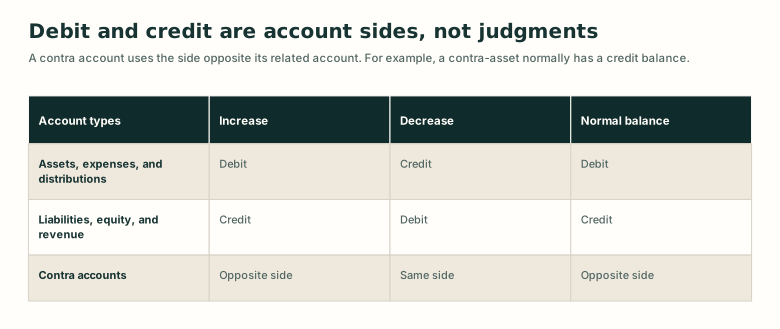
Debit and credit effects by account type
Detailed visual description
Assets, expenses, and owner distributions increase with debits, decrease with credits, and normally have debit balances. Liabilities, equity, and revenue increase with credits, decrease with debits, and normally have credit balances. A contra account increases and normally carries a balance on the side opposite its related account. It decreases on the same side that increases the related account. For example, Accumulated Depreciation is a contra-asset with a normal credit balance.
Put the concept to work
Understand this concept
- Explain why a transaction can affect more than two accounts while still requiring total debits to equal total credits.
Apply this concept
- Analyze whether a basic multi-account entry captures all classified effects and has equal debit and credit totals.
Learning resources
Choose a lesson, try an application, or inspect the sources behind this concept.
Build on these ideas
- Account — Understand
To understand this concept: Required. Double entry coordinates changes across accounts rather than across undifferentiated totals.
- Accounting equation — Apply
To understand this concept: Required. The learner needs the element-level invariant before interpreting the recording invariant.
- Accounting transaction — Apply
To apply this concept: Required. The learner must first identify every economic effect that the entry is intended to represent.
Show 1 more prerequisites
- Double-entry accounting — Understand
To apply this concept: Required. Application requires understanding that equality constrains but does not prove classification.
Lessons
Worked examples and cases
Practice
Common mistaken ideas
Sources
Related concepts
Show 2 more related concepts
Use this idea next
- Credit — Understand
Required level here: understand. Required. A credit is meaningful as one side of a balanced double-entry representation.
- Debit — Understand
Required level here: understand. Required. A debit is meaningful as one side of a balanced double-entry representation.
- Double-entry accounting — Apply
Required level here: understand. Required. Application requires understanding that equality constrains but does not prove classification.
Show 2 more next steps
- Journal entry — Understand
Required level here: understand. Required. A journal entry must preserve equal debit and credit totals across its account lines.
- Trial balance — Understand
Required level here: apply. Required. The equality check follows from the system's balanced debit-credit structure.
Used in these readings
These chapters explain or apply this concept. The label states how the chapter uses it.