On this page
A trial balance provides a narrow but important check: do the ending debit balances equal the ending credit balances? If they do, the ledger is arithmetically balanced. It does not mean every transaction and account is correct.
From ledger balances to two totals
Each ledger account contributes its ending balance to the debit or credit column. Debit-normal accounts with ordinary positive balances appear in the debit column; credit-normal accounts appear in the credit column. Abnormal balances require investigation rather than automatic relocation or deletion.
For example:
| Account | Debit | Credit |
|---|---|---|
| Cash | $13,500 | — |
| Supplies | $5,000 | — |
| Accounts Receivable | $4,500 | — |
| Utilities Expense | $1,000 | — |
| Accounts Payable | — | $3,000 |
| Owners' Equity | — | $15,000 |
| Service Revenue | — | $6,000 |
| Total | $24,000 | $24,000 |
The totals agree because the posted entries preserved equal debits and credits. If the $1,000 Utilities Expense debit had instead been posted to Supplies, the debit column would still total $24,000: Supplies would be $6,000 and Utilities Expense zero. Equality survives because one debit account replaced another, even though the asset and expense classifications are wrong.
Errors equality can reveal
An unequal trial balance can result from a one-sided posting, unequal amounts, a line posted to the wrong side, or an arithmetic error. The difference can guide the investigation, but it does not identify one specific error.
Errors equality cannot reveal
A trial balance can remain equal when:
- An entire balanced entry is omitted or duplicated.
- The correct amount is posted to the wrong account on the same side.
- Both sides use the same incorrect amount.
- A transaction is recorded in the wrong period.
- The accounting analysis is wrong but the proposed entry balances.
- Two errors offset in the totals.
These failures explain why reconciliation, source evidence, account review, cutoff tests, analytical procedures, and other controls remain necessary.
Unadjusted, adjusted, and post-closing views
A trial balance can be prepared before period-end adjustments, after accepted adjustments, and after temporary accounts are closed. The label and date matter because each version answers a different process question. An unadjusted trial balance is not a failed adjusted trial balance; it is an earlier checkpoint.
Later concepts will develop adjustments and closing. For now, treat the trial balance as a list of ledger balances at a named stage of the accounting cycle.
Where trial balances are used
Due diligence, audit support, transaction advisory, financial modeling, and data migration often begin with trial-balance or ledger exports rather than published statements. A finance reader needs to identify balance orientation, period, entity, currency, adjustment status, and mapping to statement lines before aggregating the data.
Boundaries
A trial balance is not a financial statement and does not establish GAAP presentation, disclosure, valuation, or completeness. It is a control and working representation of ledger balances whose scope must remain explicit.
Trial balance in the learning graph
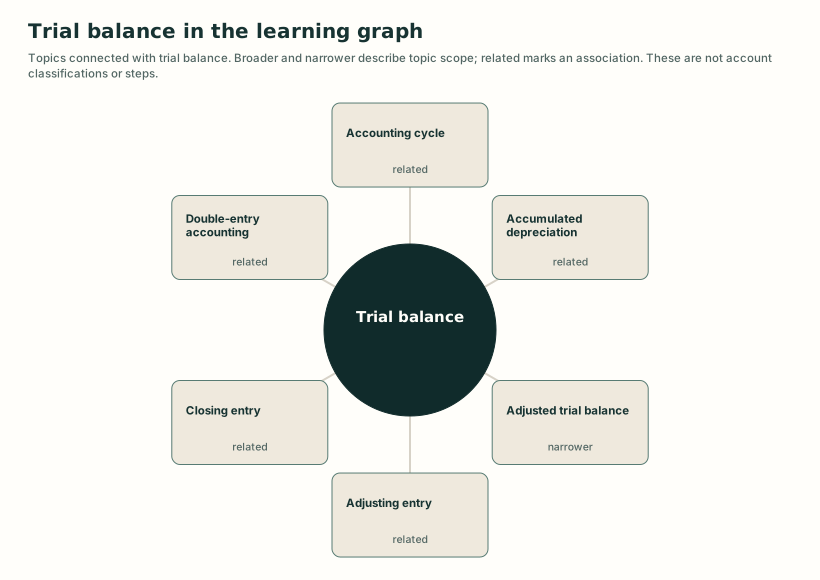
Detailed visual description
A structural map places Trial balance at the center and connects it to related concepts, prerequisite concepts, or lessons from the knowledge graph. Edge labels distinguish broader, narrower, related, prerequisite, and teaching relationships where present.
Put the concept to work
Understand this concept
- Explain what debit-credit equality in a trial balance verifies and which omission, classification, amount, and period errors can remain.
Analyze this concept
- Analyze a basic trial balance and account rollforwards to identify imbalance, abnormal balances, and errors that equality alone cannot detect.
Learning resources
Choose a lesson, try an application, or inspect the sources behind this concept.
Build on these ideas
- Double-entry accounting — Apply
To understand this concept: Required. The equality check follows from the system's balanced debit-credit structure.
- General ledger — Apply
To analyze this concept: Required. Account rollforwards provide the activity evidence needed to investigate ending balances.
- General ledger — Understand
To understand this concept: Required. The trial balance summarizes ending balances drawn from the ledger accounts.
Show 2 more prerequisites
- Normal balance — Apply
To understand this concept: Required. Each account balance must be placed on its debit or credit side before totals can be compared.
- Trial balance — Understand
To analyze this concept: Required. Analysis requires knowing the evidence supplied and omitted by debit-credit equality.
Lessons
Worked examples and cases
- A prepayment and customer advance through month-end
- Direct close and post-closing trial balance
- Posting five entries into a trial balance
Show 2 more examples and cases
Practice
Common mistaken ideas
Sources
More specific topics
Related concepts
Show 7 more related concepts
Use this idea next
- Accounting cycle — Understand
Required level here: understand. Required. Trial balances are named checkpoints before and after later period-end procedures.
- Adjusted trial balance — Understand
Required level here: understand. Required. The adjusted version is the same artifact drawn at a later point.
- Adjusting entry — Apply
Required level here: analyze. Required. The learner must distinguish the unadjusted balances from the updated adjusted balances.
Show 6 more next steps
- Closing entry — Apply
Required level here: analyze. Required. The adjusted and post-closing trial balances must be distinguished and reconciled.
- Financial statement articulation — Analyze
Required level here: analyze. Required. Statement mappings must remain traceable to adjusted ending account balances.
- Income statement — Analyze
Required level here: analyze. Required. Adjusted revenue and expense account balances supply the basic statement inputs.
- Permanent account — Apply
Required level here: analyze. Required. The post-closing trial balance checks the remaining debit and credit balances after temporary accounts are zeroed.
- Recording error — Analyze
Required level here: analyze. Required. The question is what the trial balance can and cannot prove.
- Trial balance — Analyze
Required level here: understand. Required. Analysis requires knowing the evidence supplied and omitted by debit-credit equality.
Used in these readings
These chapters explain or apply this concept. The label states how the chapter uses it.