On this page
A closing entry transfers a temporary account's balance and brings that account to zero for the next period. It adds a record; it does not delete the transactions that explain the balance.
Prepare a direct close
In a basic corporation, close directly to Retained Earnings as follows:
- Debit each revenue account for its credit balance and credit Retained Earnings.
- Credit each expense account for its debit balance and debit Retained Earnings.
- Credit Dividends for its debit balance and debit Retained Earnings separately.
Each entry must have equal debits and credits. A balance on an account's unusual side requires the opposite closing direction; inspect the actual balance instead of applying the steps without checking it.
Dividends reduce retained earnings but do not reduce net income. A separate dividend closing entry preserves that distinction. The standalone worked example shows complete entries and the resulting post-closing trial balance.
Keep adjustment and closing separate
Adjusting entries update the accounts for activity and estimates belonging to the reporting period. Closing uses those adjusted balances to reset temporary accounts. It does not fix a missing accrual or an incorrectly measured expense.
Cash is not part of the basic closing entries above. Payments were recorded when they occurred; closing an expense does not pay it again. Asset, liability, and permanent equity balances carry into the next period.
Check the result
Every temporary account should have a zero balance. Retained Earnings should agree with its beginning balance plus net income less dividends, allowing for any other changes that the facts specify. The remaining permanent balances should have equal debit and credit totals.
An equal trial balance alone does not prove those other conditions. An omitted expense closing line and its matching equity debit can preserve equality while leaving both accounts wrong.
Recognize another closing method
Some textbooks use Income Summary, an intermediate temporary account. Revenue and expenses close to Income Summary, then its net balance closes to Retained Earnings. Dividends still close directly to Retained Earnings.
That method and the direct method must produce the same final balances. Software may organize the process differently, but the student checks remain the same: correct transfers, zero temporary balances, and preserved records.
Closing entry in the learning graph
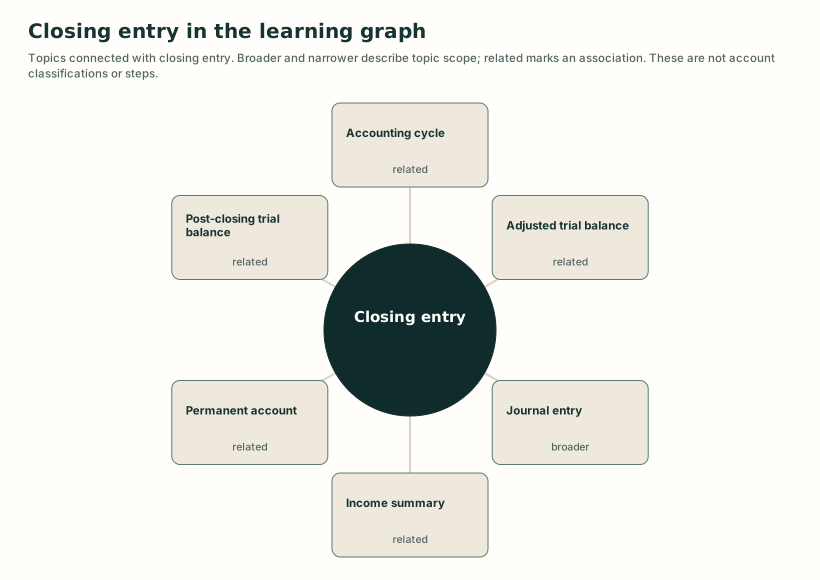
Detailed visual description
A structural map places Closing entry at the center and connects it to related concepts, prerequisite concepts, or lessons from the knowledge graph. Edge labels distinguish broader, narrower, related, prerequisite, and teaching relationships where present.
Put the concept to work
Understand this concept
- Explain how closing entries reset temporary accounts and transfer summarized period effects without deleting history, moving Cash, or creating the period's performance.
Apply this concept
- Prepare and verify basic direct closing entries for revenue, expense, and owner-distribution accounts and reconcile retained earnings and the post-closing trial balance.
Learning resources
Choose a lesson, try an application, or inspect the sources behind this concept.
Build on these ideas
- Accounting cycle — Understand
To understand this concept: Required. Closing occurs after adjusted balances and statements in the period-control sequence.
- Closing entry — Understand
To apply this concept: Required. Preparation must preserve history and period meaning rather than mechanically forcing every account to zero.
- Journal entry — Apply
To apply this concept: Required. Closing uses ordinary balanced debit-credit mechanics.
Show 4 more prerequisites
- Permanent account — Understand
To understand this concept: Required. The equity destination and other post-closing balances carry into the next period.
- Retained earnings — Analyze
To apply this concept: Required. The destination account must reconcile opening accumulated equity, net income or loss, and distributions.
- Temporary account — Understand
To understand this concept: Required. The accounts being zeroed must be distinguished from continuing balance-sheet and equity accounts.
- Trial balance — Analyze
To apply this concept: Required. The adjusted and post-closing trial balances must be distinguished and reconciled.
Lessons
Worked examples and cases
Practice
Common mistaken ideas
Sources
Broader topics
Related concepts
Show 5 more related concepts
Use this idea next
- Closing entry — Apply
Required level here: understand. Required. Preparation must preserve history and period meaning rather than mechanically forcing every account to zero.
- Income summary — Apply
Required level here: apply. Required. The sequence is the closing entries themselves.
- Income summary — Understand
Required level here: understand. Required. The account exists only to serve the closing process.
Show 1 more next steps
- Post-closing trial balance — Understand
Required level here: understand. Required. What survives closing is decided by what closing does.
Used in these readings
These chapters explain or apply this concept. The label states how the chapter uses it.