On this page
A journal entry records which accounts change, by how much, and on which side. It does not replace the contract, invoice, approval, or other evidence that supports the record.
From event to representation
Assume a company acquires $10,000 equipment, pays $3,000 cash, and owes the remaining $7,000. The event analysis comes first:
- Equipment, an asset, increases $10,000.
- Cash, an asset, decreases $3,000.
- Accounts Payable, a liability, increases $7,000.
The normal-balance map then produces the entry:
Total debits and credits are both $10,000. Three lines represent one transaction.
What a complete entry communicates
A basic entry normally includes a date, account names, debit and credit amounts, and a concise explanation or reference. A production system may also retain document links, preparer and approver identity, entity, currency, period, source system, reversal status, and other audit-trail fields.
Each field serves a different purpose. Equal totals show whether the entry balances. Evidence and authorization support recording the entry. The date places it in a reporting period, and the account names classify its effects. None of this information can be inferred safely from the other fields.
Simple and compound entries
A simple entry has one debit and one credit. A compound entry has more than two lines. Suppose employees complete $5,000 of work. The company pays $2,000 now and owes $3,000. The entry debits Wages Expense $5,000, credits Cash $2,000, and credits Wages Payable $3,000. A compound entry is not unusual or wrong; the transaction simply affects several accounts. Splitting one event across lines can be clearer than forcing it into an incorrect two-account entry.
At the same time, an entry should not combine unrelated events merely to make a batch balance. The explanation and evidence should preserve the unit of accounting that a reviewer needs to understand and test.
Reversal and correction are new events in the record
Deleting a posted error can destroy the audit trail. Accounting systems often reverse or correct entries with new, linked records so a reviewer can see the original, the reason for change, and the approved correction. The exact control depends on the system and environment, but the principle is durable: a balanced replacement should not make history invisible.
How journal entries support analysis
Journal entries show the account changes behind financial statement amounts. They can show whether reported revenue increased Cash or Receivables, whether expense created a payable, and whether a transaction affected performance or only financing. That detail is useful for diligence, modeling, controls, and forensic analysis even when the reader never posts an entry.
Boundaries
This concept does not establish the authoritative recognition or measurement of a particular transaction. It also does not prove that a posted entry was authorized, complete, or free from management bias. A correct entry is a faithful, balanced representation of an analysis that has already survived those questions.
Continue the learning path
Use the journal construction lesson to build an entry from recognized effects. Then compare entries in the mixed-events example with their source events. The entry-evidence task checks the limit of debit-credit equality before later practice asks you to prepare an entry.
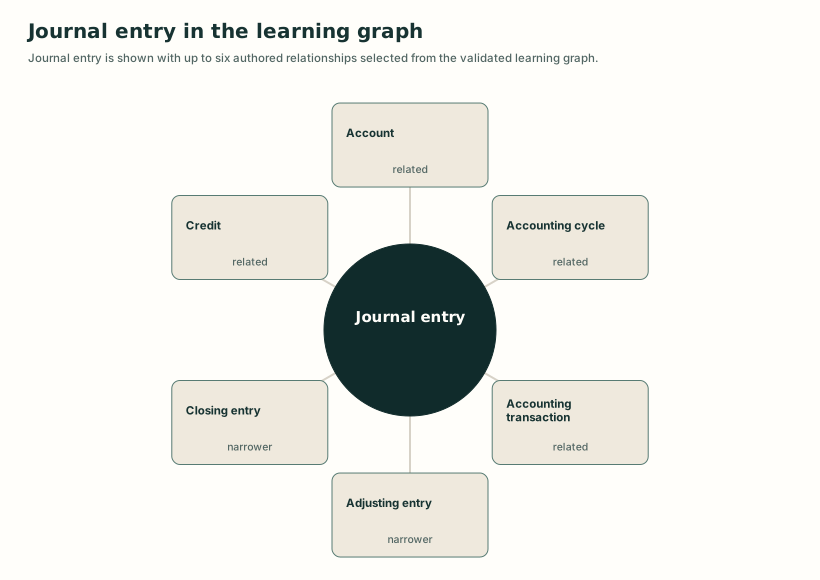
Journal entry in the learning graph
Detailed visual description
A structural map places Journal entry at the center and connects it to related concepts, prerequisite concepts, or lessons from the knowledge graph. Edge labels distinguish broader, narrower, related, prerequisite, and teaching relationships where present.
Put the concept to work
Understand this concept
- Explain how a journal entry represents a classified event without becoming the event, evidence, or authorization itself.
Apply this concept
- Prepare and explain a basic journal entry from a classified transaction, including all accounts and equal debit and credit totals.
Learning resources
Choose a lesson, try an application, or inspect the sources behind this concept.
Build on these ideas
- Account — Apply
To apply this concept: Required. A balanced entry with the wrong accounts does not faithfully represent the transaction.
- Accounting transaction — Apply
To understand this concept: Required. The economic event and its recognized effects must be identified before they can be represented.
- Credit — Apply
To apply this concept: Required. The learner must assign credit effects after classifying each account change.
Show 5 more prerequisites
- Credit — Understand
To understand this concept: Required. The learner must understand the right-side coordinate used on entry lines.
- Debit — Apply
To apply this concept: Required. The learner must assign debit effects after classifying each account change.
- Debit — Understand
To understand this concept: Required. The learner must understand the left-side coordinate used on entry lines.
- Double-entry accounting — Understand
To understand this concept: Required. A journal entry must preserve equal debit and credit totals across its account lines.
- Journal entry — Understand
To apply this concept: Required. Application requires understanding the entry as a representation with evidence and timing limits.
Lessons
Worked examples and cases
- Debit and credit effects for 7 events
- Posting five entries into a trial balance
- Prepare journal entries for routine transactions
Show 1 more examples and cases
Practice
Common mistaken ideas
Sources
More specific topics
Related concepts
Show 9 more related concepts
Use this idea next
- Accounting cycle — Understand
Required level here: apply. Required. Analyzed effects enter the records through balanced and supported entries.
- Accounting record — Apply
Required level here: understand. Helpful. The journal entry is a common first formal record of a transaction's account effects.
- Adjusting entry — Apply
Required level here: apply. Required. An adjustment uses the same balanced account-and-side mechanics as another journal entry.
Show 8 more next steps
- Closing entry — Apply
Required level here: apply. Required. Closing uses ordinary balanced debit-credit mechanics.
- General ledger — Understand
Required level here: understand. Required. Posted ledger lines originate in dated entries and remain traceable to them.
- Journal entry — Apply
Required level here: understand. Required. Application requires understanding the entry as a representation with evidence and timing limits.
- Noncash investing and financing activity — Understand
Required level here: apply. Required. A transaction can produce a valid asset, liability, or equity entry without using the Cash account.
- Posting — Apply
Required level here: apply. Required. The source entry supplies the account, side, amount, and transaction reference to post.
- Posting — Understand
Required level here: apply. Required. Only a classified and balanced entry can be transferred coherently into its affected accounts.
- Recording error — Understand
Required level here: apply. Required. An error is a departure from a correctly written entry.
- Secured borrowing using receivables — Apply
Required level here: apply. Required. The path recognizes financing without derecognizing the receivables.
Used in these readings
These chapters explain or apply this concept. The label states how the chapter uses it.