On this page
A debit means left. It does not mean decrease, loss, bad news, money leaving a bank, or a negative number. Whether a debit increases or decreases a balance depends on the account being recorded.
One side, different effects
Assets and expenses normally increase with debits. Liabilities, equity, and revenue normally decrease with debits. An owner distribution also has a debit-normal effect because it reduces equity through an owner transaction.
Consider two $1,000 debit lines:
- Debit Cash $1,000 increases an asset.
- Debit Accounts Payable $1,000 decreases a liability.
The word and side are identical. The account classification supplies the direction.
Why left and right work
An account can be pictured as a two-sided record. Debits occupy the left; credits occupy the right. The normal balance is the side used for increases in that account class. Amounts on the opposite side reduce the balance or can create an abnormal balance.
The convention is arbitrary in the limited sense that accountants could have chosen different names. Once chosen, however, the mapping is systematic. It lets a journal entry record several account changes while keeping total left-side and right-side amounts equal.
Bank language is a different perspective
A bank statement may call a reduction in a customer's deposit account a debit. From the bank's perspective, the customer's deposit is the bank's liability; debiting that liability reduces what the bank owes. The customer's own books classify Cash as an asset, so the company credits Cash when its bank balance falls.
The apparent contradiction disappears when the reporting entity and account classification are explicit. Never import a bank-interface label into the company's entry without changing perspective.
Use classification before the mnemonic
Students often memorize “debits increase assets” and then overextend it. The safer sequence is:
- Identify the economic event.
- Classify each affected account.
- Decide whether each account increases or decreases.
- Use the normal-balance map to choose debit or credit.
- Verify equal totals.
The sequence works when cash leads performance, follows performance, or does not move at all. A mnemonic that starts from cash direction does not.
Boundaries
A debit alone does not state why an account changed, whether the amount is correct, or whether the event belongs in the period. It identifies the left side of an account. Contra accounts and unusual balances require additional care because their normal side may differ from the related account they offset.
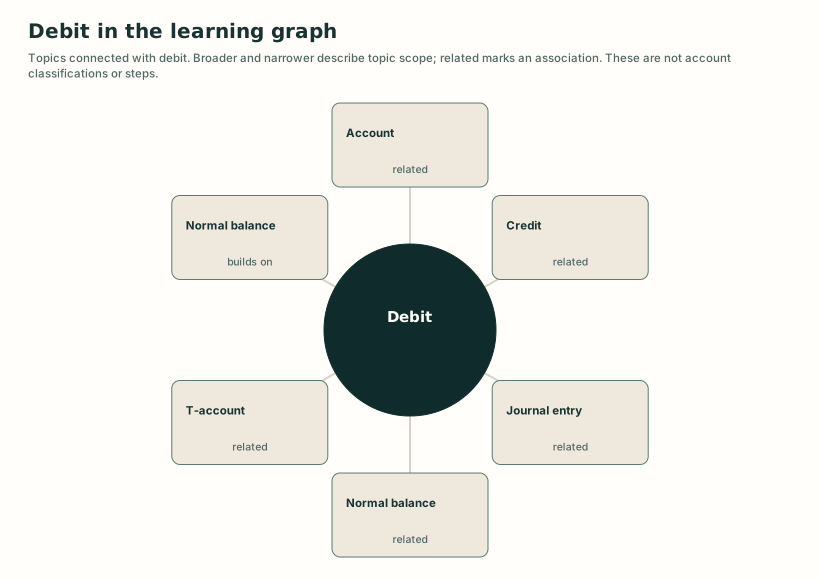
Debit in the learning graph
Detailed visual description
A structural map places Debit at the center and connects it to related concepts, prerequisite concepts, or lessons from the knowledge graph. Edge labels distinguish broader, narrower, related, prerequisite, and teaching relationships where present.
Put the concept to work
Understand this concept
- Explain that a debit records an amount on the left side of an account and that its increase-or-decrease effect depends on the account type.
Apply this concept
- Determine which classified account changes require debits in a basic transaction or adjustment.
Learning resources
Choose a lesson, try an application, or inspect the sources behind this concept.
Build on these ideas
- Account — Understand
To understand this concept: Required. The effect of a debit depends on the class and accumulated balance of the account.
- Debit — Understand
To apply this concept: Required. Application requires abandoning a universal increase or decrease meaning.
- Double-entry accounting — Understand
To understand this concept: Required. A debit is meaningful as one side of a balanced double-entry representation.
Show 1 more prerequisites
- Normal balance — Understand
To apply this concept: Required. The normal-side map determines whether a debit increases or decreases an account.
Lessons
Worked examples and cases
Practice
- Cash service followed by a wage payment
- Customer advance and refund before performance
- Ending balance in Accounts Receivable
Show 3 more practice items
Common mistaken ideas
Sources
Related concepts
Show 2 more related concepts
Use this idea next
- Debit — Apply
Required level here: understand. Required. Application requires abandoning a universal increase or decrease meaning.
- Journal entry — Apply
Required level here: apply. Required. The learner must assign debit effects after classifying each account change.
- Journal entry — Understand
Required level here: understand. Required. The learner must understand the left-side coordinate used on entry lines.
Show 2 more next steps
- Normal balance — Understand
Required level here: understand. Required. The learner must understand the left-side coordinate before using it as a normal side.
- T-account — Understand
Required level here: understand. Required. The left side must be identified independently of whether it increases the particular account.
Used in these readings
These chapters explain or apply this concept. The label states how the chapter uses it.