On this page
An account records changes in one reporting item. For example, Cash is an asset. The Cash account records cash increases, cash decreases, and the resulting balance.
Accounts preserve detail
The accounting equation uses broad classes: assets, liabilities, and equity. A company needs more detail in its records. It must distinguish Cash from Accounts Receivable, Equipment from Inventory, Accounts Payable from Notes Payable, and Common Stock from Retained Earnings. Separate accounts preserve that detail.
Consider a $15,000 equipment purchase paid in cash. The transaction affects two asset accounts: Cash decreases and Equipment increases. If the system recorded only “Assets: no net change,” the accounting equation would still balance, but readers could not see what happened to Cash or Equipment.
The account is not the thing
An account can be wrong even when the underlying resource or obligation is real. A company can own equipment but record it in the wrong account, at the wrong amount, or in the wrong period. Creating an account title also does not create an asset or liability. The event and its evidence must support the record.
Suppose a company provides a service on credit and earns $5,000 of revenue. The company should record Accounts Receivable because the customer still owes the money. Recording Cash instead would leave total assets and equity unchanged, but Cash would be too high and Accounts Receivable would be too low. The accounting equation would still balance.
Balances and flows
An account's ending balance starts with its opening balance and includes the increases and decreases recorded during the period. Asset, liability, and equity accounts carry their ending balances into the next period. Revenue, expense, and dividend accounts accumulate activity for one period and are then closed. Debit and credit rules determine which side records an increase or decrease for each account class.
Boundaries
An account does not always appear as a separate line on the financial statements. A company can combine several related accounts for presentation. Its chart of accounts is the organized list of the accounts it uses. Different companies use different account lists because their businesses and reporting needs differ.
Continue the learning path
Use classify before recording to move from element changes to account names. Then follow the same information through the posting example. The recordable-events task tests whether an event changes an account before asking which account to use.
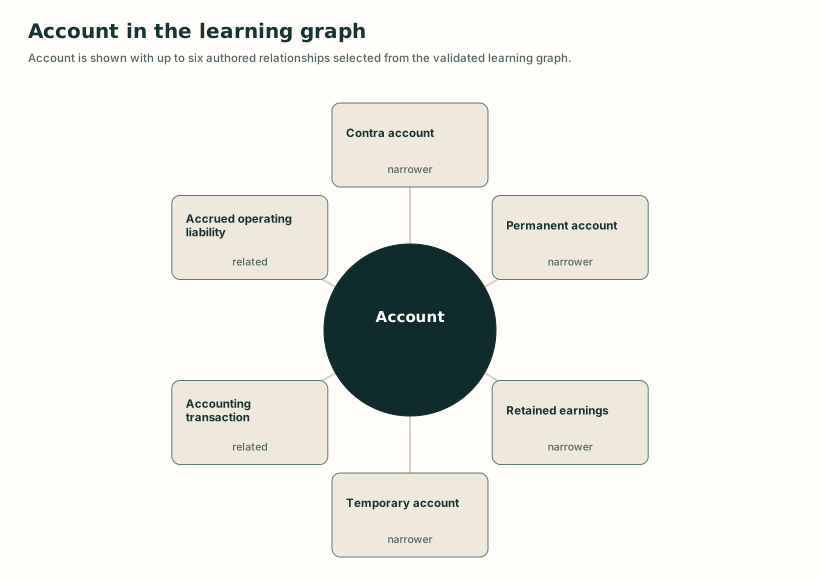
Account in the learning graph
Detailed visual description
A structural map places Account at the center and connects it to related concepts, prerequisite concepts, or lessons from the knowledge graph. Edge labels distinguish broader, narrower, related, prerequisite, and teaching relationships where present.
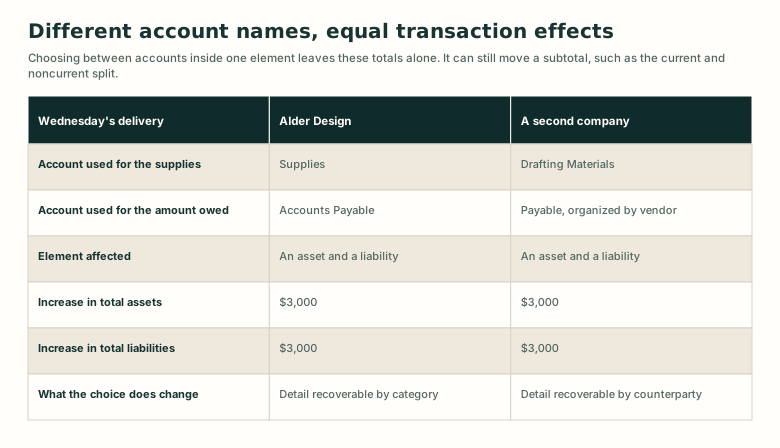
Different account names, equal transaction effects
Detailed visual description
A comparison of Alder Design and another company recording the same teaching example. One uses Supplies and Accounts Payable; the other uses Drafting Materials and a payable organized by vendor. Both record an asset increase and a liability increase of $3,000 each. These are transaction effects, not complete company totals. Account organization preserves different detail; incorrect classification can also affect subtotals and later accounting.
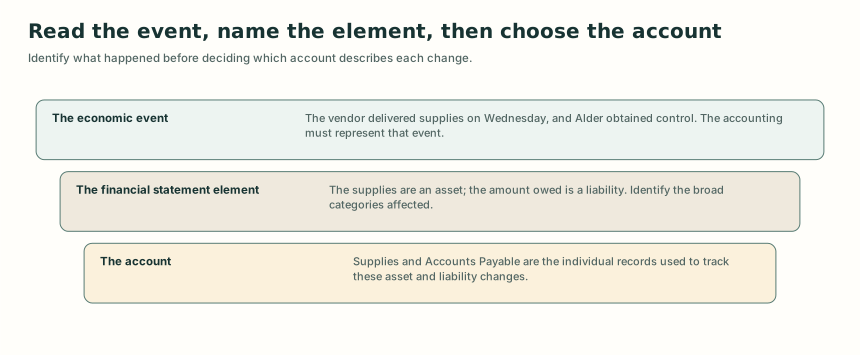
Event, element, account
Detailed visual description
Three nested rectangles organize the analysis of Alder's delivery. The outer rectangle identifies Wednesday's receipt and control of supplies. The next identifies assets and liabilities as the affected elements. The inner rectangle identifies Supplies and Accounts Payable as the accounts used to record the changes. The display shows an order of analysis, not a claim that the event occurs inside an account.
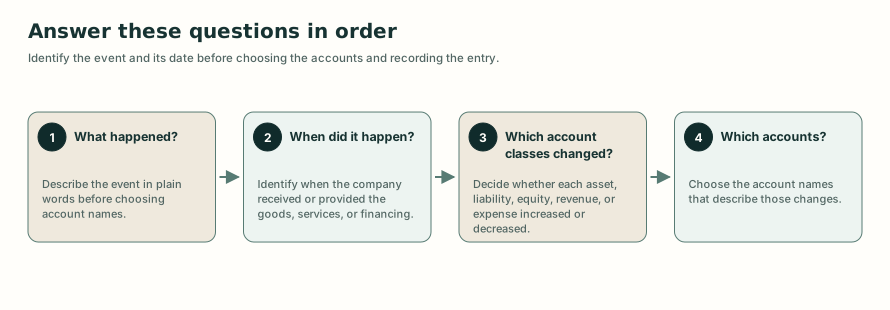
From an event to the affected accounts
Detailed visual description
A left-to-right flow of four questions. First, describe the event in plain words. Second, identify when the company received or provided the goods, services, or financing. Third, decide which asset, liability, equity, revenue, or expense classes increased or decreased. Fourth, choose the account names that describe those changes.
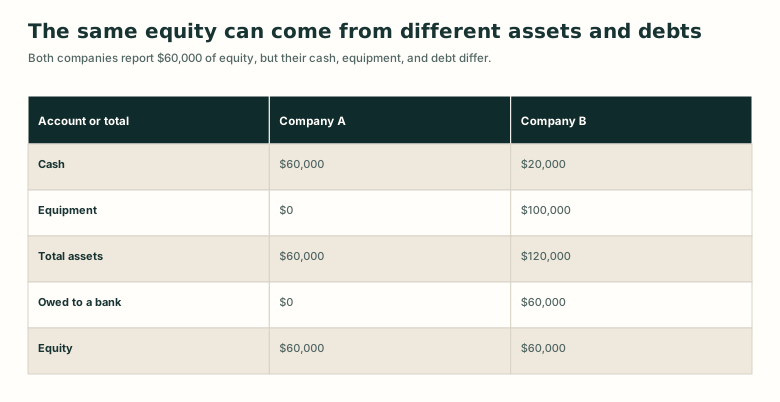
The same equity with different assets and debt
Detailed visual description
A comparison table with two columns. Company A holds $60,000 of cash, no equipment, total assets of $60,000, no bank debt, and equity of $60,000. Company B holds $20,000 of cash and $100,000 of equipment, total assets of $120,000, $60,000 owed to a bank, and equity of $60,000.
Put the concept to work
Understand this concept
- Explain how an account accumulates changes in a reporting item without becoming the underlying economic resource or obligation.
Apply this concept
- Select appropriate basic accounts for a transaction after identifying the affected financial statement elements.
Learning resources
Choose a lesson, try an application, or inspect the sources behind this concept.
Build on these ideas
- Account — Understand
To apply this concept: Required. Account selection requires understanding what information the record is intended to accumulate.
- Accounting equation — Understand
To apply this concept: Helpful. Element effects constrain which account classifications can represent a transaction coherently.
- Accounting transaction — Understand
To understand this concept: Helpful. The distinction between an event and its record makes the role of an account easier to see.
Lessons
Worked examples and cases
- Debit and credit effects for 7 events
- Posting five entries into a trial balance
- Prepare journal entries for routine transactions
Show 2 more examples and cases
Practice
- Cash before and after customer work
- Order, delivery, invoice, and payment
- Purchase order, delivery, and accounting record
Show 1 more practice items
Common mistaken ideas
Sources
More specific topics
Show 1 more more specific topics
Related concepts
Show 9 more related concepts
Use this idea next
- Account — Apply
Required level here: understand. Required. Account selection requires understanding what information the record is intended to accumulate.
- Contra account — Understand
Required level here: understand. Required. A contra account is a separate accumulation record linked to, but not identical with, another account or class.
- Credit — Understand
Required level here: understand. Required. The effect of a credit depends on the class and accumulated balance of the account.
Show 9 more next steps
- Debit — Understand
Required level here: understand. Required. The effect of a debit depends on the class and accumulated balance of the account.
- Double-entry accounting — Understand
Required level here: understand. Required. Double entry coordinates changes across accounts rather than across undifferentiated totals.
- General ledger — Understand
Required level here: understand. Required. The ledger is an organized collection of accounts rather than a single undifferentiated balance.
- Journal entry — Apply
Required level here: apply. Required. A balanced entry with the wrong accounts does not faithfully represent the transaction.
- Normal balance — Apply
Required level here: apply. Required. The account must be selected and classified before its normal side can guide recording.
- Permanent account — Understand
Required level here: understand. Required. A permanent account carries its accumulated position and history across reporting periods.
- Posting — Understand
Required level here: understand. Required. Posting accumulates entry lines in records organized by account identity.
- T-account — Understand
Required level here: understand. Required. The diagram represents changes recorded in one account.
- Temporary account — Understand
Required level here: understand. Required. A temporary account is an accumulation record whose period scope must be distinguished from the underlying economic events.
Used in these readings
These chapters explain or apply this concept. The label states how the chapter uses it.