On this page
Posting reorganizes recorded information. The journal presents entries in date order. The ledger groups the same entry lines by account.
One entry, several account histories
Suppose Alder Design acquires $10,000 of equipment, pays $3,000 cash, and owes the remaining $7,000. It records:
The debit line is posted to Equipment, the first credit line to Cash, and the second credit line to Accounts Payable. Each account retains the date, amount, side, and a reference back to the same source entry. Alder does not record the acquisition three more times. The three ledger lines all come from the one accepted entry.
Chronology and classification answer different questions
The journal answers “what was recorded on this date?” A ledger account answers “what increased and decreased this account, and what balance remains?” Both views are necessary. A chronological list makes transaction context visible, while an account history supports reconciliation, aging, rollforwards, and statement preparation.
Consider Cash. During a month it may receive an owner contribution, loan proceeds, customer collections, and asset-sale proceeds, then be credited for equipment, payroll, debt settlement, and distributions. Posting brings those lines into one Cash history without pretending the sources are economically equivalent.
Traceability is part of correct posting
A posted line should be traceable in both directions:
- From journal entry to every ledger account affected.
- From a ledger line back to the source entry and supporting evidence.
The cross-reference helps a reviewer identify missing lines, duplicates, incorrect accounts, and unexplained balance changes. Automated accounting systems may post immediately, but automation does not remove the conceptual relationship or the need for an audit trail.
Posting errors
A balanced journal entry can be posted incorrectly. One line can go to the wrong account, the wrong side, the wrong amount, or the wrong period. A line can be duplicated or omitted. Some errors make a later trial balance unequal; others preserve equality and require reconciliation or substantive review to detect.
For example, posting a $2,000 Cash credit to Equipment as a credit instead changes the account but not the side. The trial balance can still agree. Suppose a $1,000 current utility service is debited to Supplies rather than Utilities Expense. The $1,000 Cash credit is posted correctly. Both trial- balance columns still contain $1,000. Assets are overstated and expense is understated even though the totals agree.
How ledger data is used
Transaction-level exports from enterprise systems are often posted ledger data. The journal-to-ledger relationship helps a reader distinguish activity from an ending balance. It also supports rollforwards and prevents one entry from being counted several times after tables are joined.
Boundaries
Posting does not authorize an entry, prove the event occurred, or perform a new recognition analysis. It transfers an accepted record into account histories. Corrections should retain a traceable relationship to the original and follow the system's control and approval design.
Posting in the learning graph
Detailed visual description
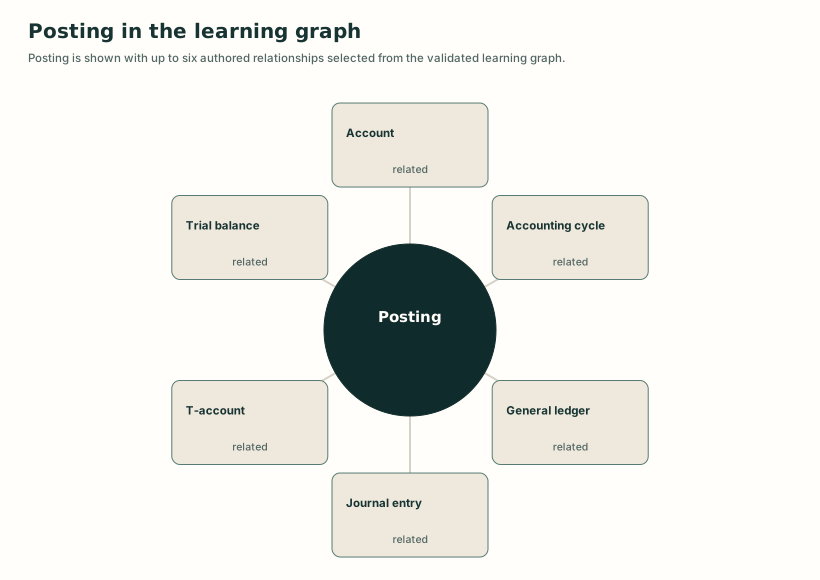
A structural map places Posting at the center and connects it to related concepts, prerequisite concepts, or lessons from the knowledge graph. Edge labels distinguish broader, narrower, related, prerequisite, and teaching relationships where present.
Put the concept to work
Understand this concept
- Explain how posting reorganizes journal-entry lines by account without creating another economic event or changing the recorded amounts.
Apply this concept
- Post basic journal-entry lines to the correct accounts while preserving date, side, amount, and cross-reference.
Learning resources
Choose a lesson, try an application, or inspect the sources behind this concept.
Build on these ideas
- Account — Understand
To understand this concept: Required. Posting accumulates entry lines in records organized by account identity.
- Journal entry — Apply
To apply this concept: Required. The source entry supplies the account, side, amount, and transaction reference to post.
To understand this concept: Required. Only a classified and balanced entry can be transferred coherently into its affected accounts.
- Posting — Understand
To apply this concept: Required. Application requires treating posting as traceable transfer rather than a second recognition decision.
Lessons
Worked examples and cases
Practice
- Compute the ending trial-balance totals
- Correct a posting that reached the wrong account
- Post 3 entries to Cash
Show 1 more practice items
Common mistaken ideas
Sources
Related concepts
Show 4 more related concepts
Use this idea next
- Accounting cycle — Understand
Required level here: understand. Required. Journal activity must accumulate in accounts before balances can support period-end work.
- General ledger — Apply
Required level here: apply. Required. The activity must be transferred to the correct account and side before its balance can be computed.
- Posting — Apply
Required level here: understand. Required. Application requires treating posting as traceable transfer rather than a second recognition decision.
Show 1 more next steps
- Recording error — Understand
Required level here: apply. Required. Some errors happen in the entry and some in the posting.
Used in these readings
These chapters explain or apply this concept. The label states how the chapter uses it.